1. Predict the effect of the following changes on the position of the equilibrium; that is,...
 1. Predict the effect of the following changes on the position of the equilibrium; that is, state which way the equilibrium will shift (left, right, or no change) when each of the following changes is made. Briefly explain your choice (6 pts) 2503(g) = 2502(g) + O2(g) (endothermic reaction) a) Oxygen gas is added. b) The pressure is increased by...
You do a PCR reaction with primers to the D1S80 locus. You use your TAs DNA...
You do a PCR reaction with primers to the D1S80 locus. You use your TAs DNA as the template. Assume there are no primer-dimer formations or non-specific priming events. What banding patterns could you possibly see on the gel after you complete the PCR reaction? a) 1 band only b) 2 bands c) 3 bands d) a and b are...
If you have a reaction: A + 3B ⟶ 4C, determine the missing initial rate data...
If you have a reaction: A + 3B ⟶ 4C, determine the missing initial rate data using the information given. The rate law for the reaction is Rate = k[B]2 [A] (M) [B] (M) Initial Rate (M/s) 0.25 0.25 5 0.5 0.5 ? A) 2.5 M/s B) 10 M/s C) 20 M/s D) 40 M/s
1. The rate constant for a certain reaction is k = 5.70×10⁻³ s−1 . If the...
1. The rate constant for a certain reaction is k = 5.70×10⁻³ s−1 . If the initial reactant concentration was 0.750 M, what will the concentration be after 13.0 minutes? 2. A zero-order reaction has a constant rate of 4.40×10⁻⁴ M/s. If after 80.0 seconds the concentration has dropped to 1.00×10⁻² M, what was the initial concentration?
The rate constant for a certain reaction is k = 1.70×10⁻³ s−1 . If the initial...
The rate constant for a certain reaction is k = 1.70×10⁻³ s−1 . If the initial reactant concentration was 0.900 M, what will the concentration be after 6.00 minutes? [A]t= B) A zero-order reaction has a constant rate of 3.90×10⁻⁴ M/s. If after 65.0 seconds the concentration has dropped to 4.00×10⁻² M, what was the initial concentration? [A]0=
The rate constant for a particular reaction that is 1st-order in N2O5 is 0.525 min–1. How...
The rate constant for a particular reaction that is 1st-order in N2O5 is 0.525 min–1. How much time will it take for the concentration of N2O5 to decrease to one-third its initial concentration? Make sure you pick an answer with the correct units. (Hint: Fora 1st-order reaction, the amount of time it takes to reduce a reactant's concentration to one-third...
The rate constant for a certain reaction is kkk = 3.50×10⁻³ s−1s−1 . If the initial...
The rate constant for a certain reaction is kkk = 3.50×10⁻³ s−1s−1 . If the initial reactant concentration was 0.450 MM, what will the concentration be after 19.0 minutes? A zero-order reaction has a constant rate of 3.50×10⁻⁴ M/sM/s. If after 65.0 seconds the concentration has dropped to 3.50×10⁻² MM, what was the initial concentration?
34. At volcanic sites, sulfur is formed via the following reaction. 2 H2S(g) +SO2(g) = 3S(s)...
 34. At volcanic sites, sulfur is formed via the following reaction. 2 H2S(g) +SO2(g) = 3S(s) +2 H20(g) a. Calculate the equilibrium constant, K, for this reaction at 25°C. 4 Gº (kJ/mol H2S (8) SO2) H20 (8) -33.0 -300.4 -228.6 s, b. Predict whether sulfur formation becomes more or less favorable as temperature increases. Explain. C Sulfur dioxide is a...
when the Cl attacks the epoxide, doesnt it invert the stereochemistry of it? i am a...
 when the Cl attacks the epoxide, doesnt it invert the
stereochemistry of it? i am a bit confused
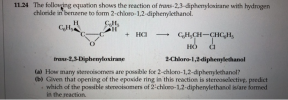
11.24 The following equation shows the reaction of trans-2,3-diphenyloxirane with hydrogen chloride in benzene to form 2-chloro-1,2-diphenylethanol. CH, CH + HCI - CH,CH-CHCH, HÓ CI trans-2,3-Diphenyloxirane 2-Chloro-1,2-diphenylethanol (a) How many stereoisomers are possible for 2-chloro-1,2-diphenylethanol? (b) Given that opening of the epoxide...
when the Cl attacks the epoxide, doesnt it invert the
stereochemistry of it? i am a bit confused
11.24 The following equation shows the reaction of trans-2,3-diphenyloxirane with hydrogen chloride in benzene to form 2-chloro-1,2-diphenylethanol. CH, CH + HCI - CH,CH-CHCH, HÓ CI trans-2,3-Diphenyloxirane 2-Chloro-1,2-diphenylethanol (a) How many stereoisomers are possible for 2-chloro-1,2-diphenylethanol? (b) Given that opening of the epoxide...
5(a). Predict the product for the following reaction. (b). Provide an arrow-pushing mechanism for the...
 5(a). Predict the product for the following reaction.
(b). Provide an arrow-pushing mechanism for the reaction above that
accounts for the formation of the product. Explicitly include all
non-bonding electrons and charges. Indicate whether each step is an
initiation, chain propagation, or termination.
(c). An additional product, shown below, is formed in the reaction
from part (a). Provide an...
5(a). Predict the product for the following reaction.
(b). Provide an arrow-pushing mechanism for the reaction above that
accounts for the formation of the product. Explicitly include all
non-bonding electrons and charges. Indicate whether each step is an
initiation, chain propagation, or termination.
(c). An additional product, shown below, is formed in the reaction
from part (a). Provide an...
 1. Predict the effect of the following changes on the position of the equilibrium; that is, state which way the equilibrium will shift (left, right, or no change) when each of the following changes is made. Briefly explain your choice (6 pts) 2503(g) = 2502(g) + O2(g) (endothermic reaction) a) Oxygen gas is added. b) The pressure is increased by...
 34. At volcanic sites, sulfur is formed via the following reaction. 2 H2S(g) +SO2(g) = 3S(s) +2 H20(g) a. Calculate the equilibrium constant, K, for this reaction at 25°C. 4 Gº (kJ/mol H2S (8) SO2) H20 (8) -33.0 -300.4 -228.6 s, b. Predict whether sulfur formation becomes more or less favorable as temperature increases. Explain. C Sulfur dioxide is a...
 when the Cl attacks the epoxide, doesnt it invert the
stereochemistry of it? i am a bit confused
11.24 The following equation shows the reaction of trans-2,3-diphenyloxirane with hydrogen chloride in benzene to form 2-chloro-1,2-diphenylethanol. CH, CH + HCI - CH,CH-CHCH, HÓ CI trans-2,3-Diphenyloxirane 2-Chloro-1,2-diphenylethanol (a) How many stereoisomers are possible for 2-chloro-1,2-diphenylethanol? (b) Given that opening of the epoxide...
when the Cl attacks the epoxide, doesnt it invert the
stereochemistry of it? i am a bit confused
11.24 The following equation shows the reaction of trans-2,3-diphenyloxirane with hydrogen chloride in benzene to form 2-chloro-1,2-diphenylethanol. CH, CH + HCI - CH,CH-CHCH, HÓ CI trans-2,3-Diphenyloxirane 2-Chloro-1,2-diphenylethanol (a) How many stereoisomers are possible for 2-chloro-1,2-diphenylethanol? (b) Given that opening of the epoxide...
 5(a). Predict the product for the following reaction.
(b). Provide an arrow-pushing mechanism for the reaction above that
accounts for the formation of the product. Explicitly include all
non-bonding electrons and charges. Indicate whether each step is an
initiation, chain propagation, or termination.
(c). An additional product, shown below, is formed in the reaction
from part (a). Provide an...
5(a). Predict the product for the following reaction.
(b). Provide an arrow-pushing mechanism for the reaction above that
accounts for the formation of the product. Explicitly include all
non-bonding electrons and charges. Indicate whether each step is an
initiation, chain propagation, or termination.
(c). An additional product, shown below, is formed in the reaction
from part (a). Provide an...
Most questions answered within 3 hours.