Write the products of the following reaction, include the states. HCl(aq) + H2O(1) Show transcribed image...
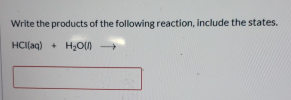 Write the products of the following reaction, include the states. HCl(aq) + H2O(1)
Give the structures and names for the products of the reaction of sodium hydroxide (aq) with...
Give the structures and names for the products of the reaction of sodium hydroxide (aq) with ethyl propanoate
11) Circle the compounds shown below that are classifed as Arrhenius acids, and underline the compounds...
 11) Circle the compounds shown below that are classifed as Arrhenius acids, and underline the compounds shown below that are classified as Arrhenius bases. Do nothing to molecules that are neither acids or bases: (4) NaOH Pb(OH). LIH Pb(CO (NH, CO, H.PO HCIO, KCIO, 12) (6) Consider the acid/base reaction shown below. CO, (aq) + H,SO. HCO, sau + HSO4...
2. What are products of the following reaction? (note: the reactants are not necessarily balanced) KO2...
 2. What are products of the following reaction? (note: the
reactants are not necessarily balanced)
KO2 + H2O → ________ + __________
NaHCO3 + heat → ________ + ________ + ________
NaNH2 + H2O → ________ + ________
LiC4H9 + C2H5OH →
________ + ________
1. Write balanced equations for the following processes: a. The reaction of potassium with water....
2. What are products of the following reaction? (note: the
reactants are not necessarily balanced)
KO2 + H2O → ________ + __________
NaHCO3 + heat → ________ + ________ + ________
NaNH2 + H2O → ________ + ________
LiC4H9 + C2H5OH →
________ + ________
1. Write balanced equations for the following processes: a. The reaction of potassium with water....
I said that the answer was D because I got 83.3333 as the answer which would...
 I said that the answer was D because I got
83.3333 as the answer which would make
Qc>Kc sending the equation to the right
towards the products. Please explain why I am right or wrong and
please provide the correct answer with an explanation if I am
incorrect. Thank you
Consider the following reaction and its equilibrium constant: 12(g) +...
I said that the answer was D because I got
83.3333 as the answer which would make
Qc>Kc sending the equation to the right
towards the products. Please explain why I am right or wrong and
please provide the correct answer with an explanation if I am
incorrect. Thank you
Consider the following reaction and its equilibrium constant: 12(g) +...
. 1) Draw ChemSketch or hand-drawn and name the posible aldehyde and ketone Isomers with CHO...
 . 1) Draw ChemSketch or hand-drawn and name the posible aldehyde and ketone Isomers with CHO molecular formula 2 Based on your textbook, show the vidation reaction of each isomer. If there is no reaction, type R . for the following compounds 1. Provide molecular formula 2. Provide IUPAC 3. Show addition of hydrogen reaction draw structures of the products...
(6.4) The rate of a chemical reaction increases with an increase in the concentration of one...
 (6.4) The rate of a chemical reaction increases with an increase in the concentration of one or more reactants. This is best explained by which statement? Select one: a. The higher concentration of reactants increases the activation energy of the reaction. Ob. The higher concentration of reactants increases the potential energy of the molecules. c. The higher concentration of reactants...
Q(18) NI(CO)49) - Ni(s) + 4 CO(g)Adding nickel (solid) to this reaction will cause the equilibrium...
 Q(18) NI(CO)49) - Ni(s) + 4 CO(g)Adding nickel (solid) to this reaction will cause the equilibrium to A) Shift toward the products B) Shift toward the reactants C) remain unchanged D) increase the temperature E) it depends on the amount added Q(19) CO2 + H2 -CO + H2O Adding a catalyst to this reaction will cause the COD at equilibrium...
Part A.The rate constant for a certain reaction is k = 7.90×10⁻³ s−1 . If the...
Part A.The rate constant for a certain reaction is k = 7.90×10⁻³ s−1 . If the initial reactant concentration was 0.250 M, what will the concentration be after 18.0 minutes? Part B A zero-order reaction has a constant rate of 4.10×10⁻⁴ M/s. If after 60.0 seconds the concentration has dropped to 7.50×10⁻² M, what was the initial concentration?
Question 3.a) The reaction A --> 2P exhibits the following rate law: rate = k *...
Question 3.a) The reaction A --> 2P exhibits the following rate law: rate = k * [A]. (k = 1.80 L mol-1s-1). How long will it take for the concentration of A to reduce to 15.00% of the initial value? Question 3.b) The reaction A --> 2P exhibits the following rate law: rate = k * [A]. (k = 1.40...
 Write the products of the following reaction, include the states. HCl(aq) + H2O(1)
 11) Circle the compounds shown below that are classifed as Arrhenius acids, and underline the compounds shown below that are classified as Arrhenius bases. Do nothing to molecules that are neither acids or bases: (4) NaOH Pb(OH). LIH Pb(CO (NH, CO, H.PO HCIO, KCIO, 12) (6) Consider the acid/base reaction shown below. CO, (aq) + H,SO. HCO, sau + HSO4...
 2. What are products of the following reaction? (note: the
reactants are not necessarily balanced)
KO2 + H2O → ________ + __________
NaHCO3 + heat → ________ + ________ + ________
NaNH2 + H2O → ________ + ________
LiC4H9 + C2H5OH →
________ + ________
1. Write balanced equations for the following processes: a. The reaction of potassium with water....
2. What are products of the following reaction? (note: the
reactants are not necessarily balanced)
KO2 + H2O → ________ + __________
NaHCO3 + heat → ________ + ________ + ________
NaNH2 + H2O → ________ + ________
LiC4H9 + C2H5OH →
________ + ________
1. Write balanced equations for the following processes: a. The reaction of potassium with water....
 I said that the answer was D because I got
83.3333 as the answer which would make
Qc>Kc sending the equation to the right
towards the products. Please explain why I am right or wrong and
please provide the correct answer with an explanation if I am
incorrect. Thank you
Consider the following reaction and its equilibrium constant: 12(g) +...
I said that the answer was D because I got
83.3333 as the answer which would make
Qc>Kc sending the equation to the right
towards the products. Please explain why I am right or wrong and
please provide the correct answer with an explanation if I am
incorrect. Thank you
Consider the following reaction and its equilibrium constant: 12(g) +...
 . 1) Draw ChemSketch or hand-drawn and name the posible aldehyde and ketone Isomers with CHO molecular formula 2 Based on your textbook, show the vidation reaction of each isomer. If there is no reaction, type R . for the following compounds 1. Provide molecular formula 2. Provide IUPAC 3. Show addition of hydrogen reaction draw structures of the products...
 (6.4) The rate of a chemical reaction increases with an increase in the concentration of one or more reactants. This is best explained by which statement? Select one: a. The higher concentration of reactants increases the activation energy of the reaction. Ob. The higher concentration of reactants increases the potential energy of the molecules. c. The higher concentration of reactants...
 Q(18) NI(CO)49) - Ni(s) + 4 CO(g)Adding nickel (solid) to this reaction will cause the equilibrium to A) Shift toward the products B) Shift toward the reactants C) remain unchanged D) increase the temperature E) it depends on the amount added Q(19) CO2 + H2 -CO + H2O Adding a catalyst to this reaction will cause the COD at equilibrium...
Most questions answered within 3 hours.