I a Write the stracture of b. (R )-2-butanol, shown below is converted to a chiral iodide by reacting with sodium iodide. Show the mechanism involved in the reaction and state configuration of th...
 I a Write the stracture of b. (R )-2-butanol, shown below is converted to a chiral iodide by reacting with sodium iodide. Show the mechanism involved in the reaction and state configuration of the chiral product. 2. Show the products of the following reactions and identify the number of possible stercoisomers that can be produced CH, CH,CH- CH, 1.BH, 2....
3. Predict and label the major and minor products from the following E2 reaction. Justify your...
 3. Predict and label the major and minor products from the following E2 reaction. Justify your answer with figures which demonstrate the transition state leading to the products obtained (4 points) 4. When the two constitutional isomers, 3,3-dimethyl-1-butene and 2,3-dimethyl-2-butene, are reacted with HCl the same major product is formed. Explain the observation and identify the product. (4 points) Scanned...
9.61 & 9.63 please Zaitzev's Rule; Intramolecular versus Intermolecular Reactions 9.61 (SYN) Suggest how each of the reactions shown here could be carried out, focusing in particular on th...
 9.61 & 9.63 please
Zaitzev's Rule; Intramolecular versus Intermolecular Reactions 9.61 (SYN) Suggest how each of the reactions shown here could be carried out, focusing in particular on the identity of the nucleophile and the choice of solvent. Cl OCH3 Cl OCH3 Racemic 9.62 Provide a complete, detailed mechanism for the reaction shown here. 9.63 For each of the following...
9.61 & 9.63 please
Zaitzev's Rule; Intramolecular versus Intermolecular Reactions 9.61 (SYN) Suggest how each of the reactions shown here could be carried out, focusing in particular on the identity of the nucleophile and the choice of solvent. Cl OCH3 Cl OCH3 Racemic 9.62 Provide a complete, detailed mechanism for the reaction shown here. 9.63 For each of the following...
1. (10 points) Predict the major organic product or products for each of the following. Be sure to include stereochemis...
 1. (10 points) Predict the major organic product or products for each of the following. Be sure to include stereochemistry where appropriate. Assume each is in the most appropriate solvent. Remember, "no reaction" may be an answer. a) O3 b) DMS HgSO4 H2SO4 H20 B12 HCI MgBr b) H+
predict the mechanism (Sn1, Sn2, E1, E2) and major products for each reaction 8) NaOCHy CH,CHE...
 predict the mechanism (Sn1, Sn2, E1, E2) and major products for
each reaction
8) NaOCHy CH,CHE CH,OH CH CH heat H,PO heat KOB HOIBU CHO CH, NaN. Br. H NaOCH CH3CH2OH heat dapted from Ruehl
predict the mechanism (Sn1, Sn2, E1, E2) and major products for
each reaction
8) NaOCHy CH,CHE CH,OH CH CH heat H,PO heat KOB HOIBU CHO CH, NaN. Br. H NaOCH CH3CH2OH heat dapted from Ruehl
Quiz Name Lead (I1) nitrate reacts with sodium chloride, please predict the products of the reaction,...
 Quiz Name Lead (I1) nitrate reacts with sodium chloride, please predict the products of the reaction, determine the molecular equation, total ionic equation, net ionic equation, spectator ions and fill in the beakers. Molecular Equation Total lonic Equation: Net lonic Equation: Spectator lons are
1. Consider the following reaction: H-Bs A. Draw the mechanism of the reaction to predict all...
 1. Consider the following reaction: H-Bs A. Draw the mechanism of the reaction to predict all the possible stereochemical products of the reaction. Show all electron flows using the curved arrows. (1) Does the reaction produce a meso compound? Explain. Justify with relevant structures to get full credit. B. Design the following synthesis. To get full credit, you will discuss...
5. A stu dent isolated a protein and assumed it was made up of a single...
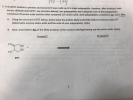 5. A stu dent isolated a protein and assumed it was made up of a single polypeptide. However, after treating it with excess dithiothreitol (DTT; see structure below), two polypeptides were obtained. One of the polypeptides contained 78 amino acids and the other contained 125 amino acids. Both polypeptides contained 1 Qys and 1 Met. A. Using the structure of...
1) Predict the Products: Using line drawings with proper use of dashed wedge and solid wedge...
 1) Predict the Products: Using line drawings with proper use of
dashed wedge and solid wedge notation where necessary, draw the
major organic products of the following reactions in the boxes
provided. If no reaction occurs write “no reaction” or “N.R.” in
the box. Include stereochemistry in your answers where appropriate.
If a product is racemic draw both enantiomers or...
1) Predict the Products: Using line drawings with proper use of
dashed wedge and solid wedge notation where necessary, draw the
major organic products of the following reactions in the boxes
provided. If no reaction occurs write “no reaction” or “N.R.” in
the box. Include stereochemistry in your answers where appropriate.
If a product is racemic draw both enantiomers or...
theres two questions 6 AND 7 6. Sn1 substitution and El elimination frequently compete in the...
 theres two questions 6 AND 7
6. Sn1 substitution and El elimination frequently compete in the same reaction. 1. Propose a mechanism and predict the products for the solvolysis of 2-bromo-2,3,3- trimethylbutane in methanol. b. Compare the function of the solvent (methanol) in the El and SN1 reactions. 7. When the following compound is heated in methanol, several different products...
theres two questions 6 AND 7
6. Sn1 substitution and El elimination frequently compete in the same reaction. 1. Propose a mechanism and predict the products for the solvolysis of 2-bromo-2,3,3- trimethylbutane in methanol. b. Compare the function of the solvent (methanol) in the El and SN1 reactions. 7. When the following compound is heated in methanol, several different products...
 I a Write the stracture of b. (R )-2-butanol, shown below is converted to a chiral iodide by reacting with sodium iodide. Show the mechanism involved in the reaction and state configuration of the chiral product. 2. Show the products of the following reactions and identify the number of possible stercoisomers that can be produced CH, CH,CH- CH, 1.BH, 2....
 3. Predict and label the major and minor products from the following E2 reaction. Justify your answer with figures which demonstrate the transition state leading to the products obtained (4 points) 4. When the two constitutional isomers, 3,3-dimethyl-1-butene and 2,3-dimethyl-2-butene, are reacted with HCl the same major product is formed. Explain the observation and identify the product. (4 points) Scanned...
 9.61 & 9.63 please
Zaitzev's Rule; Intramolecular versus Intermolecular Reactions 9.61 (SYN) Suggest how each of the reactions shown here could be carried out, focusing in particular on the identity of the nucleophile and the choice of solvent. Cl OCH3 Cl OCH3 Racemic 9.62 Provide a complete, detailed mechanism for the reaction shown here. 9.63 For each of the following...
9.61 & 9.63 please
Zaitzev's Rule; Intramolecular versus Intermolecular Reactions 9.61 (SYN) Suggest how each of the reactions shown here could be carried out, focusing in particular on the identity of the nucleophile and the choice of solvent. Cl OCH3 Cl OCH3 Racemic 9.62 Provide a complete, detailed mechanism for the reaction shown here. 9.63 For each of the following...
 1. (10 points) Predict the major organic product or products for each of the following. Be sure to include stereochemistry where appropriate. Assume each is in the most appropriate solvent. Remember, "no reaction" may be an answer. a) O3 b) DMS HgSO4 H2SO4 H20 B12 HCI MgBr b) H+
 predict the mechanism (Sn1, Sn2, E1, E2) and major products for
each reaction
8) NaOCHy CH,CHE CH,OH CH CH heat H,PO heat KOB HOIBU CHO CH, NaN. Br. H NaOCH CH3CH2OH heat dapted from Ruehl
predict the mechanism (Sn1, Sn2, E1, E2) and major products for
each reaction
8) NaOCHy CH,CHE CH,OH CH CH heat H,PO heat KOB HOIBU CHO CH, NaN. Br. H NaOCH CH3CH2OH heat dapted from Ruehl
 Quiz Name Lead (I1) nitrate reacts with sodium chloride, please predict the products of the reaction, determine the molecular equation, total ionic equation, net ionic equation, spectator ions and fill in the beakers. Molecular Equation Total lonic Equation: Net lonic Equation: Spectator lons are
 1. Consider the following reaction: H-Bs A. Draw the mechanism of the reaction to predict all the possible stereochemical products of the reaction. Show all electron flows using the curved arrows. (1) Does the reaction produce a meso compound? Explain. Justify with relevant structures to get full credit. B. Design the following synthesis. To get full credit, you will discuss...
 5. A stu dent isolated a protein and assumed it was made up of a single polypeptide. However, after treating it with excess dithiothreitol (DTT; see structure below), two polypeptides were obtained. One of the polypeptides contained 78 amino acids and the other contained 125 amino acids. Both polypeptides contained 1 Qys and 1 Met. A. Using the structure of...
 1) Predict the Products: Using line drawings with proper use of
dashed wedge and solid wedge notation where necessary, draw the
major organic products of the following reactions in the boxes
provided. If no reaction occurs write “no reaction” or “N.R.” in
the box. Include stereochemistry in your answers where appropriate.
If a product is racemic draw both enantiomers or...
1) Predict the Products: Using line drawings with proper use of
dashed wedge and solid wedge notation where necessary, draw the
major organic products of the following reactions in the boxes
provided. If no reaction occurs write “no reaction” or “N.R.” in
the box. Include stereochemistry in your answers where appropriate.
If a product is racemic draw both enantiomers or...
 theres two questions 6 AND 7
6. Sn1 substitution and El elimination frequently compete in the same reaction. 1. Propose a mechanism and predict the products for the solvolysis of 2-bromo-2,3,3- trimethylbutane in methanol. b. Compare the function of the solvent (methanol) in the El and SN1 reactions. 7. When the following compound is heated in methanol, several different products...
theres two questions 6 AND 7
6. Sn1 substitution and El elimination frequently compete in the same reaction. 1. Propose a mechanism and predict the products for the solvolysis of 2-bromo-2,3,3- trimethylbutane in methanol. b. Compare the function of the solvent (methanol) in the El and SN1 reactions. 7. When the following compound is heated in methanol, several different products...
Most questions answered within 3 hours.