Draw the structure of the major organic products of the reaction.
 Sapling question Chapter 22: Draw the structure of the major organic products of the reaction. Thank you!
5. Given the following reaction and the accompanying data: NO2 + 03 ------ NO3 + O2...
 5. Given the following reaction and the accompanying data: NO2 + 03 ------ NO3 + O2 Exper. Initial [NO2] Initial [03] Initial Rate (mol L* sl) 1 2.3 x 10⁻⁵ 3.0 x 10⁻⁵ 1.0 x 10⁻⁵ 4.6 x 10⁻⁵ 3.0 x 10⁻⁵ 2.1 x 10⁻⁵ 3 4.6 x 10⁻⁵ 6.0 x 10⁻⁵ 4.2 x 10⁻⁵ Determine the rate law and...
< Question 26 of 38 > Consider the initial-rate data at a certain temperature in the...
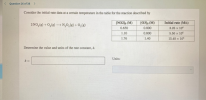 < Question 26 of 38 > Consider the initial-rate data at a certain temperature in the table for the reaction described by 2 NO,() +0,(6)-,0,() +0,(8) [NO2). (M) 0.650 [03Jo (M) 0.800 0.800 Initial rate (M/s) 3.25 x 10 5.50 x 10 15.40 x 10⁴ 1.10 1.76 1.40 Determine the value and units of the rate constant, k. Units:
1-2. Rate data were obtained for the following reaction A (g) + 2B (g) -C(8) Experiment...
 1-2. Rate data were obtained for the following reaction A (g) + 2B (g) -C(8) Experiment Initial (Al Initial [B] 1 Initial Rate, Ms 0.15 0.10 0.45 2 0.30 0.10 0.9 3 0.15 0.20 1.8 1. What is the rate law of the above reaction? This question is for the test taker to work out independently, any help from others...
Organic Chemistry Nitration lab. 1. Aromatic nitration requires the use of the HNO3 / H2SO4 mixture....
 Organic Chemistry Nitration lab. 1. Aromatic nitration requires the use of the HNO3 / H2SO4 mixture. Why not use HNO3 alone? 2. Why should the cold nitration reaction be maintained at all times? 3. What difference should be observed between the 1 H NMR spectrum of the nitrated reagent and the product obtained? Explain 4. If the yield percentages for...
For the following reaction at equilibrium with a given AHºrxn = -207 kJ/mol: N2(g) + 3H2(g)...
 For the following reaction at equilibrium with a given AHºrxn = -207 kJ/mol: N2(g) + 3H2(g) <=> 2NH3(g) What will be the response of the system at equilibrium if the temperature is decreased? More reactants will be formed. More products will be formed. There will be no change in the amount of products formed. There will be no change in...
Some mechanism questions – another look at substitution and elimination mechanisms. 2. Some mechanism questions -...
 Some mechanism questions – another look at substitution and
elimination mechanisms.
2. Some mechanism questions - another look at substitution and elimination mechanisms. Cyclohexanol is treated with hydrochloric acid. A mixture of three products form OH HCI Cl i. Which product(s) is (are) the result of s ubstitution? ii. Of the products A and B which should have a higher...
Some mechanism questions – another look at substitution and
elimination mechanisms.
2. Some mechanism questions - another look at substitution and elimination mechanisms. Cyclohexanol is treated with hydrochloric acid. A mixture of three products form OH HCI Cl i. Which product(s) is (are) the result of s ubstitution? ii. Of the products A and B which should have a higher...
17) 17) Which of the following is true for all exergonic reactions? A) The reaction proceeds...
 17) 17) Which of the following is true for all exergonic reactions? A) The reaction proceeds with a net release of free energy B) The reactions are rapid. C) The reaction goes only in a forward direction: all reactants will be converted to products, but no products will be converted to reactants. D) A net input of energy from the...
Consider the following reaction, 2AB (9) A2 (9) + B2 (9) K = 1.50x10⁻² At some...
 Consider the following reaction, 2AB (9) A2 (9) + B2 (9) K = 1.50x10⁻² At some point in the reaction, Q = 5.30. Which of the following statements is correct concerning the equilibrium? O A. At that point in the reaction, the reaction shifts right to reach equilibrium. OB. At that point in the reaction, the reaction has reached equilibrium....
The reaction A(aq) ---> B(aq) is a first order reaction with respect to A(aq). The concentration...
The reaction A(aq) ---> B(aq) is a first order reaction with respect to A(aq). The concentration of A(aq) is reduced to 31.7 % of its initial value in 1.61 minutes. What is this reaction's half-life (in s)?
 5. Given the following reaction and the accompanying data: NO2 + 03 ------ NO3 + O2 Exper. Initial [NO2] Initial [03] Initial Rate (mol L* sl) 1 2.3 x 10⁻⁵ 3.0 x 10⁻⁵ 1.0 x 10⁻⁵ 4.6 x 10⁻⁵ 3.0 x 10⁻⁵ 2.1 x 10⁻⁵ 3 4.6 x 10⁻⁵ 6.0 x 10⁻⁵ 4.2 x 10⁻⁵ Determine the rate law and...
 < Question 26 of 38 > Consider the initial-rate data at a certain temperature in the table for the reaction described by 2 NO,() +0,(6)-,0,() +0,(8) [NO2). (M) 0.650 [03Jo (M) 0.800 0.800 Initial rate (M/s) 3.25 x 10 5.50 x 10 15.40 x 10⁴ 1.10 1.76 1.40 Determine the value and units of the rate constant, k. Units:
 1-2. Rate data were obtained for the following reaction A (g) + 2B (g) -C(8) Experiment Initial (Al Initial [B] 1 Initial Rate, Ms 0.15 0.10 0.45 2 0.30 0.10 0.9 3 0.15 0.20 1.8 1. What is the rate law of the above reaction? This question is for the test taker to work out independently, any help from others...
 Organic Chemistry Nitration lab. 1. Aromatic nitration requires the use of the HNO3 / H2SO4 mixture. Why not use HNO3 alone? 2. Why should the cold nitration reaction be maintained at all times? 3. What difference should be observed between the 1 H NMR spectrum of the nitrated reagent and the product obtained? Explain 4. If the yield percentages for...
 For the following reaction at equilibrium with a given AHºrxn = -207 kJ/mol: N2(g) + 3H2(g) <=> 2NH3(g) What will be the response of the system at equilibrium if the temperature is decreased? More reactants will be formed. More products will be formed. There will be no change in the amount of products formed. There will be no change in...
 Some mechanism questions – another look at substitution and
elimination mechanisms.
2. Some mechanism questions - another look at substitution and elimination mechanisms. Cyclohexanol is treated with hydrochloric acid. A mixture of three products form OH HCI Cl i. Which product(s) is (are) the result of s ubstitution? ii. Of the products A and B which should have a higher...
Some mechanism questions – another look at substitution and
elimination mechanisms.
2. Some mechanism questions - another look at substitution and elimination mechanisms. Cyclohexanol is treated with hydrochloric acid. A mixture of three products form OH HCI Cl i. Which product(s) is (are) the result of s ubstitution? ii. Of the products A and B which should have a higher...
 17) 17) Which of the following is true for all exergonic reactions? A) The reaction proceeds with a net release of free energy B) The reactions are rapid. C) The reaction goes only in a forward direction: all reactants will be converted to products, but no products will be converted to reactants. D) A net input of energy from the...
 Consider the following reaction, 2AB (9) A2 (9) + B2 (9) K = 1.50x10⁻² At some point in the reaction, Q = 5.30. Which of the following statements is correct concerning the equilibrium? O A. At that point in the reaction, the reaction shifts right to reach equilibrium. OB. At that point in the reaction, the reaction has reached equilibrium....
Most questions answered within 3 hours.