d listing r. (Individ For a particular first-order reaction, it takes 24 minutes for the concentration...
 d listing r. (Individ For a particular first-order reaction, it takes 24 minutes for the concentration of the reactant to decrease to 25% of its initial value, what is the value for rate constant (in S-1) for the reaction? A) 2.0-104 s-1 B)9.6 x 10⁻⁴ s-1 C) 1.2 × 10⁻² s-1 D)5.8 102s-1 12. In the first order reaction A...
can you help me with this question please 5. In the reaction, (2 NO + Cl2...
 can
you help me with this question please
5. In the reaction, (2 NO + Cl2 + 2 NOCI), the following results were obtained for the initial rates of reactions for different initial concentrations: Experiment [NO] (M) [Cl] (M) Rate (M/s) 0.0300 0.0100 3.4 x 10⁻⁴ 0.0150 0.0100 85 x 10-5 0.0150 0.0400 3.4 x 10-* Determine the rate constant...
can
you help me with this question please
5. In the reaction, (2 NO + Cl2 + 2 NOCI), the following results were obtained for the initial rates of reactions for different initial concentrations: Experiment [NO] (M) [Cl] (M) Rate (M/s) 0.0300 0.0100 3.4 x 10⁻⁴ 0.0150 0.0100 85 x 10-5 0.0150 0.0400 3.4 x 10-* Determine the rate constant...
7. Consider the following second-order reaction: 2X ? Y. The initial concentration of X is 0.50...
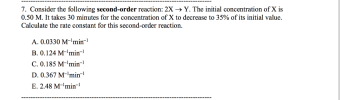 7. Consider the following second-order reaction: 2X ? Y. The initial concentration of X is 0.50 M. It takes 30 minutes for the concentration of X to decrease to 35% of its initial value. Calculate the rate constant for this second-order reaction. A. 0.0330 Mmin B. 0.124 M-min-1 C. 0.185 M-'min-1 D.0.367 Mmin-1 E. 2.48 M-min-1
QUESTION 5 The initial concentration of Ci1- is 0.100M and the initial concentration of Co(H206+ is...
 QUESTION 5 The initial concentration of Ci1- is 0.100M and the initial concentration of Co(H206+ is 0.0 M. At equilibrium the concentration of Coci42-is 0.00443. What is the value of the equilibrium constant for the reaction being studied? QUESTION 6 Calculate the concentration of Coci42- if the absorbance of its solution in a 1 cm cell is 0.416. Use the...
both questions plz. ill make sure to give you a thumbs up consider Question 10 1...
 both questions plz. ill make sure to give you a thumbs
up
consider Question 10 1 pts If the concentration of a reactant at 34 seconds is D.056 M and the rate constant is 0.034s 1, what was the initial concentration ot the reaction D Question 11 1 pts Find the half-tfe of a zero order reaction where the initial...
both questions plz. ill make sure to give you a thumbs
up
consider Question 10 1 pts If the concentration of a reactant at 34 seconds is D.056 M and the rate constant is 0.034s 1, what was the initial concentration ot the reaction D Question 11 1 pts Find the half-tfe of a zero order reaction where the initial...
Consider the reaction F2(g) + 2ClO2(g) →2FClO2(g) Use the data in the table to calculate the...
Consider the reaction F2(g) + 2ClO2(g) →2FClO2(g) Use the data in the table to calculate the initial rate of the reaction when [F2] = 0.20 M and [ClO2] = 0.045 M. Experiment [F2] M [ClO2] M Initial rate (M/s) 1 0.10 0.010 1.2 x10⁻³ 2 0.10 0.040 4.8 ×10⁻³ 3 0.20 0.010 2.4 ×10⁻³ _____ M/s
A student ran the following reaction in the laboratory at 479 K PC13(E) + Cl2) PC...
 A student ran the following reaction in the laboratory at 479 K PC13(E) + Cl2) PC (e) When she introduced PCIy(R) and Cl() into a 1.00 L evacuated container, so that the initial partial pressure of PCI, was 2.39 atm and the initial partial pressure of Cl; was 1.94 atm, she found that the equilibrium partial pressure of Cl, was...
A student ran the following reaction in the laboratory at 312 K: 2NO(g) + Br2(g) 2NOBr(g)...
A student ran the following reaction in the laboratory at 312 K: 2NO(g) + Br2(g) 2NOBr(g) When he introduced NO(g) and Br2(g) into a 1.00 L evacuated container, so that the initial partial pressure of NO was 1.07 atm and the initial partial pressure of Br2 was 0.448 atm, he found that the equilibrium partial pressure of Br2 was 0.189...
The rate constant of a chemical reaction increased from 0.100 s−1 to 3.00 s−1 upon raising...
The rate constant of a chemical reaction increased from 0.100 s−1 to 3.00 s−1 upon raising the temperature from 25.0 ∘C to 53.0 ∘C . Calculate the value of (1T2−1T1) where T1 is the initial temperature and T2 is the final temperature. Calculate the value of ln(k1k2) where k1 and k2 correspond to the rate constants at the initial and...
Can somebody help me with question B??? Using ICE table. Question 2 12 Consider the following...
 Can somebody help me with question B??? Using ICE table.
Question 2 12 Consider the following reaction. cog) + H2O(g)-CO2(g) + H2(g) k:0.400, An experiment was conducted in which exactly 1.00 mol of each gas was placed in 100. L vessel and the mixture was allowed to react (a) Calculate the value of reaction quotient, Q, for the above reaction:...
Can somebody help me with question B??? Using ICE table.
Question 2 12 Consider the following reaction. cog) + H2O(g)-CO2(g) + H2(g) k:0.400, An experiment was conducted in which exactly 1.00 mol of each gas was placed in 100. L vessel and the mixture was allowed to react (a) Calculate the value of reaction quotient, Q, for the above reaction:...
 d listing r. (Individ For a particular first-order reaction, it takes 24 minutes for the concentration of the reactant to decrease to 25% of its initial value, what is the value for rate constant (in S-1) for the reaction? A) 2.0-104 s-1 B)9.6 x 10⁻⁴ s-1 C) 1.2 × 10⁻² s-1 D)5.8 102s-1 12. In the first order reaction A...
 can
you help me with this question please
5. In the reaction, (2 NO + Cl2 + 2 NOCI), the following results were obtained for the initial rates of reactions for different initial concentrations: Experiment [NO] (M) [Cl] (M) Rate (M/s) 0.0300 0.0100 3.4 x 10⁻⁴ 0.0150 0.0100 85 x 10-5 0.0150 0.0400 3.4 x 10-* Determine the rate constant...
can
you help me with this question please
5. In the reaction, (2 NO + Cl2 + 2 NOCI), the following results were obtained for the initial rates of reactions for different initial concentrations: Experiment [NO] (M) [Cl] (M) Rate (M/s) 0.0300 0.0100 3.4 x 10⁻⁴ 0.0150 0.0100 85 x 10-5 0.0150 0.0400 3.4 x 10-* Determine the rate constant...
 7. Consider the following second-order reaction: 2X ? Y. The initial concentration of X is 0.50 M. It takes 30 minutes for the concentration of X to decrease to 35% of its initial value. Calculate the rate constant for this second-order reaction. A. 0.0330 Mmin B. 0.124 M-min-1 C. 0.185 M-'min-1 D.0.367 Mmin-1 E. 2.48 M-min-1
 QUESTION 5 The initial concentration of Ci1- is 0.100M and the initial concentration of Co(H206+ is 0.0 M. At equilibrium the concentration of Coci42-is 0.00443. What is the value of the equilibrium constant for the reaction being studied? QUESTION 6 Calculate the concentration of Coci42- if the absorbance of its solution in a 1 cm cell is 0.416. Use the...
 both questions plz. ill make sure to give you a thumbs
up
consider Question 10 1 pts If the concentration of a reactant at 34 seconds is D.056 M and the rate constant is 0.034s 1, what was the initial concentration ot the reaction D Question 11 1 pts Find the half-tfe of a zero order reaction where the initial...
both questions plz. ill make sure to give you a thumbs
up
consider Question 10 1 pts If the concentration of a reactant at 34 seconds is D.056 M and the rate constant is 0.034s 1, what was the initial concentration ot the reaction D Question 11 1 pts Find the half-tfe of a zero order reaction where the initial...
 A student ran the following reaction in the laboratory at 479 K PC13(E) + Cl2) PC (e) When she introduced PCIy(R) and Cl() into a 1.00 L evacuated container, so that the initial partial pressure of PCI, was 2.39 atm and the initial partial pressure of Cl; was 1.94 atm, she found that the equilibrium partial pressure of Cl, was...
 Can somebody help me with question B??? Using ICE table.
Question 2 12 Consider the following reaction. cog) + H2O(g)-CO2(g) + H2(g) k:0.400, An experiment was conducted in which exactly 1.00 mol of each gas was placed in 100. L vessel and the mixture was allowed to react (a) Calculate the value of reaction quotient, Q, for the above reaction:...
Can somebody help me with question B??? Using ICE table.
Question 2 12 Consider the following reaction. cog) + H2O(g)-CO2(g) + H2(g) k:0.400, An experiment was conducted in which exactly 1.00 mol of each gas was placed in 100. L vessel and the mixture was allowed to react (a) Calculate the value of reaction quotient, Q, for the above reaction:...
Most questions answered within 3 hours.