Which of the following best describes a reaction mechanism: A step by step depiction of how...
 Which of the following best describes a reaction mechanism: A step by step depiction of how a reaction takes place the movement of products to reactants The reactivity of all species from front to back An illustration of how electrons become neutrons
+ TOCH DMSO Br Part 1: a X The reaction proceeds by which mechanism? O Sni...
 + TOCH DMSO Br Part 1: a X The reaction proceeds by which mechanism? O Sni 0 Sy2 Part 2 out of 2 What are the products of the reaction? draw structure... < Prey 16 of 16 Next
Consider the reaction: Barium Hydroxide reacts with Ammonium Chloride. A) write a balanced chemical equation for...
Consider the reaction: Barium Hydroxide reacts with Ammonium Chloride. A) write a balanced chemical equation for this process. B) What kind/type of reaction is it? C) What is the molar mass of Barium Hydroxide, Ammonium Chloride, and each of the products?
5. (8 pt) Write a mechanism for the reaction shown below. Be sure to draw all...
 5. (8 pt) Write a mechanism for the reaction shown below. Be sure to draw all intermediates and BOTH the 1,2- and 1,4-addition products for the reaction. Indicate which product is the THERMODYNAMIC PRODUCT and which is the KINETIC PRODUCT. HBr
11. Select a reasonable reaction intermediate to the following reaction H0 Br 12. Select the expected...
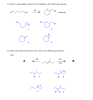 11. Select a reasonable reaction intermediate to the following reaction H0 Br 12. Select the expected products for each of the following reactions. 12a.) HBO Bf2 H20 لا لہ لا بل Br Br 4
Consider the fructose-1,6-bisphosphatase reaction. Calculate the free energy change if the ratio of the concentrations of...
 Consider the fructose-1,6-bisphosphatase reaction. Calculate the free energy change if the ratio of the concentrations of the products to the concentrations of the reactants is 20.9 and the temperature is 37.0 °C? AG'for the reaction is -16.7 kJ/mol. AG= AG= kJ/mol
Describe ligation reaction. Discuss the possible products of ligation reaction.What is the maximum transformation efficiency that...
Describe ligation reaction. Discuss the possible products of ligation reaction.What is the maximum transformation efficiency that can be expected? What things can influence the transformation efficiency and ligation reaction using 2 endonuclease for subcloning instead of one?
Y ochz OCH3 , H2SO4 a. Draw the structure of the tetrahedral intermediate INITIALLY-FORMED in the...
 Y ochz OCH3 , H2SO4 a. Draw the structure of the tetrahedral intermediate INITIALLY-FORMED in the reaction shown. . You do not have to consider stereochemistry. • Do not include counter-ions, e.g., Nat, I, in your answer. • In cases where there is more than one answer, just draw one. BSP b. Draw the structures of the organic products of...
2. (4 points) The direction of reactions (that is, whether they go forward or backward) that...
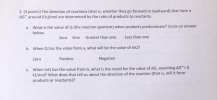 2. (4 points) The direction of reactions (that is, whether they go forward or backward) that have a AG" around 0 kJ/mol are determined by the ratio of products to reactants. a. What is the value of Q (the reaction quotient) when products predominate? Circle an answer below. Zero One Greater than one Less than one b. When Q has...
For the following reaction<br /> ClO₄⁻(aq) + 2H⁺(aq) + Pb²⁺(aq) ⇄ ClO₃⁻(aq) + H₂O(l) + Pb⁴⁺(aq)...
For the following reaction<br /> ClO₄⁻(aq) + 2H⁺(aq) + Pb²⁺(aq) ⇄ ClO₃⁻(aq) + H₂O(l) + Pb⁴⁺(aq) K=1 × 10⁻¹⁵<br /> which of the following is true? Question 3 options: ΔG° > 0 the reactants are more stable than the products. ΔG° > 0 the products are more stable than the reactants. ΔG° < 0 the reactants are more stable than...
 Which of the following best describes a reaction mechanism: A step by step depiction of how a reaction takes place the movement of products to reactants The reactivity of all species from front to back An illustration of how electrons become neutrons
 + TOCH DMSO Br Part 1: a X The reaction proceeds by which mechanism? O Sni 0 Sy2 Part 2 out of 2 What are the products of the reaction? draw structure... < Prey 16 of 16 Next
 5. (8 pt) Write a mechanism for the reaction shown below. Be sure to draw all intermediates and BOTH the 1,2- and 1,4-addition products for the reaction. Indicate which product is the THERMODYNAMIC PRODUCT and which is the KINETIC PRODUCT. HBr
 11. Select a reasonable reaction intermediate to the following reaction H0 Br 12. Select the expected products for each of the following reactions. 12a.) HBO Bf2 H20 لا لہ لا بل Br Br 4
 Consider the fructose-1,6-bisphosphatase reaction. Calculate the free energy change if the ratio of the concentrations of the products to the concentrations of the reactants is 20.9 and the temperature is 37.0 °C? AG'for the reaction is -16.7 kJ/mol. AG= AG= kJ/mol
 Y ochz OCH3 , H2SO4 a. Draw the structure of the tetrahedral intermediate INITIALLY-FORMED in the reaction shown. . You do not have to consider stereochemistry. • Do not include counter-ions, e.g., Nat, I, in your answer. • In cases where there is more than one answer, just draw one. BSP b. Draw the structures of the organic products of...
 2. (4 points) The direction of reactions (that is, whether they go forward or backward) that have a AG" around 0 kJ/mol are determined by the ratio of products to reactants. a. What is the value of Q (the reaction quotient) when products predominate? Circle an answer below. Zero One Greater than one Less than one b. When Q has...
Most questions answered within 3 hours.