There is no structure. b) The quinine isolated from this reacti pe isolated from this reaction...
 There is no structure.
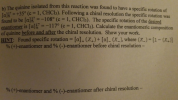
b) The quinine isolated from this reacti pe isolated from this reaction was found to have a specific rotation of 135° (c=1, CHC13). Following a chiral resolution the specific rotation was found to be ali = -108° (c = 1, CHC13). The specific rotation of the desired enantiomer is (alk = -117° (c = 1, CHC13)....
There is no structure.
b) The quinine isolated from this reacti pe isolated from this reaction was found to have a specific rotation of 135° (c=1, CHC13). Following a chiral resolution the specific rotation was found to be ali = -108° (c = 1, CHC13). The specific rotation of the desired enantiomer is (alk = -117° (c = 1, CHC13)....
The integrated rate law allows chemists to predict the reactant concentration after a certain amount of...
The integrated rate law allows chemists to predict the reactant concentration after a certain amount of time, or the time it would take for a certain concentration to be reached. The integrated rate law for a first-order reaction is: [A]=[A]0e−kt Now say we are particularly interested in the time it would take for the concentration to become one-half of its...
3. The thermal decomposition of A, 2A + products is a second-order reaction. Given that the...
 3. The thermal decomposition of A, 2A + products is a second-order reaction. Given that the initial concentration of A is = 2.45 x 10⁻³ M and the intial rate of reaction is 2.05x10⁻⁶ M s-1, calculate the rate constant. Also calculate the rate of reaction after 90% of A has reacted.
The rate constant for the reaction is 0.510 M-1.5-1 at 200 °C. A products If the...
 The rate constant for the reaction is 0.510 M-1.5-1 at 200 °C. A products If the initial concentration of A is 0.00120 M, what will be the concentration after 675 s? [A] =
Q5: Level 1 (U16, L.G. 1) Predict the products of the reaction between HOBrand NaOH. A. H2O(l) + Nat(aq) + OBr(aq)...
 Q5: Level 1 (U16, L.G. 1) Predict the products of the reaction between HOBrand NaOH. A. H2O(l) + Nat(aq) + OBr(aq) B. H2O(1) + NaO+(aq) + Br(aq) C. H2(g) + O2(g) + NaBr(aq) D. H2O2(1) + NaBr(aq)
1 (10 points) Predict the major organic product or products for each of the following. Be...
 1 (10 points) Predict the major organic product or products for each of the following. Be sure to include stereochemistry where appropriate. Assume each is in the most appropriate solvent. Remember, "no reaction" may be an answer. H", H2O a) a) b) b) H* НС c) d) но :Br: a) ВНз b) HО-
4. Predict the products for the reaction sequences shown below: 1. Br2, FeBr3 2. Mg°, ether...
 4. Predict the products for the reaction sequences shown below: 1. Br2, FeBr3 2. Mg°, ether 3. 4. HзО* 1. PCC 6% 2. CH3CH2Li ОН 1. NBS, hv 2. NaOH 3. PCC 4. (CH3)2CuLi tecno ancuo.so (Gvst poo coact
1. Predict the major organic products of the following reactions. Draw all stereoisomers that are formed....
 1. Predict the major organic products of the following reactions. Draw all stereoisomers that are formed. НО, OH 1 eq ,H2SO4 (assume H2O workup of reaction to neutralize product) 1. LDA 2. (assume H,O workup of reaction to neutralize product) 3. Hg(OAC)2 4. NaBH, EtOH 1eq HBr EtOH ambiente 1. Brz. CCL 2. NaOET, ETOH OH
Provide a retrosythesis for each of the following transformations. then provide the reagents to csrry out...
 Provide a retrosythesis for each of the following
transformations. then provide the reagents to csrry out the
synthesis in the forward direction. I have this practice worksheet
and im having trouble understanding concepts to apply/where to
start. Thanks for any input
LO6. To recognize reagents for and predict the products of oxidation reactions of alkenes and alkynes. LO7. To understand...
Provide a retrosythesis for each of the following
transformations. then provide the reagents to csrry out the
synthesis in the forward direction. I have this practice worksheet
and im having trouble understanding concepts to apply/where to
start. Thanks for any input
LO6. To recognize reagents for and predict the products of oxidation reactions of alkenes and alkynes. LO7. To understand...
In a Diels-Alder reaction, can an isolated diene act as one reactant?
In a Diels-Alder reaction, can an isolated diene act as one reactant?
 There is no structure.
b) The quinine isolated from this reacti pe isolated from this reaction was found to have a specific rotation of 135° (c=1, CHC13). Following a chiral resolution the specific rotation was found to be ali = -108° (c = 1, CHC13). The specific rotation of the desired enantiomer is (alk = -117° (c = 1, CHC13)....
There is no structure.
b) The quinine isolated from this reacti pe isolated from this reaction was found to have a specific rotation of 135° (c=1, CHC13). Following a chiral resolution the specific rotation was found to be ali = -108° (c = 1, CHC13). The specific rotation of the desired enantiomer is (alk = -117° (c = 1, CHC13)....
 3. The thermal decomposition of A, 2A + products is a second-order reaction. Given that the initial concentration of A is = 2.45 x 10⁻³ M and the intial rate of reaction is 2.05x10⁻⁶ M s-1, calculate the rate constant. Also calculate the rate of reaction after 90% of A has reacted.
 The rate constant for the reaction is 0.510 M-1.5-1 at 200 °C. A products If the initial concentration of A is 0.00120 M, what will be the concentration after 675 s? [A] =
 Q5: Level 1 (U16, L.G. 1) Predict the products of the reaction between HOBrand NaOH. A. H2O(l) + Nat(aq) + OBr(aq) B. H2O(1) + NaO+(aq) + Br(aq) C. H2(g) + O2(g) + NaBr(aq) D. H2O2(1) + NaBr(aq)
 1 (10 points) Predict the major organic product or products for each of the following. Be sure to include stereochemistry where appropriate. Assume each is in the most appropriate solvent. Remember, "no reaction" may be an answer. H", H2O a) a) b) b) H* НС c) d) но :Br: a) ВНз b) HО-
 4. Predict the products for the reaction sequences shown below: 1. Br2, FeBr3 2. Mg°, ether 3. 4. HзО* 1. PCC 6% 2. CH3CH2Li ОН 1. NBS, hv 2. NaOH 3. PCC 4. (CH3)2CuLi tecno ancuo.so (Gvst poo coact
 1. Predict the major organic products of the following reactions. Draw all stereoisomers that are formed. НО, OH 1 eq ,H2SO4 (assume H2O workup of reaction to neutralize product) 1. LDA 2. (assume H,O workup of reaction to neutralize product) 3. Hg(OAC)2 4. NaBH, EtOH 1eq HBr EtOH ambiente 1. Brz. CCL 2. NaOET, ETOH OH
 Provide a retrosythesis for each of the following
transformations. then provide the reagents to csrry out the
synthesis in the forward direction. I have this practice worksheet
and im having trouble understanding concepts to apply/where to
start. Thanks for any input
LO6. To recognize reagents for and predict the products of oxidation reactions of alkenes and alkynes. LO7. To understand...
Provide a retrosythesis for each of the following
transformations. then provide the reagents to csrry out the
synthesis in the forward direction. I have this practice worksheet
and im having trouble understanding concepts to apply/where to
start. Thanks for any input
LO6. To recognize reagents for and predict the products of oxidation reactions of alkenes and alkynes. LO7. To understand...
Most questions answered within 3 hours.