Predict the product of the following reaction. 1. BHz/THF 2. NaOH, HẠO, ??? (A) Single chiral...
 Predict the product of the following reaction. 1. BHz/THF 2. NaOH, HẠO, ??? (A) Single chiral tertiary alcohol (B) Racemic tertiary alcohol (C) Single chiral secondary alcohol (D) Racemic secondary alcohol 0 co 0 0 Moving to another question will save this response O search
Right answer pls,for right one I will rate. Predict the organic product for the following reaction...
 Right answer pls,for right one
I will rate.
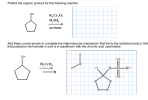
Predict the organic product for the following reaction ?? K,Cr,O, H,SO acetone Add three curved arrows to complete the intermolecular mechanism that forms the oxidized product. Not that potassium dichromate in acid is in equilibrium with the chromic acid used below ?? H,CrO
Right answer pls,for right one
I will rate.
Predict the organic product for the following reaction ?? K,Cr,O, H,SO acetone Add three curved arrows to complete the intermolecular mechanism that forms the oxidized product. Not that potassium dichromate in acid is in equilibrium with the chromic acid used below ?? H,CrO
The rate constant for a certain reaction is k = 9.00 times 10^-3 s^-1. If the...
 The rate constant for a certain reaction is k = 9.00 times 10^-3 s^-1. If the initial reactant concentration was 0 800 M, what will the concentration be after 4 00 m minutes? Express your answer with the appropriate units A zero order reaction has a constant rate of 2.10 times 10^-4 M/s. If after 65.0 seconds the concentrator has...
The following initial rate information was collected at 25°c for the following reaction: 2H2(g)+2NO(g) N2(g) +2H20(g)...
 The following initial rate information was collected at 25°c for the following reaction: 2H2(g)+2NO(g) N2(g) +2H20(g) H2lo (M) INOlo (M) Initial Rate (M/min) 0.0010 0.0020 1.2 x 10⁻⁴ 0.0010 0.0030 1.8 x 10⁴ 0.0020 0.0020 4.8 x 10⁴ Determine the overall order of the reaction and present you answer in numeric torm (le. 0, 1,2 eto)
PART A: Determine the stopping distances for an automobile going a constant initial speed of 95...
PART A: Determine the stopping distances for an automobile going a constant initial speed of 95 km/h and human reaction time of 0.30 s , for an acceleration a=−3.6m/s2. Express your answer using two significant figures. PART B: Determine the stopping distances for an automobile going a constant initial speed of 95 km/h and human reaction time of 0.30...
PART A The activation energy of a certain reaction is 30.7 kJ/mol . At 20 ∘C,...
PART A The activation energy of a certain reaction is 30.7 kJ/mol . At 20 ∘C, the rate constant is 0.0130 s−1. At what temperature would this reaction go twice as fast? Express your answer numerically in degrees Celsius Part B Given that the initial rate constant is 0.0130 s−1 at an initial temperature of 20 ∘C, what would the...
Draw a rough sketch of a reaction energy diagram for each of the following cases. Include...
Draw a rough sketch of a reaction energy diagram for each of the following cases. Include labels for reactants, products, Ea, and ∆H (difference in E between reactants and products). When products are made, 10 kJ/mol of energy are released, and Ea is 50 kJ/mol. To make products, 10 kJ/mol of energy need to be added to reactants, and Ea...
Into a system which contained only A, a limited amount of B is injected. The equilibrium,...
 Into a system which contained only A, a limited amount of B is injected. The equilibrium, A + B = C is established. Which of the following statements applies? a. The concentrations of A and B become equal. Ob. The concentration of A decreases initially, then becomes constant. c. The concentration of C increases until either A or B is...
For the following SN2 reaction, draw the organic and inorganic products of the reaction, and identify the nucleophile
 For the following SN2 reaction, draw the organic and inorganic
products of the reaction, and identify the nucleophile, substrate,
and leaving group. Include wedge/dash bonds and H on a
stereocenter.Select the statement that property identifies the nucleophile, substrate, and leaving group. Cl- is the substrate. CH3CH(CH2)2CH3Cl is the nucleophile, and CN- is the leaving group. CH3CH(CH2)2CH3Cl is the substrate. CN-...
For the following SN2 reaction, draw the organic and inorganic
products of the reaction, and identify the nucleophile, substrate,
and leaving group. Include wedge/dash bonds and H on a
stereocenter.Select the statement that property identifies the nucleophile, substrate, and leaving group. Cl- is the substrate. CH3CH(CH2)2CH3Cl is the nucleophile, and CN- is the leaving group. CH3CH(CH2)2CH3Cl is the substrate. CN-...
Consider the reaction xM + yN → products: This reaction was run 10 times with different...
Consider the reaction xM + yN → products: This reaction was run 10 times with different volumes of the two reactant solutions and the absorbance was measured. The two solutions are both 1.0 M and the total volume mixed together for all 10 reactions was the same. The reaction trial that had the largest absorbance was the one when 10.5...
 Predict the product of the following reaction. 1. BHz/THF 2. NaOH, HẠO, ??? (A) Single chiral tertiary alcohol (B) Racemic tertiary alcohol (C) Single chiral secondary alcohol (D) Racemic secondary alcohol 0 co 0 0 Moving to another question will save this response O search
 Right answer pls,for right one
I will rate.
Predict the organic product for the following reaction ?? K,Cr,O, H,SO acetone Add three curved arrows to complete the intermolecular mechanism that forms the oxidized product. Not that potassium dichromate in acid is in equilibrium with the chromic acid used below ?? H,CrO
Right answer pls,for right one
I will rate.
Predict the organic product for the following reaction ?? K,Cr,O, H,SO acetone Add three curved arrows to complete the intermolecular mechanism that forms the oxidized product. Not that potassium dichromate in acid is in equilibrium with the chromic acid used below ?? H,CrO
 The rate constant for a certain reaction is k = 9.00 times 10^-3 s^-1. If the initial reactant concentration was 0 800 M, what will the concentration be after 4 00 m minutes? Express your answer with the appropriate units A zero order reaction has a constant rate of 2.10 times 10^-4 M/s. If after 65.0 seconds the concentrator has...
 The following initial rate information was collected at 25°c for the following reaction: 2H2(g)+2NO(g) N2(g) +2H20(g) H2lo (M) INOlo (M) Initial Rate (M/min) 0.0010 0.0020 1.2 x 10⁻⁴ 0.0010 0.0030 1.8 x 10⁴ 0.0020 0.0020 4.8 x 10⁴ Determine the overall order of the reaction and present you answer in numeric torm (le. 0, 1,2 eto)
 Into a system which contained only A, a limited amount of B is injected. The equilibrium, A + B = C is established. Which of the following statements applies? a. The concentrations of A and B become equal. Ob. The concentration of A decreases initially, then becomes constant. c. The concentration of C increases until either A or B is...
 For the following SN2 reaction, draw the organic and inorganic
products of the reaction, and identify the nucleophile, substrate,
and leaving group. Include wedge/dash bonds and H on a
stereocenter.Select the statement that property identifies the nucleophile, substrate, and leaving group. Cl- is the substrate. CH3CH(CH2)2CH3Cl is the nucleophile, and CN- is the leaving group. CH3CH(CH2)2CH3Cl is the substrate. CN-...
For the following SN2 reaction, draw the organic and inorganic
products of the reaction, and identify the nucleophile, substrate,
and leaving group. Include wedge/dash bonds and H on a
stereocenter.Select the statement that property identifies the nucleophile, substrate, and leaving group. Cl- is the substrate. CH3CH(CH2)2CH3Cl is the nucleophile, and CN- is the leaving group. CH3CH(CH2)2CH3Cl is the substrate. CN-...
Most questions answered within 3 hours.