What is the change in volume for this reaction (ΔVR(1 bar, 298K)) at 298K and 1...
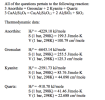 What is the change in volume for this reaction (ΔVR(1 bar,
298K)) at 298K and 1 bar? Are the products or reactants denser?
What is the change in enthalpy for this reaction (ΔHR(1 bar,
298K)) at 298K and 1 bar? Is the reaction exothermic or
endothermic?
What is the change in internal energy for this reaction (ΔER(1
bar, 298K)) at...
What is the change in volume for this reaction (ΔVR(1 bar,
298K)) at 298K and 1 bar? Are the products or reactants denser?
What is the change in enthalpy for this reaction (ΔHR(1 bar,
298K)) at 298K and 1 bar? Is the reaction exothermic or
endothermic?
What is the change in internal energy for this reaction (ΔER(1
bar, 298K)) at...
PLEASE ANSWER ALL QUESTIONS Question 5 The reaction below occurs via SN2 and E2 reaction mechanisms....
 PLEASE ANSWER ALL QUESTIONS
Question 5 The reaction below occurs via SN2 and E2 reaction mechanisms. The question only requires you to address the E2 reaction only. For the E2 reaction: Use Newman projections to show the relationship between the leaving group and the beta-hydrogen on the carbon labeled with the asterisk ("). 1. If the leaving group and the...
PLEASE ANSWER ALL QUESTIONS
Question 5 The reaction below occurs via SN2 and E2 reaction mechanisms. The question only requires you to address the E2 reaction only. For the E2 reaction: Use Newman projections to show the relationship between the leaving group and the beta-hydrogen on the carbon labeled with the asterisk ("). 1. If the leaving group and the...
1. For the reaction 2A(g)⇌B(g)+2C(g), a reaction vessel initially contains only A at a pressure of...
1. For the reaction 2A(g)⇌B(g)+2C(g), a reaction vessel initially contains only A at a pressure of PA=265 mmHg. At equilibrium, PA=41 mmHg. Calculate the value of Kp. (Assume no changes in volume or temperature.) 2. consider the following reaction: A(g)⇌2B(g) Find the equilibrium partial pressures of A and B for each of the following different values of Kp. Assume that...
Experiment Initial Rate (M/s) [N205(g)] (M) 0.225 0.450 0.0500 0.200 3rd attempt du See Periodic Ta...
 Experiment Initial Rate (M/s) [N205(g)] (M) 0.225 0.450 0.0500 0.200 3rd attempt du See Periodic Ta Determine the order of the decomposition reaction of N2O5, by using the initial rate data from the given table:
For the following reaction: A(g) + 2 B(g) ⇌ 2 C(g) Calculate the equilibrium constant K...
For the following reaction: A(g) + 2 B(g) ⇌ 2 C(g) Calculate the equilibrium constant K given the following information: The initial pressure of A is 1.831 bar and the initial pressure of B is 3.460 bar The equilibrium pressure of C is 0.520 bar
Given that the initial rate constant is 0.0190s−1 at an initial temperature of 20 ∘C ,...
Given that the initial rate constant is 0.0190s−1 at an initial temperature of 20 ∘C , what would the rate constant be at a temperature of 140. ∘C for the same reaction described in Part A? Part A was EA =47.7kJ/mol. I need to see the all the step
For the following reaction: A(g) + 2 B(g) ⇌ 2 C(g) Calculate the equilibrium constant K...
For the following reaction: A(g) + 2 B(g) ⇌ 2 C(g) Calculate the equilibrium constant K given the following information: The initial pressure of A is 2.421 bar and the initial pressure of B is 1.558 bar The equilibrium pressure of C is 0.864 bar
Enthalpy Determination for HCI+NaOH Reaction 1. Mass of empty Styrofoam cup, g: 2. Mass of Styrofoam...
 Enthalpy Determination for HCI+NaOH Reaction 1. Mass of empty Styrofoam cup, g: 2. Mass of Styrofoam cup + HCl, g: 3. Initial temperature of HCl solution, "C: Final temperature of solution after mixing, °C 4. 5. Change in temperature, °C: 1215 6. Mass of Styrofoam cup with HCI and NaOH added, g 7. Mass of solution, g: 8. AH of...
QUESTION 10 Given the data below for the reaction, 2 A + 2 B + 4...
 QUESTION 10 Given the data below for the reaction, 2 A + 2 B + 4 C-> D + E + 3 F the reaction is order in A, order in B order in C and order overall. USE WORDS TO FILL IN THE BLANKS NOT NUMBERS(i.e., zero, first, second etc) Initial conc of A, ial conc of B, mol/L...
UUTIIL NAME: PRE-LAB ENDOTHERMIC AND EXOTHERMIC REACTIONS. VERNIER Consider the following Data 59°C Final temperature, 1...
 UUTIIL NAME: PRE-LAB ENDOTHERMIC AND EXOTHERMIC REACTIONS. VERNIER Consider the following Data 59°C Final temperature, 1 (°C) 39°C Initial temperature, (°C) Temperature change, A/ (°C) PROCESSING THE DATA 1. Calculate the temperature change, A1, for the reaction by subtracting the initial temperature, 1, from the final temperature, 1. (Ar=1:- ). 2. Calculate the amount of heat energy, g, produced in...
 What is the change in volume for this reaction (ΔVR(1 bar,
298K)) at 298K and 1 bar? Are the products or reactants denser?
What is the change in enthalpy for this reaction (ΔHR(1 bar,
298K)) at 298K and 1 bar? Is the reaction exothermic or
endothermic?
What is the change in internal energy for this reaction (ΔER(1
bar, 298K)) at...
What is the change in volume for this reaction (ΔVR(1 bar,
298K)) at 298K and 1 bar? Are the products or reactants denser?
What is the change in enthalpy for this reaction (ΔHR(1 bar,
298K)) at 298K and 1 bar? Is the reaction exothermic or
endothermic?
What is the change in internal energy for this reaction (ΔER(1
bar, 298K)) at...
 PLEASE ANSWER ALL QUESTIONS
Question 5 The reaction below occurs via SN2 and E2 reaction mechanisms. The question only requires you to address the E2 reaction only. For the E2 reaction: Use Newman projections to show the relationship between the leaving group and the beta-hydrogen on the carbon labeled with the asterisk ("). 1. If the leaving group and the...
PLEASE ANSWER ALL QUESTIONS
Question 5 The reaction below occurs via SN2 and E2 reaction mechanisms. The question only requires you to address the E2 reaction only. For the E2 reaction: Use Newman projections to show the relationship between the leaving group and the beta-hydrogen on the carbon labeled with the asterisk ("). 1. If the leaving group and the...
 Experiment Initial Rate (M/s) [N205(g)] (M) 0.225 0.450 0.0500 0.200 3rd attempt du See Periodic Ta Determine the order of the decomposition reaction of N2O5, by using the initial rate data from the given table:
 Enthalpy Determination for HCI+NaOH Reaction 1. Mass of empty Styrofoam cup, g: 2. Mass of Styrofoam cup + HCl, g: 3. Initial temperature of HCl solution, "C: Final temperature of solution after mixing, °C 4. 5. Change in temperature, °C: 1215 6. Mass of Styrofoam cup with HCI and NaOH added, g 7. Mass of solution, g: 8. AH of...
 QUESTION 10 Given the data below for the reaction, 2 A + 2 B + 4 C-> D + E + 3 F the reaction is order in A, order in B order in C and order overall. USE WORDS TO FILL IN THE BLANKS NOT NUMBERS(i.e., zero, first, second etc) Initial conc of A, ial conc of B, mol/L...
 UUTIIL NAME: PRE-LAB ENDOTHERMIC AND EXOTHERMIC REACTIONS. VERNIER Consider the following Data 59°C Final temperature, 1 (°C) 39°C Initial temperature, (°C) Temperature change, A/ (°C) PROCESSING THE DATA 1. Calculate the temperature change, A1, for the reaction by subtracting the initial temperature, 1, from the final temperature, 1. (Ar=1:- ). 2. Calculate the amount of heat energy, g, produced in...
Most questions answered within 3 hours.