3. a) How would you drive the following reaction to the right to form more products:...
 3. a) How would you drive the following reaction to the right to form more products: CO(g) + H2O(g) + CO2(g) + H, (g) AH°= -40.3 kJ Ans. b) One of the products is a 'high value substance. Which one, and what is it used for?
For the following reaction: (type the number, 0-10, in the blanks provided below). CHO H -OH...
 For the following reaction: (type the number, 0-10, in the blanks provided below). CHO H -OH H-H HIOA Products HO-H НЕОН CH2OH The products will include formic acid molecule(s), carbon formaldehyde molecule(s), and dioxide molecule(s).
Methoxy benzene (anisole) reacts with a mixture of FeBr3 and Br2 and the major products obtained...
Methoxy benzene (anisole) reacts with a mixture of FeBr3 and Br2 and the major products obtained are ortho- and para-substituted. Draw the 3 major and minor products of the reaction and use resonance structures of the carbocation intermediate to explain why ortho and para substitution occur in preference to the meta-substitution.
Please explain which is the most reactive reagent of aniline, acetanilide and phenol. List them in...
 Please explain which is the most reactive
reagent of aniline, acetanilide and phenol. List them in order with
#1 being the most reactive. The reaction is
included below with possible products. Please rank each of the
products according to expected BP.
NH2 HN CHE OH aniline acetanilide phenol Br3 CH3COOH Possible Products I Br Br. Br Br Br Br Br
Please explain which is the most reactive
reagent of aniline, acetanilide and phenol. List them in order with
#1 being the most reactive. The reaction is
included below with possible products. Please rank each of the
products according to expected BP.
NH2 HN CHE OH aniline acetanilide phenol Br3 CH3COOH Possible Products I Br Br. Br Br Br Br Br
For the reaction CH3OH(aq) + Cl-(aq) <--> CH3Cl(aq) + OH-(aq) , K = 3.4 x 10⁻¹⁵...
For the reaction CH3OH(aq) + Cl-(aq) <--> CH3Cl(aq) + OH-(aq) , K = 3.4 x 10⁻¹⁵ at a particular temperature. What can be said about the relative energies of products and reactants? Group of answer choices products must be more stable products and reactants must be of nearly equal stabilities no way to determine without more information reactants must be...
Draw the structures of all neutral organic products formed in the following reaction. Do not include...
 Draw the structures of all neutral organic products formed in the following reaction. Do not include counterions or byproducts. H20
2. Complete the following reactions by drawing a structural formula of the products. Indicate the type...
 2. Complete the following reactions by drawing a structural formula of the products. Indicate the type of reaction. Strong[O a. CH3CH2OH
What products would you expect from reaction of 3-methyl cyclohexene with HBr. Is the product(s) chiral?
What products would you expect from reaction of 3-methyl cyclohexene with HBr. Is the product(s) chiral?
Question 1 There are two possible products from the following reaction. Select two answers. H2SO4 /...
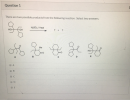 Question 1 There are two possible products from the following reaction. Select two answers. H2SO4 / Heat . ? ? of goede
Draw the products and the full electron pushing mechanism for the reaction below. Initiation: Propagation: Termination...
 Draw the products and the full electron pushing mechanism for the reaction below. Initiation: Propagation: Termination (show one possibility):
 3. a) How would you drive the following reaction to the right to form more products: CO(g) + H2O(g) + CO2(g) + H, (g) AH°= -40.3 kJ Ans. b) One of the products is a 'high value substance. Which one, and what is it used for?
 For the following reaction: (type the number, 0-10, in the blanks provided below). CHO H -OH H-H HIOA Products HO-H НЕОН CH2OH The products will include formic acid molecule(s), carbon formaldehyde molecule(s), and dioxide molecule(s).
 Please explain which is the most reactive
reagent of aniline, acetanilide and phenol. List them in order with
#1 being the most reactive. The reaction is
included below with possible products. Please rank each of the
products according to expected BP.
NH2 HN CHE OH aniline acetanilide phenol Br3 CH3COOH Possible Products I Br Br. Br Br Br Br Br
Please explain which is the most reactive
reagent of aniline, acetanilide and phenol. List them in order with
#1 being the most reactive. The reaction is
included below with possible products. Please rank each of the
products according to expected BP.
NH2 HN CHE OH aniline acetanilide phenol Br3 CH3COOH Possible Products I Br Br. Br Br Br Br Br
 Draw the structures of all neutral organic products formed in the following reaction. Do not include counterions or byproducts. H20
 2. Complete the following reactions by drawing a structural formula of the products. Indicate the type of reaction. Strong[O a. CH3CH2OH
 Question 1 There are two possible products from the following reaction. Select two answers. H2SO4 / Heat . ? ? of goede
 Draw the products and the full electron pushing mechanism for the reaction below. Initiation: Propagation: Termination (show one possibility):
Most questions answered within 3 hours.