2. Superposition (35%) In this problem we consider the electric field generated by combinations of some...
 2. Superposition (35%) In this problem we consider the electric field generated by combinations of some familiar geometries. (Unless you are told otherwise, assume that all charge distribu- tions in this problem are fixed, that is the charges cannot move.) (a) Consider an infinite line of charge with linear charge density 1. Assume this line of charge lies on the...
Helical (1.5 x 105,0,2 x 105) v 3. Consider a proton at an instance with the velocity given above where B 0.1T (a)...
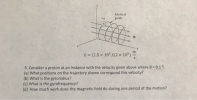 Helical (1.5 x 105,0,2 x 105) v 3. Consider a proton at an instance with the velocity given above where B 0.1T (a) What positions on the trajectory shown correspond this velocity? (b) What is the gyroradius? (c) What is the gyrofrequency? (d) How much work does the magnetic field do during one period of the motion?
Helical (1.5 x...
Helical (1.5 x 105,0,2 x 105) v 3. Consider a proton at an instance with the velocity given above where B 0.1T (a) What positions on the trajectory shown correspond this velocity? (b) What is the gyroradius? (c) What is the gyrofrequency? (d) How much work does the magnetic field do during one period of the motion?
Helical (1.5 x...
The equation of electric potential in space is given by: V(x,y,z) = 2xy/x 1. Calculate the...
The equation of electric potential in space is given by: V(x,y,z) = 2xy/x 1. Calculate the electric potential at point (x = 1, y = -2, z = 3) in space. 2. Find the electric field E vector as a function of x, y, z. 3. Calculate the electric field at point (x = 1, y = -2, z =...
A +60nC charge is located at +3cmj^, and a +60nC charge is located at −3cmj^. What...
A +60nC charge is located at +3cmj^, and a +60nC charge is located at −3cmj^. What is the electric field and electric potential at the point +3cmi^? E→= N/Ci^+ N/Cj^ V= V A +60nC charge is located at +3cmj^, and a −60nC charge is located at −3cmj^. What is the electric field and electric potential at the point +3cmi^? E→=...
Q-3 (25pts) The wave function of a ns electron in a hydrogen atom is r -r/(2a)...
 Q-3 (25pts) The wave function of a ns electron in a hydrogen atom is r -r/(2a) y (,0,0)=1/27 927 (2-3) a) (10pts) Show that y function is already normalized. b) (10pts) Find the energy (En) of the electron. c) (5pts) Write the principle quantum number (n), orbital quantum number (?), and magnetic quantum number (mi) of the hydrogen electron state.
2) The hydraulic cylinder extends and causes point B to have the velocity and acceleration shown....
 2) The hydraulic cylinder extends and causes point B to have the velocity and acceleration shown. Set up the equations needed to determine the acceleration of point A at the instant shown. Complete all cross products and separate the equations into components. You do not need to solve the equations for the unknowns. CO B us = 4 ft/s ab...
Two point charges are separated by 25.0 cm (see (Figure 1)). Assume that q1 = -6.50 nC and q2 = - 14.0 nC.
 Two point charges are separated by 25.0 cm (see (Figure 1)). Assume that q1 = -6.50 nC and q2 = - 14.0 nC. Part A Find the net electric field these charges produce at point A. Part B Find the net electric field these charges produce at point B. Part C What would be the magnitude of the electric force this combination of charges would produce...
The figure above shows two identical parallel rods, which are both evenly charged with the same amount of positive charge
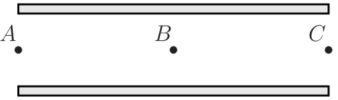 The figure above shows two identical parallel rods, which are both evenly charged with the same amount of positive charge. Thc points A, B, and C are in the space directly inbetween the two rods.Part (a) What direction is the electric field in at point A? Part (b) What direction is the electric field in at point B?Part (c) What direction...
In a rectangular coordinate system, a positive point charge q = 7.00 nC is placed at...
In a rectangular coordinate system, a positive point charge q = 7.00 nC is placed at the point x=0.150m , y=0, and an identical point charge is placed at x=−0.150m , y=0. Find the x and y components and the magnitude and direction of the electric field at the following points. a. Find the x and y components of the...
 2. Superposition (35%) In this problem we consider the electric field generated by combinations of some familiar geometries. (Unless you are told otherwise, assume that all charge distribu- tions in this problem are fixed, that is the charges cannot move.) (a) Consider an infinite line of charge with linear charge density 1. Assume this line of charge lies on the...
 Helical (1.5 x 105,0,2 x 105) v 3. Consider a proton at an instance with the velocity given above where B 0.1T (a) What positions on the trajectory shown correspond this velocity? (b) What is the gyroradius? (c) What is the gyrofrequency? (d) How much work does the magnetic field do during one period of the motion?
Helical (1.5 x...
Helical (1.5 x 105,0,2 x 105) v 3. Consider a proton at an instance with the velocity given above where B 0.1T (a) What positions on the trajectory shown correspond this velocity? (b) What is the gyroradius? (c) What is the gyrofrequency? (d) How much work does the magnetic field do during one period of the motion?
Helical (1.5 x...
 Q-3 (25pts) The wave function of a ns electron in a hydrogen atom is r -r/(2a) y (,0,0)=1/27 927 (2-3) a) (10pts) Show that y function is already normalized. b) (10pts) Find the energy (En) of the electron. c) (5pts) Write the principle quantum number (n), orbital quantum number (?), and magnetic quantum number (mi) of the hydrogen electron state.
 2) The hydraulic cylinder extends and causes point B to have the velocity and acceleration shown. Set up the equations needed to determine the acceleration of point A at the instant shown. Complete all cross products and separate the equations into components. You do not need to solve the equations for the unknowns. CO B us = 4 ft/s ab...
Most questions answered within 3 hours.