O ACIDS AND BASES Making qualitative estimates of pH change Each row of the table below...
 O ACIDS AND BASES Making qualitative estimates of pH change Each row of the table below describes an aqueous solution at 25 °C. The second column of the table shows the initial components of the solution. • Use the checkboxes in the third column to explain the type of the initial solution. The fourth column describes a change in the...
Which of the following statements correctly describe the half-life of a reaction? Select all that apply....
 Which of the following statements correctly describe the half-life of a reaction? Select all that apply. Check all that apply. The half-life of a first-order reaction is independent of the initial concentration. The half-life of a reaction is related to its rate constant. The half-life of a reaction is the time taken for (A)to drop to half its original value....
7.2 b) c) Draw the major organic product(s) of the following reaction. CH3 H3C-C-CEC-H | NaNH, / NH (1) more pollastre...
 7.2
b)
c)
Draw the major organic product(s) of the following reaction. CH3 H3C-C-CEC-H | NaNH, / NH (1) more pollastre CH3CH2–1 CH3 • You do not have to consider stereochemistry. • If no reaction occurs, draw the organic starting material. • Draw one structure per sketcher. Add additional sketchers using the drop-down menu in the bottom right corner. •...
7.2
b)
c)
Draw the major organic product(s) of the following reaction. CH3 H3C-C-CEC-H | NaNH, / NH (1) more pollastre CH3CH2–1 CH3 • You do not have to consider stereochemistry. • If no reaction occurs, draw the organic starting material. • Draw one structure per sketcher. Add additional sketchers using the drop-down menu in the bottom right corner. •...
7.2 b) c) Draw the major organic product(s) of the following reaction. NaNH / NH3(I) CH3CH2CH2CH2-Br CH3CH2-CEC-H • Yo...
 7.2
b)
c)
Draw the major organic product(s) of the following reaction. NaNH / NH3(I) CH3CH2CH2CH2-Br CH3CH2-CEC-H • You do not have to consider stereochemistry. • If no reaction occurs, draw the organic starting material. • Draw one structure per sketcher. Add additional sketchers using the drop-down menu in the bottom right corner. • Separate multiple products using the +...
7.2
b)
c)
Draw the major organic product(s) of the following reaction. NaNH / NH3(I) CH3CH2CH2CH2-Br CH3CH2-CEC-H • You do not have to consider stereochemistry. • If no reaction occurs, draw the organic starting material. • Draw one structure per sketcher. Add additional sketchers using the drop-down menu in the bottom right corner. • Separate multiple products using the +...
2. The Haber process was developed to convert molecular nitrogen from the atmosphere into ammonia for...
 2. The Haber process was developed to convert molecular nitrogen from the atmosphere into ammonia for use infertiler. "Pested podcast is excited with this question N.)+3H. - ZH, The reaction coordinate diagram for the process is given below. It is a heterogeneous catalytic reaction, so the first step is reactants adsorbing to the surface and the last step is desorption...
< Question 14 of 15 > For the Wittig reaction between cyclohexanone and Ph3P=C(CH)CH,CH,, where Ph...
 < Question 14 of 15 > For the Wittig reaction between cyclohexanone and Ph3P=C(CH)CH,CH,, where Ph = CH., draw the curved arrows for the reaction mechanism. Step 1: The ketone and ylide react to form the betaine. Draw curved arrows. Step 2: The betaine converts to the oxaphosphetane. Draw curved arrows. Select Draw Rings Groups More Erase Select Draw Rings...
6. (8 points, 2 points each) Consider the following reaction: CO2(g) + 2 NH3(g) = CO(NH2)2(s)...
 6. (8 points, 2 points each) Consider the following reaction: CO2(g) + 2 NH3(g) = CO(NH2)2(s) + H2O(g) AH° = -90 kJ Circle the change expected for each of the following to reestablish equilibrium: a. Add CO2 to the equilibrium mixture form more form more no change products reactants b. Compress the equilibrium mixture at constant temperature. (smaller volume) form...
Which of the following expressions is the correct equilibrium-constant expression for the reaction below? 200(g) =...
 Which of the following expressions is the correct equilibrium-constant expression for the reaction below? 200(g) = CO2(g) + C(s) A. [CO][C]/[CO] B. K [CO] C. [CO] / [CO2) D. [CO]/[CO] E. 2[CO] /[CO][C] In which of the following reactions would increasing pressure at constant temperature not change the concentrations of reactants and products, based on Le Châtelier's principle? ООООО A....
Question1: Introduction Three aromatic compounds that have ortho-para directing and activating substituents will be brominated. The...
 Question1:
Introduction Three aromatic compounds that have ortho-para directing and activating substituents will be brominated. The extent of activation will be judged by the number of bromine atoms that add to the benzene ring in each case. For each of the compounds shown below you will work out if a mono- di- or tri- brominated derivative formed following treatment with...
Question1:
Introduction Three aromatic compounds that have ortho-para directing and activating substituents will be brominated. The extent of activation will be judged by the number of bromine atoms that add to the benzene ring in each case. For each of the compounds shown below you will work out if a mono- di- or tri- brominated derivative formed following treatment with...
Question 2 108, BAg --> 108 Pd +? 47 46 ое 1 ое -1 1n о...
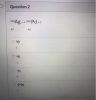 Question 2 108, BAg --> 108 Pd +? 47 46 ое 1 ое -1 1n о О4Не 2 Question 3 The type of reaction in question 2 is positron emission beta decay alpha decay electron capture Question 4 0 If H2S has a bent shape, what is the shape of H2O? bent trigonal planar tetrahedral linear Partial Question 5 0.67/2...
 O ACIDS AND BASES Making qualitative estimates of pH change Each row of the table below describes an aqueous solution at 25 °C. The second column of the table shows the initial components of the solution. • Use the checkboxes in the third column to explain the type of the initial solution. The fourth column describes a change in the...
 Which of the following statements correctly describe the half-life of a reaction? Select all that apply. Check all that apply. The half-life of a first-order reaction is independent of the initial concentration. The half-life of a reaction is related to its rate constant. The half-life of a reaction is the time taken for (A)to drop to half its original value....
 7.2
b)
c)
Draw the major organic product(s) of the following reaction. CH3 H3C-C-CEC-H | NaNH, / NH (1) more pollastre CH3CH2–1 CH3 • You do not have to consider stereochemistry. • If no reaction occurs, draw the organic starting material. • Draw one structure per sketcher. Add additional sketchers using the drop-down menu in the bottom right corner. •...
7.2
b)
c)
Draw the major organic product(s) of the following reaction. CH3 H3C-C-CEC-H | NaNH, / NH (1) more pollastre CH3CH2–1 CH3 • You do not have to consider stereochemistry. • If no reaction occurs, draw the organic starting material. • Draw one structure per sketcher. Add additional sketchers using the drop-down menu in the bottom right corner. •...
 7.2
b)
c)
Draw the major organic product(s) of the following reaction. NaNH / NH3(I) CH3CH2CH2CH2-Br CH3CH2-CEC-H • You do not have to consider stereochemistry. • If no reaction occurs, draw the organic starting material. • Draw one structure per sketcher. Add additional sketchers using the drop-down menu in the bottom right corner. • Separate multiple products using the +...
7.2
b)
c)
Draw the major organic product(s) of the following reaction. NaNH / NH3(I) CH3CH2CH2CH2-Br CH3CH2-CEC-H • You do not have to consider stereochemistry. • If no reaction occurs, draw the organic starting material. • Draw one structure per sketcher. Add additional sketchers using the drop-down menu in the bottom right corner. • Separate multiple products using the +...
 2. The Haber process was developed to convert molecular nitrogen from the atmosphere into ammonia for use infertiler. "Pested podcast is excited with this question N.)+3H. - ZH, The reaction coordinate diagram for the process is given below. It is a heterogeneous catalytic reaction, so the first step is reactants adsorbing to the surface and the last step is desorption...
 < Question 14 of 15 > For the Wittig reaction between cyclohexanone and Ph3P=C(CH)CH,CH,, where Ph = CH., draw the curved arrows for the reaction mechanism. Step 1: The ketone and ylide react to form the betaine. Draw curved arrows. Step 2: The betaine converts to the oxaphosphetane. Draw curved arrows. Select Draw Rings Groups More Erase Select Draw Rings...
 6. (8 points, 2 points each) Consider the following reaction: CO2(g) + 2 NH3(g) = CO(NH2)2(s) + H2O(g) AH° = -90 kJ Circle the change expected for each of the following to reestablish equilibrium: a. Add CO2 to the equilibrium mixture form more form more no change products reactants b. Compress the equilibrium mixture at constant temperature. (smaller volume) form...
 Which of the following expressions is the correct equilibrium-constant expression for the reaction below? 200(g) = CO2(g) + C(s) A. [CO][C]/[CO] B. K [CO] C. [CO] / [CO2) D. [CO]/[CO] E. 2[CO] /[CO][C] In which of the following reactions would increasing pressure at constant temperature not change the concentrations of reactants and products, based on Le Châtelier's principle? ООООО A....
 Question1:
Introduction Three aromatic compounds that have ortho-para directing and activating substituents will be brominated. The extent of activation will be judged by the number of bromine atoms that add to the benzene ring in each case. For each of the compounds shown below you will work out if a mono- di- or tri- brominated derivative formed following treatment with...
Question1:
Introduction Three aromatic compounds that have ortho-para directing and activating substituents will be brominated. The extent of activation will be judged by the number of bromine atoms that add to the benzene ring in each case. For each of the compounds shown below you will work out if a mono- di- or tri- brominated derivative formed following treatment with...
 Question 2 108, BAg --> 108 Pd +? 47 46 ое 1 ое -1 1n о О4Не 2 Question 3 The type of reaction in question 2 is positron emission beta decay alpha decay electron capture Question 4 0 If H2S has a bent shape, what is the shape of H2O? bent trigonal planar tetrahedral linear Partial Question 5 0.67/2...
Most questions answered within 3 hours.