Different types of time-series forecasting models and their applicability in different organizations are given below: 1. ...
Different types of time-series forecasting models and their applicability in different organizations are given below: 1. Naive approach: In naive approach, demand for the next period is assumed to be same in the most recent period. This method can be used in economic and financial time series analysis. It can be used to forecast demand for mature products having level...
Suppose for the following reaction the initial pressures are: 2 CO2(g) = 2 CO(g) + O2(g)...
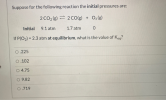 Suppose for the following reaction the initial pressures are: 2 CO2(g) = 2 CO(g) + O2(g) Initial 9.1 atm 1.7 atm 0 If P(O2) = 2.3 atm at equilibrium, what is the value of Keg? 0.225 0.102 0 4.75 0 9.82 0.719
3) Perform an equilibrium calculation using the quadratic formula to determine the equilibrium concentrations of each...
3) Perform an equilibrium calculation using the quadratic formula to determine the equilibrium concentrations of each species in the following reaction, given the initial concentrations: Initial concentrations: [H2] 0.10M. [I2] 0.20M. [HI]0.00M. H2 (g) + I2 (g) ———- 2HI. Kc= 81 at 70 c
i really need help plugging in my numbers. im not sure what S water stands for....
 i really need help plugging in my numbers. im not sure what S
water stands for.
yields NaCtfaa) HiO) AH is negative HClfoa)+NaOH(aq) The net ionic equation for the reaction above is yletds HO) H(aa) + OH (ag) Since the reaction is exothermic, the enthalpy of the reaction is negative. Since the resulting solution is composed primarily of water, the...
i really need help plugging in my numbers. im not sure what S
water stands for.
yields NaCtfaa) HiO) AH is negative HClfoa)+NaOH(aq) The net ionic equation for the reaction above is yletds HO) H(aa) + OH (ag) Since the reaction is exothermic, the enthalpy of the reaction is negative. Since the resulting solution is composed primarily of water, the...
Draw a structural formula for the substitution product of the reaction shown below. OCH + Br...
 Draw a structural formula for the substitution product of the reaction shown below. OCH + Br Nac Na OCCHE DMSO DMSO = dimethyl sulfoxide • Use the wedge/hash bond tools to indicate stereochemistry where it exists. • If more than one stereoisomer of product is formed, draw both. • Separate multiple products using the + sign from the drop-down menu....
vion to the struc. s, and explain voc H a us unu uw reaction-energy diagrams for...
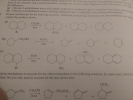 vion to the struc. s, and explain voc H a us unu uw reaction-energy diagrams for the following reactions. Pay particular attention to tures of any transition states and intermediates. Compare the reaction-energy diagrams for the two reactions, and the differences. (a) 2-Bromo-2-methylbutane reacts with sodium methoxide in methanol to give 2-methylbut-2-ene (among other (b) 2-Bromo-2-methylbutane reacts in boiling methanol...
In thermodynamics we spend a considerable amount of time determining the energetics of reactions that are...
In thermodynamics we spend a considerable amount of time determining the energetics of reactions that are at “standard conditions” of concentration/pressure. Standard conditions of concentration are exactly 1 M for all aqueous reactants or products and exactly 1 atm pressure for all gaseous reactants or products. Answer the following questions assuming we begin (QI) with standard conditions for all reactants...
Consider the following reaction: A + B + C +D The rate law for this reaction...
 Consider the following reaction: A + B + C +D The rate law for this reaction is as follows: Rate = k Alla B11/2 Suppose the rate of the reaction at certain initial concentrations of A, B, and C is 1.14x10⁻² M/s. Part A What is the rate of the reaction if the concentrations of A and C are doubled...
Problem 8: Two amounts of salt water at different temperatures are brought into thermal contact with...
 Problem 8: Two amounts of salt water at different temperatures are brought into thermal contact with each other and mixed thoroughly. The first amount of water has mass m, = 0.302 kg and its initial temperature is T, = 7.61 °C. The second has a mass of m2 = 0.873 kg and an initial temperature of T2 = 34.5 °C....
Chem 202, Autumn 2019 Homework Packet 10 (Aldehydes and Ketones) 6. Reaction Fill-ins. Predict the product(s)...
 Chem 202, Autumn 2019 Homework Packet 10 (Aldehydes and Ketones) 6. Reaction Fill-ins. Predict the product(s) OR starting material of the following reactions. Put your answers in the indicated boxes. NaOCI CH3COOH 1. NaBH4 2. H3O+ MgBr 2. Hz0+ H2Cr04 e. YYOH HyCros NaOCI OH CH3COOH 4 Page
 Suppose for the following reaction the initial pressures are: 2 CO2(g) = 2 CO(g) + O2(g) Initial 9.1 atm 1.7 atm 0 If P(O2) = 2.3 atm at equilibrium, what is the value of Keg? 0.225 0.102 0 4.75 0 9.82 0.719
 i really need help plugging in my numbers. im not sure what S
water stands for.
yields NaCtfaa) HiO) AH is negative HClfoa)+NaOH(aq) The net ionic equation for the reaction above is yletds HO) H(aa) + OH (ag) Since the reaction is exothermic, the enthalpy of the reaction is negative. Since the resulting solution is composed primarily of water, the...
i really need help plugging in my numbers. im not sure what S
water stands for.
yields NaCtfaa) HiO) AH is negative HClfoa)+NaOH(aq) The net ionic equation for the reaction above is yletds HO) H(aa) + OH (ag) Since the reaction is exothermic, the enthalpy of the reaction is negative. Since the resulting solution is composed primarily of water, the...
 Draw a structural formula for the substitution product of the reaction shown below. OCH + Br Nac Na OCCHE DMSO DMSO = dimethyl sulfoxide • Use the wedge/hash bond tools to indicate stereochemistry where it exists. • If more than one stereoisomer of product is formed, draw both. • Separate multiple products using the + sign from the drop-down menu....
 vion to the struc. s, and explain voc H a us unu uw reaction-energy diagrams for the following reactions. Pay particular attention to tures of any transition states and intermediates. Compare the reaction-energy diagrams for the two reactions, and the differences. (a) 2-Bromo-2-methylbutane reacts with sodium methoxide in methanol to give 2-methylbut-2-ene (among other (b) 2-Bromo-2-methylbutane reacts in boiling methanol...
 Consider the following reaction: A + B + C +D The rate law for this reaction is as follows: Rate = k Alla B11/2 Suppose the rate of the reaction at certain initial concentrations of A, B, and C is 1.14x10⁻² M/s. Part A What is the rate of the reaction if the concentrations of A and C are doubled...
 Problem 8: Two amounts of salt water at different temperatures are brought into thermal contact with each other and mixed thoroughly. The first amount of water has mass m, = 0.302 kg and its initial temperature is T, = 7.61 °C. The second has a mass of m2 = 0.873 kg and an initial temperature of T2 = 34.5 °C....
 Chem 202, Autumn 2019 Homework Packet 10 (Aldehydes and Ketones) 6. Reaction Fill-ins. Predict the product(s) OR starting material of the following reactions. Put your answers in the indicated boxes. NaOCI CH3COOH 1. NaBH4 2. H3O+ MgBr 2. Hz0+ H2Cr04 e. YYOH HyCros NaOCI OH CH3COOH 4 Page
Most questions answered within 3 hours.