Why 3-sulfolene is taken in excess to maleic anhydride? Select one: a. 3-sulfolene shifts equilibrium in...
 Why 3-sulfolene is taken in excess to maleic anhydride? Select one: a. 3-sulfolene shifts equilibrium in the reaction towards products b. 3-sulfolene is not soluble in xylene c. formed 1,3-butadiene is volatile and rapidly leaves the reaction mixture d. 3-sulfolene is cyclic compound
QUESTION 7 Me Br hoe i D Which compounds will undergo reaction with "NEt2 la nitrogen...
 QUESTION 7 Me Br hoe i D Which compounds will undergo reaction with "NEt2 la nitrogen anion) to give major products formed from the E2 reaction mechanism? Select all that apply. Compound A Compound B Compound C Compound D Compound E
1. Draw the products for the following reaction. CH(CNH, (excess) J. Draw the product of the...
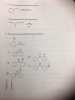 1. Draw the products for the following reaction. CH(CNH, (excess) J. Draw the product of the following reaction CH CH; 0 K. What is the product of the following aldol addition? HO OH I. IV. OH Π. V. ii) II iv) Ⅳ v) V
(10 pts) A chemist is investigating a reaction that has a ΔG。f-5.5 kJ/mol. a) At equilibrium...
 (10 pts) A chemist is investigating a reaction that has a ΔG。f-5.5 kJ/mol. a) At equilibrium what percentage of the reaction mixture will be products? Show your work. b) Will equilibrium be achieved quickly, slowly, or do you need more information to make that determination? Explain your reasoning
Give the products of the reaction and show the step by step arrow pushing mechanisms for...
 Give the products of the reaction and show the step by step
arrow pushing mechanisms for each reaction please.
HCI (cat.) NH pH = 4.5 3 2. H30* HCN NaOH (cat.) 5. PPhs 1. BuLi, THF 1. (Et) Culi 2. H3O 1. EtMgBr
Give the products of the reaction and show the step by step
arrow pushing mechanisms for each reaction please.
HCI (cat.) NH pH = 4.5 3 2. H30* HCN NaOH (cat.) 5. PPhs 1. BuLi, THF 1. (Et) Culi 2. H3O 1. EtMgBr
Draw the mechanism for the acid-catalyzed reaction of an amide with a methanol to form an...
 Draw the mechanism for the acid-catalyzed reaction of an amide
with a methanol to form an ester.
Draw the mechanism for the acid-catalyzed reaction of an amide with a methanol to form an ester Draw all missing reactants and/or products in the appropriate boxes by placing atoms on the canvas and connecting them with b be created. L2 NH NHH
Draw the mechanism for the acid-catalyzed reaction of an amide
with a methanol to form an ester.
Draw the mechanism for the acid-catalyzed reaction of an amide with a methanol to form an ester Draw all missing reactants and/or products in the appropriate boxes by placing atoms on the canvas and connecting them with b be created. L2 NH NHH
Draw the major organic product from reaction of 1-butyne with 1 equiv Br2 Specify stereochemistry when...
 Draw the major organic product from reaction of 1-butyne with 1 equiv Br2 Specify stereochemistry when it is relevant. In cases where there is more than one answer, just draw one. • Do not draw inorganic by-products. • If no reaction occurs, draw the organic starting material. OOO.
holte Podl meolly 2. (15) Give structures for all mono-bromo products from the following reaction: NBS...
 holte Podl meolly 2. (15) Give structures for all mono-bromo products from the following reaction: NBS CH3 light NBS = NaNH 2 6. (10-extra credit) Give a detailed mechanism for the reaction of 2-methylpropane with one equivalent of bromine in the presence of light.
2. In the reaction of potassium fluoride with potassium chromate and sulfuric acid, the products are...
 2. In the reaction of potassium fluoride with potassium chromate and sulfuric acid, the products are fluorine gas, potassium sulfate, chromium (III) sulfate and water. If 39.3 liters of fluorine gas was formed in this reaction and the gas was collected at-10.0°C and 725 Torr, how many grams of potassium fluoride reacted?
The DGº´for the reaction below is -15 kJ/mol at 37º C. What is the Gibbs free...
The DGº´for the reaction below is -15 kJ/mol at 37º C. What is the Gibbs free energy change for the reaction at 37° C if [A] = 1 x 10⁻⁴ M and each of the products are 1 mM? R is 8.31 J/ºK×mol A --> B + C answer is -27kj/mol
 Why 3-sulfolene is taken in excess to maleic anhydride? Select one: a. 3-sulfolene shifts equilibrium in the reaction towards products b. 3-sulfolene is not soluble in xylene c. formed 1,3-butadiene is volatile and rapidly leaves the reaction mixture d. 3-sulfolene is cyclic compound
 QUESTION 7 Me Br hoe i D Which compounds will undergo reaction with "NEt2 la nitrogen anion) to give major products formed from the E2 reaction mechanism? Select all that apply. Compound A Compound B Compound C Compound D Compound E
 1. Draw the products for the following reaction. CH(CNH, (excess) J. Draw the product of the following reaction CH CH; 0 K. What is the product of the following aldol addition? HO OH I. IV. OH Π. V. ii) II iv) Ⅳ v) V
 (10 pts) A chemist is investigating a reaction that has a ΔG。f-5.5 kJ/mol. a) At equilibrium what percentage of the reaction mixture will be products? Show your work. b) Will equilibrium be achieved quickly, slowly, or do you need more information to make that determination? Explain your reasoning
 Give the products of the reaction and show the step by step
arrow pushing mechanisms for each reaction please.
HCI (cat.) NH pH = 4.5 3 2. H30* HCN NaOH (cat.) 5. PPhs 1. BuLi, THF 1. (Et) Culi 2. H3O 1. EtMgBr
Give the products of the reaction and show the step by step
arrow pushing mechanisms for each reaction please.
HCI (cat.) NH pH = 4.5 3 2. H30* HCN NaOH (cat.) 5. PPhs 1. BuLi, THF 1. (Et) Culi 2. H3O 1. EtMgBr
 Draw the mechanism for the acid-catalyzed reaction of an amide
with a methanol to form an ester.
Draw the mechanism for the acid-catalyzed reaction of an amide with a methanol to form an ester Draw all missing reactants and/or products in the appropriate boxes by placing atoms on the canvas and connecting them with b be created. L2 NH NHH
Draw the mechanism for the acid-catalyzed reaction of an amide
with a methanol to form an ester.
Draw the mechanism for the acid-catalyzed reaction of an amide with a methanol to form an ester Draw all missing reactants and/or products in the appropriate boxes by placing atoms on the canvas and connecting them with b be created. L2 NH NHH
 Draw the major organic product from reaction of 1-butyne with 1 equiv Br2 Specify stereochemistry when it is relevant. In cases where there is more than one answer, just draw one. • Do not draw inorganic by-products. • If no reaction occurs, draw the organic starting material. OOO.
 holte Podl meolly 2. (15) Give structures for all mono-bromo products from the following reaction: NBS CH3 light NBS = NaNH 2 6. (10-extra credit) Give a detailed mechanism for the reaction of 2-methylpropane with one equivalent of bromine in the presence of light.
 2. In the reaction of potassium fluoride with potassium chromate and sulfuric acid, the products are fluorine gas, potassium sulfate, chromium (III) sulfate and water. If 39.3 liters of fluorine gas was formed in this reaction and the gas was collected at-10.0°C and 725 Torr, how many grams of potassium fluoride reacted?
Most questions answered within 3 hours.