Consider the following reaction: SO2Cl2(g)⇌SO2(g)+Cl2(g) A reaction mixture is made containing an initial [SO2Cl2] of 2.4×10⁻²...
Consider the following reaction: SO2Cl2(g)⇌SO2(g)+Cl2(g) A reaction mixture is made containing an initial [SO2Cl2] of 2.4×10⁻² M. At equilibrium, [Cl2]= 1.3×10⁻² M. Calculate the value of the equilibrium constant (Kc). Express your answer to two significant figures.
Consider the following reaction: SO2Cl2(g)⇌SO2(g)+Cl2(g) A reaction mixture is made containing an initial [SO2Cl2] of 2.4×10⁻²...
Consider the following reaction: SO2Cl2(g)⇌SO2(g)+Cl2(g) A reaction mixture is made containing an initial [SO2Cl2] of 2.4×10⁻² M . At equilibrium, [Cl2]= 1.0×10⁻² M . Calculate the value of the equilibrium constant (Kc). Express your answer to two significant figures.
Consider the following gas phase reaction: A + B ↔ C When two atmospheres of each...
Consider the following gas phase reaction: A + B ↔ C When two atmospheres of each product and reactant is placed in a vessel @ 315K, the total pressure at equilibrium is 5 atmospheres. Calculate the equilibrium partial pressures under the same initial conditions at 375K, assuming the enthalpy change for the reaction is -145kJ.
Introduction A common method for synthesizing alkenes is by dehydrating (removing the elements of water) an...
 Introduction
A common method for synthesizing alkenes is by dehydrating
(removing the elements of water) an alcohol. The dehydration is
accomplished by heating the alcohol with either phosphoric or
sulfuric acid. In this experiment, the dehydration reaction is
illustrated by the conversion of 2-methylcyclohexanol to a mixture
of alkenes (remember the Saytzeff rule).
Information
Each step of this E1 elimination...
Introduction
A common method for synthesizing alkenes is by dehydrating
(removing the elements of water) an alcohol. The dehydration is
accomplished by heating the alcohol with either phosphoric or
sulfuric acid. In this experiment, the dehydration reaction is
illustrated by the conversion of 2-methylcyclohexanol to a mixture
of alkenes (remember the Saytzeff rule).
Information
Each step of this E1 elimination...
Below is the SN1 reaction of (S)-2-iodopentane and bromide (Br–). Complete the mechanism by providing the...
 Below is the SN1 reaction of
(S)-2-iodopentane and bromide (Br–). Complete
the mechanism by providing the missing curved arrow notation, lone
pairs of electrons, and nonzero formal charges. Be sure to draw the
two organic products that will be produced in the third box.
16 Question (3 points) @ See page 407 Below is the Sn1 reaction of (9)-2-iodopentane and...
Below is the SN1 reaction of
(S)-2-iodopentane and bromide (Br–). Complete
the mechanism by providing the missing curved arrow notation, lone
pairs of electrons, and nonzero formal charges. Be sure to draw the
two organic products that will be produced in the third box.
16 Question (3 points) @ See page 407 Below is the Sn1 reaction of (9)-2-iodopentane and...
2.67 When nitroglycerin explodes, the chemical reaction that occurs can be assumed to be CzH5N309(1) =...
 2.67 When nitroglycerin explodes, the chemical reaction that occurs can be assumed to be CzH5N309(1) = 3CO2(g) + H2O(g) + {N2(g) + 102(g) (a) Calculate ArHº and AU° for this reaction at 298 K, given that the enthalpy of formation of liquid nitroglycerin is -372.4kJ mol-1.(b) Consider 0.20 mol of nitroglycerin at 25°C completely filling a constant-volume cell of 0.030...
14.An ________ chemical reaction releases energy, whereas an ________ reaction requires an input of energy. Group...
14.An ________ chemical reaction releases energy, whereas an ________ reaction requires an input of energy. Group of answer choices exergonic; endergonic endergonic; exergonic enzymatic; endergonic endergonic; enzymatic equilibrium; exergonic 15. Where does the O2 released during photosynthesis come from? Group of answer choices CO2 H2O ATP C6H12O6 RuBP 20. What happens during chemiosmosis? Group of answer choices glucose is broken...
You may want to reference (Pages 629 - 634) Section 14.3 while completing this problem Consider...
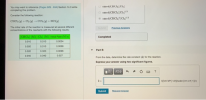 You may want to reference (Pages 629 - 634) Section 14.3 while completing this problem Consider the following reaction: CHC1, (g) + Cl2 (9) + CC14(9) + HC1(9) The initial rate of the reaction is measured at several different concentrations of the reactants with the following results: rate CHCICH ratek(CHCI||C1,112 ratok (CHCI,)*(Cl)/2 Subm Previous Answers Completed (CHC) (M) (C) (M)...
Please help me I got this wrong Kc 14, The following initial rate data were found...
 Please help me I got this wrong
Kc 14, The following initial rate data were found for the reaction Mno lo [H C 0Jo [o Initial Rate (M/s) 1 x 10³ 1x 10- 2x10⁻³ 1x10⁻³ 2 x 10 2 x10- 2 x 10³ 2 x 10 2 x 10⁴ 8 x 10⁴ 1.6 x 10⁻³ 1.6 x 10⁻³ 1.0 1.0...
Please help me I got this wrong
Kc 14, The following initial rate data were found for the reaction Mno lo [H C 0Jo [o Initial Rate (M/s) 1 x 10³ 1x 10- 2x10⁻³ 1x10⁻³ 2 x 10 2 x10- 2 x 10³ 2 x 10 2 x 10⁴ 8 x 10⁴ 1.6 x 10⁻³ 1.6 x 10⁻³ 1.0 1.0...
Useful Information: Please show your work and write in complete sentences. R= 8.314 J/mol K 1/[A].=...
 Useful Information: Please show your work and write in complete sentences. R= 8.314 J/mol K 1/[A].= kt +1/[A]. In k=-E/RT+ In A In [A] =-kt + In[A]. In kı/k2 = E/R (1/T2 - 1/11) 1. The following data were collected for the reaction: 2 C102(aq) + 2 OH (g) → C103 (aq) + ClO2 (aq) + H2O(1) Experiment [C102], M...
 Introduction
A common method for synthesizing alkenes is by dehydrating
(removing the elements of water) an alcohol. The dehydration is
accomplished by heating the alcohol with either phosphoric or
sulfuric acid. In this experiment, the dehydration reaction is
illustrated by the conversion of 2-methylcyclohexanol to a mixture
of alkenes (remember the Saytzeff rule).
Information
Each step of this E1 elimination...
Introduction
A common method for synthesizing alkenes is by dehydrating
(removing the elements of water) an alcohol. The dehydration is
accomplished by heating the alcohol with either phosphoric or
sulfuric acid. In this experiment, the dehydration reaction is
illustrated by the conversion of 2-methylcyclohexanol to a mixture
of alkenes (remember the Saytzeff rule).
Information
Each step of this E1 elimination...
 Below is the SN1 reaction of
(S)-2-iodopentane and bromide (Br–). Complete
the mechanism by providing the missing curved arrow notation, lone
pairs of electrons, and nonzero formal charges. Be sure to draw the
two organic products that will be produced in the third box.
16 Question (3 points) @ See page 407 Below is the Sn1 reaction of (9)-2-iodopentane and...
Below is the SN1 reaction of
(S)-2-iodopentane and bromide (Br–). Complete
the mechanism by providing the missing curved arrow notation, lone
pairs of electrons, and nonzero formal charges. Be sure to draw the
two organic products that will be produced in the third box.
16 Question (3 points) @ See page 407 Below is the Sn1 reaction of (9)-2-iodopentane and...
 2.67 When nitroglycerin explodes, the chemical reaction that occurs can be assumed to be CzH5N309(1) = 3CO2(g) + H2O(g) + {N2(g) + 102(g) (a) Calculate ArHº and AU° for this reaction at 298 K, given that the enthalpy of formation of liquid nitroglycerin is -372.4kJ mol-1.(b) Consider 0.20 mol of nitroglycerin at 25°C completely filling a constant-volume cell of 0.030...
 You may want to reference (Pages 629 - 634) Section 14.3 while completing this problem Consider the following reaction: CHC1, (g) + Cl2 (9) + CC14(9) + HC1(9) The initial rate of the reaction is measured at several different concentrations of the reactants with the following results: rate CHCICH ratek(CHCI||C1,112 ratok (CHCI,)*(Cl)/2 Subm Previous Answers Completed (CHC) (M) (C) (M)...
 Please help me I got this wrong
Kc 14, The following initial rate data were found for the reaction Mno lo [H C 0Jo [o Initial Rate (M/s) 1 x 10³ 1x 10- 2x10⁻³ 1x10⁻³ 2 x 10 2 x10- 2 x 10³ 2 x 10 2 x 10⁴ 8 x 10⁴ 1.6 x 10⁻³ 1.6 x 10⁻³ 1.0 1.0...
Please help me I got this wrong
Kc 14, The following initial rate data were found for the reaction Mno lo [H C 0Jo [o Initial Rate (M/s) 1 x 10³ 1x 10- 2x10⁻³ 1x10⁻³ 2 x 10 2 x10- 2 x 10³ 2 x 10 2 x 10⁴ 8 x 10⁴ 1.6 x 10⁻³ 1.6 x 10⁻³ 1.0 1.0...
 Useful Information: Please show your work and write in complete sentences. R= 8.314 J/mol K 1/[A].= kt +1/[A]. In k=-E/RT+ In A In [A] =-kt + In[A]. In kı/k2 = E/R (1/T2 - 1/11) 1. The following data were collected for the reaction: 2 C102(aq) + 2 OH (g) → C103 (aq) + ClO2 (aq) + H2O(1) Experiment [C102], M...
Most questions answered within 3 hours.