Attempt 4 - Bacteria and other microbes can be used to clean up an oil spill...
 Attempt 4 - Bacteria and other microbes can be used to clean up an oil spill by breaking down oil into carbon dioxide and water. Two samples isolated from the Deepwater Horizon leak in the Gulf of Mexico were labeled A and B. The DNA of each was isolated and the percent thymine measured in each sample Sample A contains...
Imagine these two products are dissolved in CH2Cl2. The solution is treated with 2-propanol/HCl until pH...
 Imagine these two products are dissolved in CH2Cl2. The solution
is treated with 2-propanol/HCl until pH is approximately 7,
resulting in the formation of crystals. The crystals are isolated
using vacuum filtration. The sequence of actions described above
results in the separation of the two products A and B. Why? How?
Write a concise discussion.
NH ОН
Imagine these two products are dissolved in CH2Cl2. The solution
is treated with 2-propanol/HCl until pH is approximately 7,
resulting in the formation of crystals. The crystals are isolated
using vacuum filtration. The sequence of actions described above
results in the separation of the two products A and B. Why? How?
Write a concise discussion.
NH ОН
please help 18. Which of the following determines the equilibrium position of a chemical reaction? 1....
 please help
18. Which of the following determines the equilibrium position of a chemical reaction? 1. Initial concentration of the reactants 2. Relative energies of the reactants and products 3. Relative degree of organization of the reactants and products A) 1, 2, and 3 B) 2 only C) 1 and 3 D) 1 only E) 3 only
please help
18. Which of the following determines the equilibrium position of a chemical reaction? 1. Initial concentration of the reactants 2. Relative energies of the reactants and products 3. Relative degree of organization of the reactants and products A) 1, 2, and 3 B) 2 only C) 1 and 3 D) 1 only E) 3 only
what is the correcr answer? 18. Which of the following determines the equilibrium position of a chemical reaction?...
 what is the correcr answer?
18. Which of the following determines the equilibrium position of a chemical reaction? 1. Initial concentration of the reactants 2. Relative energies of the reactants and products 3. Relative degree of organization of the reactants and products A) 1, 2, and 3 B) 2 only C) 1 and 3 D) 1 only E) 3 only
what is the correcr answer?
18. Which of the following determines the equilibrium position of a chemical reaction? 1. Initial concentration of the reactants 2. Relative energies of the reactants and products 3. Relative degree of organization of the reactants and products A) 1, 2, and 3 B) 2 only C) 1 and 3 D) 1 only E) 3 only
. fect Journal Describe the relationship between substrate concentration and the initial reaction rate of an...
 .
fect Journal Describe the relationship between substrate concentration and the initial reaction rate of an enzyme-catalyzed reaction. Is this a linear relationship? What happens to the initial reaction rate as substrate concentration increases? Question 1 of 6 ect Journal Explain why the maximum initial reaction rate cannot be reached at low lactose concentrations Question 3 of 6 HET ournal...
.
fect Journal Describe the relationship between substrate concentration and the initial reaction rate of an enzyme-catalyzed reaction. Is this a linear relationship? What happens to the initial reaction rate as substrate concentration increases? Question 1 of 6 ect Journal Explain why the maximum initial reaction rate cannot be reached at low lactose concentrations Question 3 of 6 HET ournal...
A(g) -> B(g)+C(g) Find the equilibrium concentrations of A, B, and C for each of the...
 A(g) -> B(g)+C(g) Find the equilibrium concentrations of A,
B, and C for each of the following different values of Kc. Assume
that the initial concentration of A in each case is 1.0 M and that
the reaction mixture initially contains no products.
UNITS_18_19_HW Exercise 15.61 A Review Constants 1 Peric Submit Request Answer Consider the following reaction: A(9) B(9)...
A(g) -> B(g)+C(g) Find the equilibrium concentrations of A,
B, and C for each of the following different values of Kc. Assume
that the initial concentration of A in each case is 1.0 M and that
the reaction mixture initially contains no products.
UNITS_18_19_HW Exercise 15.61 A Review Constants 1 Peric Submit Request Answer Consider the following reaction: A(9) B(9)...
An enzyme that degrades pheromone is isolated from the sensory hairs of the silk moth, Antheraea...
 An enzyme that degrades pheromone is isolated from the sensory hairs of the silk moth, Antheraea polyphemus. The kinetics of the reaction are studied at pH 7.2 using a fixed enzyme concentration and temperatures of 10 C to 40 C. The following table lists results for reaction velocity as a function of substrate concentration. (a) Determine vmax and km at...
An enzyme that degrades pheromone is isolated from the sensory hairs of the silk moth, Antheraea...
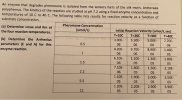 An enzyme that degrades pheromone is isolated from the sensory hairs of the silk moth, Antheraea polyphemus. The kinetics of the reaction are studied at pH 7.2 using a fixed enzyme concentration and temperatures of 10 C to 40 C. The following table lists results for reaction velocity as a function of substrate concentration. (a) Determine vmax and km at...
Item 29 29 of 32 Review | Constants Periodic Table Calculate the change in Gibbs free energy for each of the...
 Item 29 29 of 32 Review | Constants Periodic Table Calculate the change in Gibbs free energy for each of the sets of AH AS and T given in the following problems. Submit Request Answer Predict whether or not the reaction in part will be spontaneous at the temperature indicated. (Assume that all reactants and products are in their standard...
12. Potassium reacts aggressively with water, as shown in this equation: 2 K + 2 H20→2...
 12. Potassium reacts aggressively with water, as shown in this equation: 2 K + 2 H20→2 KOH + H2 If 0.2 grams of potassium are added to 15.0 grams of water, what mass of KOH can form in this reaction? 7.4 Theoretical and Percent Yield 13. A chemist carries out the following reaction: C.He + Brı → C.H.Br + HBr...
 Attempt 4 - Bacteria and other microbes can be used to clean up an oil spill by breaking down oil into carbon dioxide and water. Two samples isolated from the Deepwater Horizon leak in the Gulf of Mexico were labeled A and B. The DNA of each was isolated and the percent thymine measured in each sample Sample A contains...
 Imagine these two products are dissolved in CH2Cl2. The solution
is treated with 2-propanol/HCl until pH is approximately 7,
resulting in the formation of crystals. The crystals are isolated
using vacuum filtration. The sequence of actions described above
results in the separation of the two products A and B. Why? How?
Write a concise discussion.
NH ОН
Imagine these two products are dissolved in CH2Cl2. The solution
is treated with 2-propanol/HCl until pH is approximately 7,
resulting in the formation of crystals. The crystals are isolated
using vacuum filtration. The sequence of actions described above
results in the separation of the two products A and B. Why? How?
Write a concise discussion.
NH ОН
 please help
18. Which of the following determines the equilibrium position of a chemical reaction? 1. Initial concentration of the reactants 2. Relative energies of the reactants and products 3. Relative degree of organization of the reactants and products A) 1, 2, and 3 B) 2 only C) 1 and 3 D) 1 only E) 3 only
please help
18. Which of the following determines the equilibrium position of a chemical reaction? 1. Initial concentration of the reactants 2. Relative energies of the reactants and products 3. Relative degree of organization of the reactants and products A) 1, 2, and 3 B) 2 only C) 1 and 3 D) 1 only E) 3 only
 what is the correcr answer?
18. Which of the following determines the equilibrium position of a chemical reaction? 1. Initial concentration of the reactants 2. Relative energies of the reactants and products 3. Relative degree of organization of the reactants and products A) 1, 2, and 3 B) 2 only C) 1 and 3 D) 1 only E) 3 only
what is the correcr answer?
18. Which of the following determines the equilibrium position of a chemical reaction? 1. Initial concentration of the reactants 2. Relative energies of the reactants and products 3. Relative degree of organization of the reactants and products A) 1, 2, and 3 B) 2 only C) 1 and 3 D) 1 only E) 3 only
 .
fect Journal Describe the relationship between substrate concentration and the initial reaction rate of an enzyme-catalyzed reaction. Is this a linear relationship? What happens to the initial reaction rate as substrate concentration increases? Question 1 of 6 ect Journal Explain why the maximum initial reaction rate cannot be reached at low lactose concentrations Question 3 of 6 HET ournal...
.
fect Journal Describe the relationship between substrate concentration and the initial reaction rate of an enzyme-catalyzed reaction. Is this a linear relationship? What happens to the initial reaction rate as substrate concentration increases? Question 1 of 6 ect Journal Explain why the maximum initial reaction rate cannot be reached at low lactose concentrations Question 3 of 6 HET ournal...
 A(g) -> B(g)+C(g) Find the equilibrium concentrations of A,
B, and C for each of the following different values of Kc. Assume
that the initial concentration of A in each case is 1.0 M and that
the reaction mixture initially contains no products.
UNITS_18_19_HW Exercise 15.61 A Review Constants 1 Peric Submit Request Answer Consider the following reaction: A(9) B(9)...
A(g) -> B(g)+C(g) Find the equilibrium concentrations of A,
B, and C for each of the following different values of Kc. Assume
that the initial concentration of A in each case is 1.0 M and that
the reaction mixture initially contains no products.
UNITS_18_19_HW Exercise 15.61 A Review Constants 1 Peric Submit Request Answer Consider the following reaction: A(9) B(9)...
 An enzyme that degrades pheromone is isolated from the sensory hairs of the silk moth, Antheraea polyphemus. The kinetics of the reaction are studied at pH 7.2 using a fixed enzyme concentration and temperatures of 10 C to 40 C. The following table lists results for reaction velocity as a function of substrate concentration. (a) Determine vmax and km at...
 An enzyme that degrades pheromone is isolated from the sensory hairs of the silk moth, Antheraea polyphemus. The kinetics of the reaction are studied at pH 7.2 using a fixed enzyme concentration and temperatures of 10 C to 40 C. The following table lists results for reaction velocity as a function of substrate concentration. (a) Determine vmax and km at...
 Item 29 29 of 32 Review | Constants Periodic Table Calculate the change in Gibbs free energy for each of the sets of AH AS and T given in the following problems. Submit Request Answer Predict whether or not the reaction in part will be spontaneous at the temperature indicated. (Assume that all reactants and products are in their standard...
 12. Potassium reacts aggressively with water, as shown in this equation: 2 K + 2 H20→2 KOH + H2 If 0.2 grams of potassium are added to 15.0 grams of water, what mass of KOH can form in this reaction? 7.4 Theoretical and Percent Yield 13. A chemist carries out the following reaction: C.He + Brı → C.H.Br + HBr...
Most questions answered within 3 hours.