Draw a structural formula for the substitution product of the reaction shown below. Draw a structural...
 Draw a structural formula for the substitution product of the
reaction shown below.
Draw a structural formula for the substitution product of the reaction show below. Use the wedge/hash bond tools to indicate stereochemistry. If more than one stereoisomer of product is formed, draw both. Separate multiple products using the + sign from the dropdown menu.
Draw a structural formula for the substitution product of the
reaction shown below.
Draw a structural formula for the substitution product of the reaction show below. Use the wedge/hash bond tools to indicate stereochemistry. If more than one stereoisomer of product is formed, draw both. Separate multiple products using the + sign from the dropdown menu.
4. (6 points) a. Draw the product(s) of an aldol cleavage carried out on glucose-6-phosphate. (This...
 4. (6 points) a. Draw the product(s) of an aldol cleavage carried out on glucose-6-phosphate. (This reaction is not part of glycolysis, but please give the products of what this reaction would be if it took place.) b. Explain why the aldol cleavage in glycolysis takes place on fructose-1,6-bisphophate instead of glucose-6-phosphate.
please be very detailed 7. For each of these substances, if it reacts with water, write...
 please be very detailed
7. For each of these substances, if it reacts with water, write the reaction and classify the reactants and products using the terms acid", "base", "conjugate acid", and "conjugate base". If the substance does not react with water write "no reaction". a. K.S04 b. (CH3)2N 8. Determine the pH and the concentration of hydronium in a...
please be very detailed
7. For each of these substances, if it reacts with water, write the reaction and classify the reactants and products using the terms acid", "base", "conjugate acid", and "conjugate base". If the substance does not react with water write "no reaction". a. K.S04 b. (CH3)2N 8. Determine the pH and the concentration of hydronium in a...
1)A limiting reactant is completely consumed in the course of a reaction and may be used...
1)A limiting reactant is completely consumed in the course of a reaction and may be used to determine how much product may be produced. True or False? 2)The reactant that is in excess in a chemical reaction is called the limiting reactant. True or False? 3)Complete combustion of gasoline will yield carbon dioxide and water as the major products. True...
V Use the potential energy diagram on the left to answer the question on the table...
 V Use the potential energy diagram on the left to answer the question on the table below. AL Polonial Brgy (W) BT . | || || I Reaction Coordinato Questions What is the potential energy of the activated complex? What is the heat of the reaction (AH)? What is the potential energy of the reactants? What is the potential energy...
Consider the following endothermic reaction at equilibrium A(aq) + B(s) ⇌ C(aq) From the options listed,...
Consider the following endothermic reaction at equilibrium A(aq) + B(s) ⇌ C(aq) From the options listed, state which will cause the reaction to produce more products? (a) Increasing the temperature (b) Increasing the quantity of "A" (c) Increasing the quantity of "B" (d) Increasing the quantity of "C" (e) Adding a catalyst (f) Decreasing the temperature
(a) Calculate AG for the reaction: Ols, graphite) + H2O(g) → CO (6) + H2 (6)...
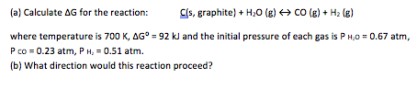 (a) Calculate AG for the reaction: Ols, graphite) + H2O(g) → CO (6) + H2 (6) where temperature is 700 K, AGⓇ = 92 kJ and the initial pressure of each gas is PHO.0.67 atm, Pco - 0.23 atm, PH, = 0.51 atm. (b) What direction would this reaction proceed?
A certain reaction is second order in N2 and first order in H2. Use this information...
 A certain reaction is second order in N2 and first order in H2. Use this information to complete the table below. Round each of your answers to 3 significant digits. 112 | 0.275 M1.61 M 0.653 M1.61 M 0.105 M4.23 M | initial rate of reaction 0.322 Mls MIS Mis
Consider the following reaction: 2CH() CH2(g) + 3H2(g) The reaction of CH is carried out at...
 Consider the following reaction: 2CH() CH2(g) + 3H2(g) The reaction of CH is carried out at some temperature with an initial concentration of CH4) = 0.091 M. At equilibrium, the concentration of H, is 0.010 M. Find the equilibrium constant at this temperature. Express your answer using two significant figures. ΜΕ ΑΣφ ?
Consider the reaction: SO2Cl2(g) SO2(g) + Cl2(g) Kc = 2.99 x 10⁻⁷ (at 227oC) A reaction...
Consider the reaction: SO2Cl2(g) SO2(g) + Cl2(g) Kc = 2.99 x 10⁻⁷ (at 227oC) A reaction mixture initially contains 0.175 M SO2Cl2 and no SO2 and Cl2. What is the equilibrium concentration of Cl2 at this temperature (227oC)? Use the assumption that x is small compared to the initial concentration of reactant.
 Draw a structural formula for the substitution product of the
reaction shown below.
Draw a structural formula for the substitution product of the reaction show below. Use the wedge/hash bond tools to indicate stereochemistry. If more than one stereoisomer of product is formed, draw both. Separate multiple products using the + sign from the dropdown menu.
Draw a structural formula for the substitution product of the
reaction shown below.
Draw a structural formula for the substitution product of the reaction show below. Use the wedge/hash bond tools to indicate stereochemistry. If more than one stereoisomer of product is formed, draw both. Separate multiple products using the + sign from the dropdown menu.
 4. (6 points) a. Draw the product(s) of an aldol cleavage carried out on glucose-6-phosphate. (This reaction is not part of glycolysis, but please give the products of what this reaction would be if it took place.) b. Explain why the aldol cleavage in glycolysis takes place on fructose-1,6-bisphophate instead of glucose-6-phosphate.
 please be very detailed
7. For each of these substances, if it reacts with water, write the reaction and classify the reactants and products using the terms acid", "base", "conjugate acid", and "conjugate base". If the substance does not react with water write "no reaction". a. K.S04 b. (CH3)2N 8. Determine the pH and the concentration of hydronium in a...
please be very detailed
7. For each of these substances, if it reacts with water, write the reaction and classify the reactants and products using the terms acid", "base", "conjugate acid", and "conjugate base". If the substance does not react with water write "no reaction". a. K.S04 b. (CH3)2N 8. Determine the pH and the concentration of hydronium in a...
 V Use the potential energy diagram on the left to answer the question on the table below. AL Polonial Brgy (W) BT . | || || I Reaction Coordinato Questions What is the potential energy of the activated complex? What is the heat of the reaction (AH)? What is the potential energy of the reactants? What is the potential energy...
 (a) Calculate AG for the reaction: Ols, graphite) + H2O(g) → CO (6) + H2 (6) where temperature is 700 K, AGⓇ = 92 kJ and the initial pressure of each gas is PHO.0.67 atm, Pco - 0.23 atm, PH, = 0.51 atm. (b) What direction would this reaction proceed?
 A certain reaction is second order in N2 and first order in H2. Use this information to complete the table below. Round each of your answers to 3 significant digits. 112 | 0.275 M1.61 M 0.653 M1.61 M 0.105 M4.23 M | initial rate of reaction 0.322 Mls MIS Mis
 Consider the following reaction: 2CH() CH2(g) + 3H2(g) The reaction of CH is carried out at some temperature with an initial concentration of CH4) = 0.091 M. At equilibrium, the concentration of H, is 0.010 M. Find the equilibrium constant at this temperature. Express your answer using two significant figures. ΜΕ ΑΣφ ?
Most questions answered within 3 hours.