These two products are the same so would their orientation have an affect on the answer?...
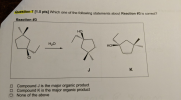 These two products are the same so would their
orientation have an affect on the answer?
Question 7 (1.5 pts] Which one of the following statements about Reaction #3 is correct? Reaction #3 HO H2O HO 0 O Compound J is the major organic product Compound K is the major organic product None of the above
These two products are the same so would their
orientation have an affect on the answer?
Question 7 (1.5 pts] Which one of the following statements about Reaction #3 is correct? Reaction #3 HO H2O HO 0 O Compound J is the major organic product Compound K is the major organic product None of the above
8. 11 pt 4-chlorobenzaldehyde and 4-bromoacetophenone are both solid starting materials for the synthesis of substituted...
 8. 11 pt 4-chlorobenzaldehyde and 4-bromoacetophenone are both solid starting materials for the synthesis of substituted chalcone. When both of these compounds are ground with solid sodium hydroxide, the entire reaction mixture turns liquid. Explain why the solid reactants turn liquid when intimately mixing them. (Hint: What are the final products of the reaction?)
pre-Laboratory Questions-EXP 6 Name: Qualitative Analysis of Ketones and Aldehydes Due before lab begins. Answer in...
 pre-Laboratory Questions-EXP 6 Name: Qualitative Analysis of Ketones and Aldehydes Due before lab begins. Answer in space provided. 1. Give the structure of the organic product of the reaction of phenylacetaldehyde with the following.(give the names of the products). (a) Tollens' reagent (b) Jones' reagent 2. Write a complete mechanism of reaction of 2,4-dinitrophenylhydrazine with acetaldehyde.
8. 1 pt] 4-chlorobenzaldehyde and 4-bromoacetophenone are both solid starting materials for the synthesis of substituted...
 8. 1 pt] 4-chlorobenzaldehyde and 4-bromoacetophenone are both solid starting materials for the synthesis of substituted chalcone. When both of these compounds are ground with solid sodium hydroxide, the entire reaction mixture turns liquid. Explain why the solid reactants turn liquid when intimately mixing them. (Hint: What are the final products of the reaction?)
(R)–3-chloro-2-methylhexane may undergo a nucleophilic substitution reaction in the presence of sodium ethoxide and ethanol. Complete...
 (R)–3-chloro-2-methylhexane may undergo a nucleophilic
substitution reaction in the presence of sodium ethoxide and
ethanol. Complete the mechanism and draw the products of the
reaction.
<Chapter 7 SN2 and E2 Reactions of Alkyl Halides DOCH: FU MacBook Air
(R)–3-chloro-2-methylhexane may undergo a nucleophilic
substitution reaction in the presence of sodium ethoxide and
ethanol. Complete the mechanism and draw the products of the
reaction.
<Chapter 7 SN2 and E2 Reactions of Alkyl Halides DOCH: FU MacBook Air
HELP PLEASEEE!!! 29. . What is the principal product for this reaction? H20 CHOOH CH BO...
 HELP PLEASEEE!!!
29. . What is the principal product for this reaction? H20 CHOOH CH BO CHE Br OH 30. What is the product of this reaction? Os04 2. NaHSO, H20 3 (C) OH 31 . What is the structure of the compound that, upon azonolysis, forms the products shown? 1. Os 2. (CH3)2 ova
HELP PLEASEEE!!!
29. . What is the principal product for this reaction? H20 CHOOH CH BO CHE Br OH 30. What is the product of this reaction? Os04 2. NaHSO, H20 3 (C) OH 31 . What is the structure of the compound that, upon azonolysis, forms the products shown? 1. Os 2. (CH3)2 ova
12. For the chemical reaction, Al20s(s) + 3 H2 (. p-1 atm) 2 Al(s)3 H200) at...
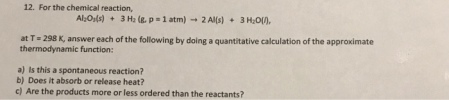 12. For the chemical reaction, Al20s(s) + 3 H2 (. p-1 atm) 2 Al(s)3 H200) at T# 298 K, answer each of the following by doing a quantitative calculation of the approximate thermodynamic function: a) Is this a spontaneous reaction? b) Does it absorb or release heat? c) Are the products more or less ordered than the reactants?
Draw the major organic product for each reaction sequence. Noinorganic by-product.Draw the major organic...
 Draw the major organic product for each reaction sequence. No
inorganic by-product.Draw the major organic product for each reaction sequence. Do not add inorganic by-products: only show the transformation for the starting organic compound. 1. PBr3, pyridene 2. Mg, THF 3. dilute H3O^+ 1. Na^0 2. dilute H3O^+
Draw the major organic product for each reaction sequence. No
inorganic by-product.Draw the major organic product for each reaction sequence. Do not add inorganic by-products: only show the transformation for the starting organic compound. 1. PBr3, pyridene 2. Mg, THF 3. dilute H3O^+ 1. Na^0 2. dilute H3O^+
h. Draw the El mechanism for the reaction of 2,5-dimethyl-2,5-hexanediol and hydrochloric acid (excess). Show lone...
 h. Draw the El mechanism for the reaction of 2,5-dimethyl-2,5-hexanediol and hydrochloric acid (excess). Show lone pairs, electron pushing arrows, 3-D view to reflect appropriate stereochemistry, reactants, transition states, and products. Name the product. Draw and completely label a reaction energy diagram corresponding to the mechanism you have drawn.
The following aldol reaction can produce 4 products. Select the structure that is not a possible...
 The following aldol reaction can produce 4 products. Select the structure that is not a possible product of the following reaction. (5 points) NaOH Д. І. Н Н но ОН ОН ОН ОН Улт хи HO A B с E Enter Your Answer: од ов о D ОЕ ок
 These two products are the same so would their
orientation have an affect on the answer?
Question 7 (1.5 pts] Which one of the following statements about Reaction #3 is correct? Reaction #3 HO H2O HO 0 O Compound J is the major organic product Compound K is the major organic product None of the above
These two products are the same so would their
orientation have an affect on the answer?
Question 7 (1.5 pts] Which one of the following statements about Reaction #3 is correct? Reaction #3 HO H2O HO 0 O Compound J is the major organic product Compound K is the major organic product None of the above
 8. 11 pt 4-chlorobenzaldehyde and 4-bromoacetophenone are both solid starting materials for the synthesis of substituted chalcone. When both of these compounds are ground with solid sodium hydroxide, the entire reaction mixture turns liquid. Explain why the solid reactants turn liquid when intimately mixing them. (Hint: What are the final products of the reaction?)
 pre-Laboratory Questions-EXP 6 Name: Qualitative Analysis of Ketones and Aldehydes Due before lab begins. Answer in space provided. 1. Give the structure of the organic product of the reaction of phenylacetaldehyde with the following.(give the names of the products). (a) Tollens' reagent (b) Jones' reagent 2. Write a complete mechanism of reaction of 2,4-dinitrophenylhydrazine with acetaldehyde.
 8. 1 pt] 4-chlorobenzaldehyde and 4-bromoacetophenone are both solid starting materials for the synthesis of substituted chalcone. When both of these compounds are ground with solid sodium hydroxide, the entire reaction mixture turns liquid. Explain why the solid reactants turn liquid when intimately mixing them. (Hint: What are the final products of the reaction?)
 (R)–3-chloro-2-methylhexane may undergo a nucleophilic
substitution reaction in the presence of sodium ethoxide and
ethanol. Complete the mechanism and draw the products of the
reaction.
<Chapter 7 SN2 and E2 Reactions of Alkyl Halides DOCH: FU MacBook Air
(R)–3-chloro-2-methylhexane may undergo a nucleophilic
substitution reaction in the presence of sodium ethoxide and
ethanol. Complete the mechanism and draw the products of the
reaction.
<Chapter 7 SN2 and E2 Reactions of Alkyl Halides DOCH: FU MacBook Air
 HELP PLEASEEE!!!
29. . What is the principal product for this reaction? H20 CHOOH CH BO CHE Br OH 30. What is the product of this reaction? Os04 2. NaHSO, H20 3 (C) OH 31 . What is the structure of the compound that, upon azonolysis, forms the products shown? 1. Os 2. (CH3)2 ova
HELP PLEASEEE!!!
29. . What is the principal product for this reaction? H20 CHOOH CH BO CHE Br OH 30. What is the product of this reaction? Os04 2. NaHSO, H20 3 (C) OH 31 . What is the structure of the compound that, upon azonolysis, forms the products shown? 1. Os 2. (CH3)2 ova
 12. For the chemical reaction, Al20s(s) + 3 H2 (. p-1 atm) 2 Al(s)3 H200) at T# 298 K, answer each of the following by doing a quantitative calculation of the approximate thermodynamic function: a) Is this a spontaneous reaction? b) Does it absorb or release heat? c) Are the products more or less ordered than the reactants?
 Draw the major organic product for each reaction sequence. No
inorganic by-product.Draw the major organic product for each reaction sequence. Do not add inorganic by-products: only show the transformation for the starting organic compound. 1. PBr3, pyridene 2. Mg, THF 3. dilute H3O^+ 1. Na^0 2. dilute H3O^+
Draw the major organic product for each reaction sequence. No
inorganic by-product.Draw the major organic product for each reaction sequence. Do not add inorganic by-products: only show the transformation for the starting organic compound. 1. PBr3, pyridene 2. Mg, THF 3. dilute H3O^+ 1. Na^0 2. dilute H3O^+
 h. Draw the El mechanism for the reaction of 2,5-dimethyl-2,5-hexanediol and hydrochloric acid (excess). Show lone pairs, electron pushing arrows, 3-D view to reflect appropriate stereochemistry, reactants, transition states, and products. Name the product. Draw and completely label a reaction energy diagram corresponding to the mechanism you have drawn.
 The following aldol reaction can produce 4 products. Select the structure that is not a possible product of the following reaction. (5 points) NaOH Д. І. Н Н но ОН ОН ОН ОН Улт хи HO A B с E Enter Your Answer: од ов о D ОЕ ок
Most questions answered within 3 hours.