st submission is used for your score. PRACTICE ANOTHER ASK YOUR TEACHER MY NOTES -10.76 Points]...
 st submission is used for your score. PRACTICE ANOTHER ASK YOUR TEACHER MY NOTES -10.76 Points] DETAILS SERCP11 13.1.OP.001. An object, whose mass is 0.580 kg, is attached to a spring with a force constant of 142 N/m. The object rests upon a frictionless, horizontal surface (shown in the figure below). The object is pulled to the right a distance...
Unit 2: Prelecture/Homework/Bridge Question Homework: Homework 1: Charge, Electric Materials, Coulomb's Law, & Electric Dipoles Deadline:...
 Unit 2: Prelecture/Homework/Bridge Question Homework: Homework 1: Charge, Electric Materials, Coulomb's Law, & Electric Dipoles Deadline: 100% until Thursday, January 24 at 8:00 AM Problem 10 Two point charges are separated by a distance of 30.0 cm. The numerical value of one charge is twice that of the other. Each charge exerts a force of magnitude 65.0 N on the...
2. (10 points) The English physicists J.J. Thompson proposed a model in which the atoms consisted...
 2. (10 points) The English physicists J.J. Thompson proposed a model in which the atoms consisted of a sphere of positively charged material into which were embedded negatively charged electrons. Consider such an atom consisting of one electron of mass m, having a charge -e which is considered as a point charge, embedded in a sphere having total charge e...
Help please! 3. Calculate the Electric Potential at the center of the 4 charges placed on...
 Help please!
3. Calculate the Electric Potential at the center of the 4 charges placed on the corners of a square with side lengths of 6.22 nm. The charge at point 1 is 3 electrons The charge at point 2 is 3 electrons. The charge at point 3 is 3 protons. The charge at point 4 is 3 protons. 30...
Help please!
3. Calculate the Electric Potential at the center of the 4 charges placed on the corners of a square with side lengths of 6.22 nm. The charge at point 1 is 3 electrons The charge at point 2 is 3 electrons. The charge at point 3 is 3 protons. The charge at point 4 is 3 protons. 30...
An electric field of strength E = 4700 N/C is directed along the +x-axis as shown....
 An electric field of strength E = 4700 N/C is directed along the
+x-axis as shown.
An electric field of strength E = 4700 N/C is directed along the +x-axis as shown. What is the magnitude of the potential difference between point B and point A if the distance between these two points is 10 cm? An electron is initially...
An electric field of strength E = 4700 N/C is directed along the
+x-axis as shown.
An electric field of strength E = 4700 N/C is directed along the +x-axis as shown. What is the magnitude of the potential difference between point B and point A if the distance between these two points is 10 cm? An electron is initially...
twelve electric field lines point out of a point charge, but only 8 of them point...
twelve electric field lines point out of a point charge, but only 8 of them point into the charge nearby. what does that tell us about the charge of each point charge? what else do we need to know to determine the charge of the second charge?
If you had one coulomb of negative charge sitting on your porch, what would be the...
If you had one coulomb of negative charge sitting on your porch, what would be the electric field strength at a distance of the International space Station (ISS) which orbits at an average height of 370km.
Question 1. A charge is placed at origin. Calculate the electric flux going through a square...
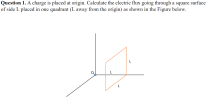 Question 1. A charge is placed at origin. Calculate the electric flux going through a square surface of side L placed in one quadrant (L away from the origin) as shown in the Figure below.
need help. please answer #3 and 4 3. The electric field in an EM wave is...
 need help. please answer #3 and 4
3. The electric field in an EM wave is given by (In Sl units): E = (15) sin(1.1x10'x-01) [N/C] where is the unit vector in the y-axis. calculate its wavelength. 4. The pilot of an aircraft flying over a lake notices an illuminated circular path of diameter 20.0 m at the surface of...
need help. please answer #3 and 4
3. The electric field in an EM wave is given by (In Sl units): E = (15) sin(1.1x10'x-01) [N/C] where is the unit vector in the y-axis. calculate its wavelength. 4. The pilot of an aircraft flying over a lake notices an illuminated circular path of diameter 20.0 m at the surface of...
Not sure if there isn't enough information since the left loop is increasing while the right...
 Not sure if there isn't enough information since the left loop
is increasing while the right loop is decreasing flux. Or is it
clockwise? I would love an explanation.
Question 2 1 pts For our review of the second unit of the course, we'll be focusing on (1) Loop and Junction rules in circuits, (2) the magnitude and direction of...
Not sure if there isn't enough information since the left loop
is increasing while the right loop is decreasing flux. Or is it
clockwise? I would love an explanation.
Question 2 1 pts For our review of the second unit of the course, we'll be focusing on (1) Loop and Junction rules in circuits, (2) the magnitude and direction of...
 st submission is used for your score. PRACTICE ANOTHER ASK YOUR TEACHER MY NOTES -10.76 Points] DETAILS SERCP11 13.1.OP.001. An object, whose mass is 0.580 kg, is attached to a spring with a force constant of 142 N/m. The object rests upon a frictionless, horizontal surface (shown in the figure below). The object is pulled to the right a distance...
 Unit 2: Prelecture/Homework/Bridge Question Homework: Homework 1: Charge, Electric Materials, Coulomb's Law, & Electric Dipoles Deadline: 100% until Thursday, January 24 at 8:00 AM Problem 10 Two point charges are separated by a distance of 30.0 cm. The numerical value of one charge is twice that of the other. Each charge exerts a force of magnitude 65.0 N on the...
 2. (10 points) The English physicists J.J. Thompson proposed a model in which the atoms consisted of a sphere of positively charged material into which were embedded negatively charged electrons. Consider such an atom consisting of one electron of mass m, having a charge -e which is considered as a point charge, embedded in a sphere having total charge e...
 Help please!
3. Calculate the Electric Potential at the center of the 4 charges placed on the corners of a square with side lengths of 6.22 nm. The charge at point 1 is 3 electrons The charge at point 2 is 3 electrons. The charge at point 3 is 3 protons. The charge at point 4 is 3 protons. 30...
Help please!
3. Calculate the Electric Potential at the center of the 4 charges placed on the corners of a square with side lengths of 6.22 nm. The charge at point 1 is 3 electrons The charge at point 2 is 3 electrons. The charge at point 3 is 3 protons. The charge at point 4 is 3 protons. 30...
 An electric field of strength E = 4700 N/C is directed along the
+x-axis as shown.
An electric field of strength E = 4700 N/C is directed along the +x-axis as shown. What is the magnitude of the potential difference between point B and point A if the distance between these two points is 10 cm? An electron is initially...
An electric field of strength E = 4700 N/C is directed along the
+x-axis as shown.
An electric field of strength E = 4700 N/C is directed along the +x-axis as shown. What is the magnitude of the potential difference between point B and point A if the distance between these two points is 10 cm? An electron is initially...
 Question 1. A charge is placed at origin. Calculate the electric flux going through a square surface of side L placed in one quadrant (L away from the origin) as shown in the Figure below.
 need help. please answer #3 and 4
3. The electric field in an EM wave is given by (In Sl units): E = (15) sin(1.1x10'x-01) [N/C] where is the unit vector in the y-axis. calculate its wavelength. 4. The pilot of an aircraft flying over a lake notices an illuminated circular path of diameter 20.0 m at the surface of...
need help. please answer #3 and 4
3. The electric field in an EM wave is given by (In Sl units): E = (15) sin(1.1x10'x-01) [N/C] where is the unit vector in the y-axis. calculate its wavelength. 4. The pilot of an aircraft flying over a lake notices an illuminated circular path of diameter 20.0 m at the surface of...
 Not sure if there isn't enough information since the left loop
is increasing while the right loop is decreasing flux. Or is it
clockwise? I would love an explanation.
Question 2 1 pts For our review of the second unit of the course, we'll be focusing on (1) Loop and Junction rules in circuits, (2) the magnitude and direction of...
Not sure if there isn't enough information since the left loop
is increasing while the right loop is decreasing flux. Or is it
clockwise? I would love an explanation.
Question 2 1 pts For our review of the second unit of the course, we'll be focusing on (1) Loop and Junction rules in circuits, (2) the magnitude and direction of...
Most questions answered within 3 hours.