(a) Three point charges, A = 2.25 μC, B = 7.2 μC, and C=-4.6S μC
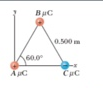 (a) Three point charges, A = 2.25 μC, B = 7.2 μC, and C=-4.6S μC, are located at the corners of an equilateral triangle as in the figure above. Find the magnitude and direction of the electric field at the position of the 2.25 μC charge (b) How would the electric field at that point be affected if the charge there were...
The two charges in the figure below are separated by d = 2.50 cm. (Let q1...
The two charges in the figure below are separated by d = 2.50 cm. (Let q1 = -14.5 nC and q2 = 29.5 nC.) (a) Find the electric potential at point A. kV (b) Find the electric potential at point B, which is halfway between the charges. kV Need Help? Read It Chat About It
Charges qi and q4 are fixed in place as shown below. a) Find the magnitude and...
 Charges qi and q4 are fixed in place as shown below. a) Find the magnitude and direction of the electric fild at point A b) Find the magnitude and direction of the acceleration experienced by an object at point A with a mass of 25.0 grams and a charge of -7.50 HC. Assume the electric force is the only relevant...
A particle of charge 3.85\times 10^{-8}~\text{C}3.85×10⁻⁸ C experiences a force of magnitude 7.65\times 10^{-6}~\text{N}7.65×10⁻⁶ N when...
A particle of charge 3.85\times 10^{-8}~\text{C}3.85×10⁻⁸ C experiences a force of magnitude 7.65\times 10^{-6}~\text{N}7.65×10⁻⁶ N when it is placed in a particular point in an electric field. What is the magnitude of the electric field at that point?
are (-0.850, -0.450) m, and those of point ® are A uniform electric field of magnitude...
 are (-0.850, -0.450) m, and those of point ® are A uniform electric field of magnitude 330 V/m is directed in the negative y direction as shown in the figure below. The coordinates of point (0.650, 0.800) m. Calculate the electric potential difference VB - VA using the dashed-line path. --+---.B -
10. Consider the three charges along the y axis shown in the diagram. Find an expression for the electric potential...
 10. Consider the three charges along the y axis shown in the diagram. Find an expression for the electric potential at point P, when d < r. -oO
10. Consider the three charges along the y axis shown in the diagram. Find an expression for the electric potential at point P, when d
10. Consider the three charges along the y axis shown in the diagram. Find an expression for the electric potential at point P, when d < r. -oO
10. Consider the three charges along the y axis shown in the diagram. Find an expression for the electric potential at point P, when d
please solve in a detailed manner with neat handwriting ???? cie p s Cosn Using Gauss...
 please solve in a detailed manner with neat
handwriting ????
cie p s Cosn Using Gauss law for the electric lield in dallerential form and symmetry considerations, find the electric field everywhere. 3.24. Given D -ya, - y'ay, find the charge density at (a) the point (2.1.0) and (b) the point (3,2,0).
please solve in a detailed manner with neat
handwriting ????
cie p s Cosn Using Gauss law for the electric lield in dallerential form and symmetry considerations, find the electric field everywhere. 3.24. Given D -ya, - y'ay, find the charge density at (a) the point (2.1.0) and (b) the point (3,2,0).
12- A point charge Q1 = +1.50×10⁻⁵ C exerts an electric force 2.56 N on an...
12- A point charge Q1 = +1.50×10⁻⁵ C exerts an electric force 2.56 N on an unknown point charge Q2 that is 1.20 m from Q1. If Q2 is moved to another position that is 4.80 m from Q1, what is the magnitude of electric force that Q2 exerts on Q1?
i) If the total charge enclosed inside a Gaussian surface is zero, then E everywhere on...
i) If the total charge enclosed inside a Gaussian surface is zero, then E everywhere on the Gaussian surface must be zero. Circle one: True, False. Explain very briefly if you wish: ii) A spherical region (radius R, centered on the origin) has electric field E(r)=0 throughout. The voltage V(r) must also vanish throughout that region. Circle one: True, False....
4. Orbital Magnetic Moment - In the derivation of the orbital magn etic dipole moment in the notes, we assumed a si...
 4. Orbital Magnetic Moment - In the derivation of the orbital magn etic dipole moment in the notes, we assumed a single electron orbiting a nucleus to obtain the magnetic moment. From a quantum mechanical point of view this is strange because the electron's position is uncertain. Instead of the single charge consider the cases below. Follow the analysis th...
 Charges qi and q4 are fixed in place as shown below. a) Find the magnitude and direction of the electric fild at point A b) Find the magnitude and direction of the acceleration experienced by an object at point A with a mass of 25.0 grams and a charge of -7.50 HC. Assume the electric force is the only relevant...
 are (-0.850, -0.450) m, and those of point ® are A uniform electric field of magnitude 330 V/m is directed in the negative y direction as shown in the figure below. The coordinates of point (0.650, 0.800) m. Calculate the electric potential difference VB - VA using the dashed-line path. --+---.B -
 10. Consider the three charges along the y axis shown in the diagram. Find an expression for the electric potential at point P, when d < r. -oO
10. Consider the three charges along the y axis shown in the diagram. Find an expression for the electric potential at point P, when d
10. Consider the three charges along the y axis shown in the diagram. Find an expression for the electric potential at point P, when d < r. -oO
10. Consider the three charges along the y axis shown in the diagram. Find an expression for the electric potential at point P, when d
 please solve in a detailed manner with neat
handwriting ????
cie p s Cosn Using Gauss law for the electric lield in dallerential form and symmetry considerations, find the electric field everywhere. 3.24. Given D -ya, - y'ay, find the charge density at (a) the point (2.1.0) and (b) the point (3,2,0).
please solve in a detailed manner with neat
handwriting ????
cie p s Cosn Using Gauss law for the electric lield in dallerential form and symmetry considerations, find the electric field everywhere. 3.24. Given D -ya, - y'ay, find the charge density at (a) the point (2.1.0) and (b) the point (3,2,0).
 4. Orbital Magnetic Moment - In the derivation of the orbital magn etic dipole moment in the notes, we assumed a single electron orbiting a nucleus to obtain the magnetic moment. From a quantum mechanical point of view this is strange because the electron's position is uncertain. Instead of the single charge consider the cases below. Follow the analysis th...
Most questions answered within 3 hours.