Biochemistry and Differential Equations: (25 pts) and Given the following simple reaction mechanism: A + B...
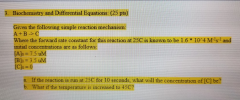 Biochemistry and Differential Equations: (25 pts) and Given the following simple reaction mechanism: A + B ->C Where the forward rate constant for this reaction at 25C is known to be 1.6 * 1044 V initial concentrations are as follows: [A]o = 7.5 uM Blo= 3.5 M [C]m = 0 If the reaction is run at 250 for 10 seconds,...
(15 points) Consider the following reaction: CO2+H20 F HCO; +H* This reaction is catalyzed by the...
 (15 points) Consider the following reaction: CO2+H20 F HCO; +H* This reaction is catalyzed by the enzyme carbonic anhydrase. The following data was obtained for an initial enzyme concentration of 2.3 nM and temperature of 0.5°C: [CO2] (MM) 1.25 Rate (M/s) 2.8x10⁻⁵ 5.00x 10⁻⁵ 8.33x10⁻⁵ 1.67x10⁻⁴ 2.5 5.0 20.0 Determine Km and Vmax for this reaction at the given enzyme...
Experiment 19 DATA AND CALCULATIONS Reaction 1 (MgO) Reaction 2 (Mg) 1. Volume of 1.00 M...
 Experiment 19 DATA AND CALCULATIONS Reaction 1 (MgO) Reaction 2 (Mg) 1. Volume of 1.00 M HCl 2. Final temperature, t 3. Initial temperature, 4. Change in temperature, ar 2 eC 5. Mass of solid 6. Heat, q kJ 7. AH 8. Moles mol Mgo mol Mg 10. Determine ??mol Mg for reaction (4)". 11. Percent error
A laboratory technician combined sodium hydroxide with excess iron(II) nitrate. A reaction took place according to...
A laboratory technician combined sodium hydroxide with excess iron(II) nitrate. A reaction took place according to this chemical equation: 2NaOH + Fe(NO3)2 → NaNO3 + Fe(OH)2. The reaction produced 3.70 grams of iron(II) hydroxide. Assuming the reaction came to completion, what was the initial mass of sodium hydroxide? Use the periodic table. A. 1.6 g B. 2.0 g C. 3.3...
Consider the following reaction: H2 + I2 ➞ 2HI They react by a second-order process, first...
Consider the following reaction: H2 + I2 ➞ 2HI They react by a second-order process, first order with respect to each reactant with k = 0.63 L/(mol*sec). a) What is the initial reaction rate when we add 0.50 g H2 and 0.20 g I2 to a 800. mL vessel? b) How does the reaction rate change (by what factor/amount) when...
a. Draw the structure of the tetrahedral intermediate INITIALLY FORMED in the reaction shown * You...
 a. Draw the structure of the tetrahedral intermediate INITIALLY FORMED in the reaction shown * You do not have to consider stereochemistry. . Do not include counter-ions, e.g., Nat, I, in your answer. In cases where there is more than one answer, ust draw one ChemDoodle b. Draw the structures of the final acyl transfer products obtained. You do not...
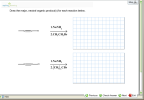
draw the major neutral organic products for each reaction below
 help on reaction problem
Draw the major, neutral organic product(s) for each reaction below.
Draw the major, neutral organic product(s) for each reaction below.
help on reaction problem
Draw the major, neutral organic product(s) for each reaction below.
Draw the major, neutral organic product(s) for each reaction below.
Fill the table with the products of the reaction of the substrated under each set of...
 Fill the table with the products of the reaction of the
substrated under each set of conditions. Assume a work-up at the
end for each reaction. Draw an X through the square of reactions
that would not proceed under the given conditions. (Py = pyridine,
Ac = acetyl)
Assume a work-up at the end for each reaction. Draw an X...
Fill the table with the products of the reaction of the
substrated under each set of conditions. Assume a work-up at the
end for each reaction. Draw an X through the square of reactions
that would not proceed under the given conditions. (Py = pyridine,
Ac = acetyl)
Assume a work-up at the end for each reaction. Draw an X...
Draw the structure of the organic product or products formed in the following reaction.
 Draw the structure of the organic product or products formed in the following reaction.
Include hydrogen atoms.
H2C=CH-CH=CH-CH2-Mg-Br
1. H2C-O-CH2 2.H3O+
Draw the structure of the organic product or products formed in the following reaction.
Include hydrogen atoms.
H2C=CH-CH=CH-CH2-Mg-Br
1. H2C-O-CH2 2.H3O+
Which of the following statements is true about the products (A and B) of the reaction...
 Which of the following statements is true about the products (A and B) of the reaction shown below? HBr A + B Br 1 (a) A and B are enantiomers. (b) A and B are racemic mixture (c) A and B are diastereomers. (d) Two of the above (e) All of the above
 Biochemistry and Differential Equations: (25 pts) and Given the following simple reaction mechanism: A + B ->C Where the forward rate constant for this reaction at 25C is known to be 1.6 * 1044 V initial concentrations are as follows: [A]o = 7.5 uM Blo= 3.5 M [C]m = 0 If the reaction is run at 250 for 10 seconds,...
 (15 points) Consider the following reaction: CO2+H20 F HCO; +H* This reaction is catalyzed by the enzyme carbonic anhydrase. The following data was obtained for an initial enzyme concentration of 2.3 nM and temperature of 0.5°C: [CO2] (MM) 1.25 Rate (M/s) 2.8x10⁻⁵ 5.00x 10⁻⁵ 8.33x10⁻⁵ 1.67x10⁻⁴ 2.5 5.0 20.0 Determine Km and Vmax for this reaction at the given enzyme...
 Experiment 19 DATA AND CALCULATIONS Reaction 1 (MgO) Reaction 2 (Mg) 1. Volume of 1.00 M HCl 2. Final temperature, t 3. Initial temperature, 4. Change in temperature, ar 2 eC 5. Mass of solid 6. Heat, q kJ 7. AH 8. Moles mol Mgo mol Mg 10. Determine ??mol Mg for reaction (4)". 11. Percent error
 a. Draw the structure of the tetrahedral intermediate INITIALLY FORMED in the reaction shown * You do not have to consider stereochemistry. . Do not include counter-ions, e.g., Nat, I, in your answer. In cases where there is more than one answer, ust draw one ChemDoodle b. Draw the structures of the final acyl transfer products obtained. You do not...
 help on reaction problem
Draw the major, neutral organic product(s) for each reaction below.
Draw the major, neutral organic product(s) for each reaction below.
help on reaction problem
Draw the major, neutral organic product(s) for each reaction below.
Draw the major, neutral organic product(s) for each reaction below.
 Fill the table with the products of the reaction of the
substrated under each set of conditions. Assume a work-up at the
end for each reaction. Draw an X through the square of reactions
that would not proceed under the given conditions. (Py = pyridine,
Ac = acetyl)
Assume a work-up at the end for each reaction. Draw an X...
Fill the table with the products of the reaction of the
substrated under each set of conditions. Assume a work-up at the
end for each reaction. Draw an X through the square of reactions
that would not proceed under the given conditions. (Py = pyridine,
Ac = acetyl)
Assume a work-up at the end for each reaction. Draw an X...
 Which of the following statements is true about the products (A and B) of the reaction shown below? HBr A + B Br 1 (a) A and B are enantiomers. (b) A and B are racemic mixture (c) A and B are diastereomers. (d) Two of the above (e) All of the above
Most questions answered within 3 hours.