For the following reaction, the cyanide nucleophile could reasonably substitute at either of two positions. One...
 For the following reaction, the cyanide nucleophile could reasonably substitute at either of two positions. One mechanism produces 4-cyanoheptane and dimethylsulfide. The competing mechanism produces 4-methylthioheptane and acetonitrile (CH_3CN). In practice, only one substitution is observed. Choose the most likely mechanistic pathway for this reaction and draw both of the products. Select whether it proceeds via an S_N1 or S_N2...
2. Consider the following SNl reaction: H3 CHs CH3 CH3 i. Draw a mechanism using curved...
 2. Consider the following SNl reaction: H3 CHs CH3 CH3 i. Draw a mechanism using curved arrows. Show all step(s) involved in bond breaking& forming. ii. Draw an energy diagram. Label the axes, the reactants, products, Ea, and AH. Assume that the reaction is exothermic. ili Draw the structure of the intermediate product at the correct position in the energy...
(UPLOAD THIS PAGE TO SHOW YOUR WORK) 6. Haloalkane RXN mechanisms. Please draw an arrow pushing...
 (UPLOAD THIS PAGE TO SHOW YOUR WORK) 6. Haloalkane RXN mechanisms. Please draw an arrow pushing mechanism's) for the following reaction(s). Identify ALL products and indicate the absolute configuration (if applicable) of the product(s). Write the rate law for the reaction. (20 pts.) RXN #1: SH (Ethanethiol) Rate Law: RXN #2: You Youne Rate Law:
2Ca(s)+O2(g) → 2CaO(s) ΔH∘rxn= -1269.8 kJ; ΔS∘rxn= -364.6 J/K For this problem, assume that all reactants...
2Ca(s)+O2(g) → 2CaO(s) ΔH∘rxn= -1269.8 kJ; ΔS∘rxn= -364.6 J/K For this problem, assume that all reactants and products are in their standard states. Calculate the free energy change for the reaction at 29 ∘C. Express your answer using four significant figures. Part A ΔG = ______ kJ Part B Is the reaction spontaneous? spontaneous OR nonspontaneous
Use reaction stoichiometry to calculate amounts of reactants and products. The substances ammonia and oxygen gas...
 Use reaction stoichiometry to calculate amounts of reactants and products. The substances ammonia and oxygen gas react to form nitrogen monoxide and water. Unbalanced equation: NH; (g) + O2(g) — NO(g) + H20 (g) In one reaction, 66.9 g of H2O is produced. What amount (in mol) of O2 was consumed? What mass (in grams) of NO is produced? mol...
Chemical Bond 24. What type of bonding is found between molecules in a substance? 12 volence...
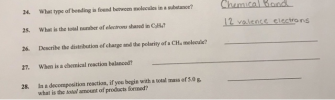 Chemical Bond 24. What type of bonding is found between molecules in a substance? 12 volence electrons 25. What is the total number of electrons shared in CH,? 26. Describe the distribution of charge and the polarity of a CHmolecule? 27. When is a chemical reaction balanced? 28. In a decomposition reaction, if you begin with a total mass of...
Why are we treating our purified PCR products with a DNA polymerase before adding them to...
Why are we treating our purified PCR products with a DNA polymerase before adding them to the ligation reaction? and What is the purpose of ATP in the ligation reaction? Group of answer choices -It provides energy to the ligase to catalyze a peptide bond -It provides energy to the ligase to catalyze a phosphodiester bond -It provides energy to...
Explain how the type and size of lipids change in a biomembrane, and how this impacts...
Explain how the type and size of lipids change in a biomembrane, and how this impacts the fluidity and function of that membrane. Explain the fluid mosaic model of biomembranes, by describing the diversity of proteins Explain the fluid mosaic model of biomembranes, by describing the structure and properties of biomembranes If given a reaction diagram, identify ΔG for the...
10. Initial rate data have been determined at a certain temperature for the gaseous reaction: 2NO...
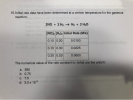 10. Initial rate data have been determined at a certain temperature for the gaseous reaction: 2NO + 2 H2 → N2 + 2 H20 [NO], [Hz]. Initial Rate (M/s) 0.10 0.20 0.0150 0.10 0.30 0.0225 0.20 0.20 0.0600 The numerical value of the rate constant is: (what are the units?) a. 380 b. 0.75 c. 7.5 d. 3.0 x 10⁻³
Consider the initial-rate data at a certain temperature in the table for the reaction described by 2 NO,(g) +0,(2)...
 Consider the initial-rate data at a certain temperature in the table for the reaction described by 2 NO,(g) +0,(2) NO.(8) + O2(g) [NO210 (M) 0.650 [O3lo (M) 0.800 0.800 1.40 Initial rate (M/s) 2.34 x 10" 3.96 x 10⁴ 11.09 x 10⁴ 1.10 1.76 Determine the value and units of the rate constant, k. Units:
 For the following reaction, the cyanide nucleophile could reasonably substitute at either of two positions. One mechanism produces 4-cyanoheptane and dimethylsulfide. The competing mechanism produces 4-methylthioheptane and acetonitrile (CH_3CN). In practice, only one substitution is observed. Choose the most likely mechanistic pathway for this reaction and draw both of the products. Select whether it proceeds via an S_N1 or S_N2...
 2. Consider the following SNl reaction: H3 CHs CH3 CH3 i. Draw a mechanism using curved arrows. Show all step(s) involved in bond breaking& forming. ii. Draw an energy diagram. Label the axes, the reactants, products, Ea, and AH. Assume that the reaction is exothermic. ili Draw the structure of the intermediate product at the correct position in the energy...
 (UPLOAD THIS PAGE TO SHOW YOUR WORK) 6. Haloalkane RXN mechanisms. Please draw an arrow pushing mechanism's) for the following reaction(s). Identify ALL products and indicate the absolute configuration (if applicable) of the product(s). Write the rate law for the reaction. (20 pts.) RXN #1: SH (Ethanethiol) Rate Law: RXN #2: You Youne Rate Law:
 Use reaction stoichiometry to calculate amounts of reactants and products. The substances ammonia and oxygen gas react to form nitrogen monoxide and water. Unbalanced equation: NH; (g) + O2(g) — NO(g) + H20 (g) In one reaction, 66.9 g of H2O is produced. What amount (in mol) of O2 was consumed? What mass (in grams) of NO is produced? mol...
 Chemical Bond 24. What type of bonding is found between molecules in a substance? 12 volence electrons 25. What is the total number of electrons shared in CH,? 26. Describe the distribution of charge and the polarity of a CHmolecule? 27. When is a chemical reaction balanced? 28. In a decomposition reaction, if you begin with a total mass of...
 10. Initial rate data have been determined at a certain temperature for the gaseous reaction: 2NO + 2 H2 → N2 + 2 H20 [NO], [Hz]. Initial Rate (M/s) 0.10 0.20 0.0150 0.10 0.30 0.0225 0.20 0.20 0.0600 The numerical value of the rate constant is: (what are the units?) a. 380 b. 0.75 c. 7.5 d. 3.0 x 10⁻³
 Consider the initial-rate data at a certain temperature in the table for the reaction described by 2 NO,(g) +0,(2) NO.(8) + O2(g) [NO210 (M) 0.650 [O3lo (M) 0.800 0.800 1.40 Initial rate (M/s) 2.34 x 10" 3.96 x 10⁴ 11.09 x 10⁴ 1.10 1.76 Determine the value and units of the rate constant, k. Units:
Most questions answered within 3 hours.