Consider the reaction. PCI (6) PCI,(9) + CIB) K = 0.042 The concentrations of the products...
 Consider the reaction. PCI (6) PCI,(9) + CIB) K = 0.042 The concentrations of the products at equilibrium are (PCII = 0.27 M and ICI,l = 0.10 M. What is the concentration of the reactant, PCs, at equilibrium? IPCI1 = M
A. Use the curved arrow notation to draw the step-wise reaction mechanisms that account for the...
 A. Use the curved arrow notation to draw the step-wise reaction mechanisms that account for the formation of the products shown in the transformation below. All reactants are shown. (8 MARKS] OES=0 MeOH w осн. -TsOH
13.6% Resources [ Give Up? Feedback Press esc to exit full screen Identify the products formed...
 13.6% Resources [ Give Up? Feedback Press esc to exit full screen Identify the products formed in this Brønsted-Lowry reaction. HSO, +F acid + base acid: F base: HSO4 Incorrect Incorrect
14. write the formula of the products. Name each of the reaction type. Ar-H + HNO3,...
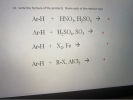 14. write the formula of the products. Name each of the reaction type. Ar-H + HNO3, H2SO4 → a Ar-H + H2SO4, SO3 → Ar-H + X2, Fe → Ar-H + R-X, AICI, → d
Provide mechanism is reagent above arrow catalytic or stoichiometric? 4. When you catalytic the products, even...
 Provide mechanism is reagent above arrow catalytic or
stoichiometric?
4. When you catalytic the products, even if not shown. ider catalytic vs stoichiometric reaction here, make sure to consider all NaOH H20
Provide mechanism is reagent above arrow catalytic or
stoichiometric?
4. When you catalytic the products, even if not shown. ider catalytic vs stoichiometric reaction here, make sure to consider all NaOH H20
Draw the major organic product obtained by reaction of benzoyl chloride with dimethylamine, (CH3)2NH. Please show...
Draw the major organic product obtained by reaction of benzoyl chloride with dimethylamine, (CH3)2NH. Please show the smaller molecular weight molecule and the larger molecular weight molecule. Please show both the products. Thanks
Polypropylene is made up of propene monomers. Fill in the brackets to indicate what the structure...
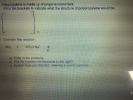 Polypropylene is made up of propene monomers. Fill in the brackets to indicate what the structure of polypropylene would be. a) Write in the products. b) Will the reaction be favorable to the right? c) Explain how you deeded, referring to some numbers.
Provide a mechanism to explain the formation of the two products shown following reaction. Show all...
 Provide a mechanism to explain the formation of the two products
shown following reaction. Show all key intermediates and indicate
electron flow using arrows.
a. OH H2O, Ht, heat CH3 H3C CH3 CH3
Provide a mechanism to explain the formation of the two products
shown following reaction. Show all key intermediates and indicate
electron flow using arrows.
a. OH H2O, Ht, heat CH3 H3C CH3 CH3
A certain first-order reaction (A?products) has a rate constant of 5.70×10?3 s?1 at 45 ?C. How...
A certain first-order reaction (A?products) has a rate constant of 5.70×10?3 s?1 at 45 ?C. How many minutes does it take for the concentration of the reactant, [A], to drop to 6.25% of the original concentration?
Which part(s) of the reaction Cl2(g) <---> 2 Cl(g) will be favored by an increase in...
Which part(s) of the reaction Cl2(g) <---> 2 Cl(g) will be favored by an increase in the total pressure (resulting in compression)? Please explain. a.) neither is favored b.) unable to determine c.) products d.) reactants
 Consider the reaction. PCI (6) PCI,(9) + CIB) K = 0.042 The concentrations of the products at equilibrium are (PCII = 0.27 M and ICI,l = 0.10 M. What is the concentration of the reactant, PCs, at equilibrium? IPCI1 = M
 A. Use the curved arrow notation to draw the step-wise reaction mechanisms that account for the formation of the products shown in the transformation below. All reactants are shown. (8 MARKS] OES=0 MeOH w осн. -TsOH
 13.6% Resources [ Give Up? Feedback Press esc to exit full screen Identify the products formed in this Brønsted-Lowry reaction. HSO, +F acid + base acid: F base: HSO4 Incorrect Incorrect
 14. write the formula of the products. Name each of the reaction type. Ar-H + HNO3, H2SO4 → a Ar-H + H2SO4, SO3 → Ar-H + X2, Fe → Ar-H + R-X, AICI, → d
 Provide mechanism is reagent above arrow catalytic or
stoichiometric?
4. When you catalytic the products, even if not shown. ider catalytic vs stoichiometric reaction here, make sure to consider all NaOH H20
Provide mechanism is reagent above arrow catalytic or
stoichiometric?
4. When you catalytic the products, even if not shown. ider catalytic vs stoichiometric reaction here, make sure to consider all NaOH H20
 Polypropylene is made up of propene monomers. Fill in the brackets to indicate what the structure of polypropylene would be. a) Write in the products. b) Will the reaction be favorable to the right? c) Explain how you deeded, referring to some numbers.
 Provide a mechanism to explain the formation of the two products
shown following reaction. Show all key intermediates and indicate
electron flow using arrows.
a. OH H2O, Ht, heat CH3 H3C CH3 CH3
Provide a mechanism to explain the formation of the two products
shown following reaction. Show all key intermediates and indicate
electron flow using arrows.
a. OH H2O, Ht, heat CH3 H3C CH3 CH3
Most questions answered within 3 hours.