9) Using the information given calculate, AH, AS and AG at 25°C (remember, for a reaction...
 9) Using the information given calculate, AH, AS and AG at 25°C (remember, for a reaction calculated using the relationship: AH = AH° reaction = nАHºf(products) - EnАHºt(reactants). PAY ATTENTION TO UNITS AND SIGN PC13(g) + Cl2 (g) → PCls(g) AHºt(kJ/mol) -287 O -374.9 (why is AHºt = 0 for Cl2?) Sºt (J/K) 311.67 223.1 364.47
Draw the organic product(s) you would expect from the following reaction. Draw the organic product(s) you...
 Draw the organic product(s) you would expect from the following
reaction.
Draw the organic product(s) you would expect from the following reaction. You do not have to consider stereochemistry. Draw one structure per sketcher. Add additional sketchers using the dropdown menu in the bottom right corner. Separate multiple products using the + sign from the dropdown menu.
Draw the organic product(s) you would expect from the following
reaction.
Draw the organic product(s) you would expect from the following reaction. You do not have to consider stereochemistry. Draw one structure per sketcher. Add additional sketchers using the dropdown menu in the bottom right corner. Separate multiple products using the + sign from the dropdown menu.
The starting alcohol from question 3 is deprotonated with sodium hydride to give the sodium alkoxide,...
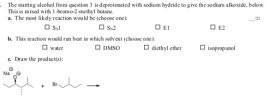 The starting alcohol from question 3 is deprotonated with sodium hydride to give the sodium alkoxide, below. This is mixed with 1-bromo-2-methyl butane. a. The most likely reaction would be choose one): SI OS2 DEI E2 b. This reaction would run best in which solvent (choose one): water DMSO diethyl ether isopropanol c Draw the products): towa
Standard heats of formation for reactants and products in the reaction below are provided. 2 HA(aq)...
 Standard heats of formation for reactants and products in the reaction below are provided. 2 HA(aq) + MX2(aq) → MA2(aq) + 2 HX(1) Substance HA(aq) HX(1) MA2(aq) MX2(aq) AHf° (kJ/mol) 107.523 -449.653 297.503 297.138 What is the standard enthalpy of reaction, in kJ? Report your answer to three digits after the decimal.
Draw the structure(s) of the major organic product(s) of the following reaction, omitting the phosphine oxide....
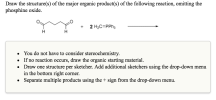 Draw the structure(s) of the major organic product(s) of the following reaction, omitting the phosphine oxide. You do not have to consider stereochemistry. If no reaction occurs, draw the organic starting material. Draw one structure per sketcher. Add additional sketchers using the drop-down menu in the bottom right corner. Separate multiple products using the sign from the drop-down menu.
g. Draw the Snl mechanism of the reaction between 2,5-dimethyl-2,5-hexanediol and hydrochloric acid (excess). Show lone...
 g. Draw the Snl mechanism of the reaction between 2,5-dimethyl-2,5-hexanediol and hydrochloric acid (excess). Show lone pairs, electron pushing arrows, 3-D view to reflect appropriate stereochemistry, reactants, intermediates, and products. You do not have to show transition states. Name the product. Draw and completely label a reaction energy diagram corresponding to the mechanism you have drawn.
3. Give the reagents necessary to complete the following transformation. Hint: It can be accomplished in...
 3. Give the reagents necessary to complete the following transformation. Hint: It can be accomplished in one step. (3 pts.) Br 4. Circle which reaction in the following reaction pairs you would expect to be faster. You do not need to give the products. (2 pts, each) Br + CH,OH methanol . . -Br . chou + CH.OH methanol methanol...
46.1 g of ethanol (C2H5OH) is burnt in a rigid 5.00 L container resulting a mixture...
46.1 g of ethanol (C2H5OH) is burnt in a rigid 5.00 L container resulting a mixture of gaseous products according to the reaction equation: C2H5OH(g) + 3O2(g) -> 2CO2(g) + 3H2O(g) Calculate the total pressure in the reaction vessel at 200 °C. (A) 1660 kPa (B) 3930 kPa (C) 3.93 x10^6 kPa (D) 38.8 kPa (E) 787 kPa
PROBLEM 5. Reaction Mechanism 1. Propose products (major/minor) and provide a detaile reaction mechanism to account...
 PROBLEM 5. Reaction Mechanism 1. Propose products (major/minor) and provide a detaile reaction mechanism to account for the formation of the major product. Use curved arrow notation to indicate electron flow. Also, draw a structure of the transition state that accounts for the formation of the major product HЕr он 0° C major minor transition state corresponding to the major...
3. Draw the needed alcohol and reactants to prepare the shown products. Be sure to include...
 3. Draw the needed alcohol and reactants to prepare the shown products. Be sure to include stereochemistry, if applicable. You do not need to draw the mechanism for this question. (10 points) CI 4a. Determine the structure of the unknown alcohol using the given 1H NMR. (5 points) 4b. Write the equation for the reaction of the above alcohol with...
 9) Using the information given calculate, AH, AS and AG at 25°C (remember, for a reaction calculated using the relationship: AH = AH° reaction = nАHºf(products) - EnАHºt(reactants). PAY ATTENTION TO UNITS AND SIGN PC13(g) + Cl2 (g) → PCls(g) AHºt(kJ/mol) -287 O -374.9 (why is AHºt = 0 for Cl2?) Sºt (J/K) 311.67 223.1 364.47
 Draw the organic product(s) you would expect from the following
reaction.
Draw the organic product(s) you would expect from the following reaction. You do not have to consider stereochemistry. Draw one structure per sketcher. Add additional sketchers using the dropdown menu in the bottom right corner. Separate multiple products using the + sign from the dropdown menu.
Draw the organic product(s) you would expect from the following
reaction.
Draw the organic product(s) you would expect from the following reaction. You do not have to consider stereochemistry. Draw one structure per sketcher. Add additional sketchers using the dropdown menu in the bottom right corner. Separate multiple products using the + sign from the dropdown menu.
 The starting alcohol from question 3 is deprotonated with sodium hydride to give the sodium alkoxide, below. This is mixed with 1-bromo-2-methyl butane. a. The most likely reaction would be choose one): SI OS2 DEI E2 b. This reaction would run best in which solvent (choose one): water DMSO diethyl ether isopropanol c Draw the products): towa
 Standard heats of formation for reactants and products in the reaction below are provided. 2 HA(aq) + MX2(aq) → MA2(aq) + 2 HX(1) Substance HA(aq) HX(1) MA2(aq) MX2(aq) AHf° (kJ/mol) 107.523 -449.653 297.503 297.138 What is the standard enthalpy of reaction, in kJ? Report your answer to three digits after the decimal.
 Draw the structure(s) of the major organic product(s) of the following reaction, omitting the phosphine oxide. You do not have to consider stereochemistry. If no reaction occurs, draw the organic starting material. Draw one structure per sketcher. Add additional sketchers using the drop-down menu in the bottom right corner. Separate multiple products using the sign from the drop-down menu.
 g. Draw the Snl mechanism of the reaction between 2,5-dimethyl-2,5-hexanediol and hydrochloric acid (excess). Show lone pairs, electron pushing arrows, 3-D view to reflect appropriate stereochemistry, reactants, intermediates, and products. You do not have to show transition states. Name the product. Draw and completely label a reaction energy diagram corresponding to the mechanism you have drawn.
 3. Give the reagents necessary to complete the following transformation. Hint: It can be accomplished in one step. (3 pts.) Br 4. Circle which reaction in the following reaction pairs you would expect to be faster. You do not need to give the products. (2 pts, each) Br + CH,OH methanol . . -Br . chou + CH.OH methanol methanol...
 PROBLEM 5. Reaction Mechanism 1. Propose products (major/minor) and provide a detaile reaction mechanism to account for the formation of the major product. Use curved arrow notation to indicate electron flow. Also, draw a structure of the transition state that accounts for the formation of the major product HЕr он 0° C major minor transition state corresponding to the major...
 3. Draw the needed alcohol and reactants to prepare the shown products. Be sure to include stereochemistry, if applicable. You do not need to draw the mechanism for this question. (10 points) CI 4a. Determine the structure of the unknown alcohol using the given 1H NMR. (5 points) 4b. Write the equation for the reaction of the above alcohol with...
Most questions answered within 3 hours.