(I have to be able to teach someone this) illustrate/draw and explain each step of the...
 (I have to be able to teach someone this)
illustrate/draw and explain each step of the reaction mechanism
to show how the expected major organic products form.
you should draw and explain (what is happening and
why) at each of the steps in the reaction using
the proper terminology. please use accurate lone pair electrons,
formal charges, and accurate electron...
(I have to be able to teach someone this)
illustrate/draw and explain each step of the reaction mechanism
to show how the expected major organic products form.
you should draw and explain (what is happening and
why) at each of the steps in the reaction using
the proper terminology. please use accurate lone pair electrons,
formal charges, and accurate electron...
Draw the organic product(s) of the following reaction. Draw the organic product(s) of the following reaction....
 Draw the organic product(s) of the following reaction.
 p-toluenesulfonic acid toluene /reflux . You do not have to consider stereochemistry. • Draw one structure per sketcher. Add additional sketchers using the drop-down menu in the bottom right corner. • Separate multiple products using the + sign from the drop-down menu. ChemDoodle
Draw the organic product(s) of the following reaction.
Draw the organic product(s) of the following reaction. p-toluenesulfonic acid toluene /reflux . You do not have to consider stereochemistry. • Draw one structure per sketcher. Add additional sketchers using the drop-down menu in the bottom right corner. • Separate multiple products using the + sign from the drop-down menu. ChemDoodle
3. The reaction below has Kc = 3.8 at a certain temperature. Calculate the conce reactants...
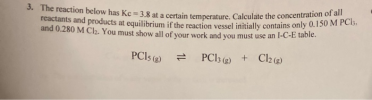 3. The reaction below has Kc = 3.8 at a certain temperature. Calculate the conce reactants and products at equilibrium if the reaction vessel initially contains on and 0.280 M Cl2. You must show all of your work and you must use an 1- ure. Calculate the concentration of all on vessel initially contains only 0.150 M PCI, PCls (g)...
Consider the following chemical reaction and free energies of formation in the table: 4 NH3(g) +...
Consider the following chemical reaction and free energies of formation in the table: 4 NH3(g) + 7 O2(g) → 4 NO2(g) + 6 H2O(l) Calculate ∆G°rxn (kJ) for the reaction. Only enter a numerical value. Products or reactants ∆G°f, kJ/mol NH3(g) -17 O2(g) 0 NO2(g) +52 H2O(l) -237
1.) Please explain the importance of the Ficsher Esterfication reaction. 1-3 sentences will be sufficient. 2....
1.) Please explain the importance of the Ficsher Esterfication reaction. 1-3 sentences will be sufficient. 2. Which one in more soluble in water, propanoic acid or 1,3-propanedioic acid? Please explain why? 1-2 sentences will be sufficient. 3.) Name all of the functional groups that can undergo hydrolysis, and give the corresponding products. Also, include any conditions per reaction.
What would the results of a Sanger sequencing read look like if you accidentally omitted the...
What would the results of a Sanger sequencing read look like if you accidentally omitted the deoxyCTP (dCTP) from the reaction? Multiple Choice No Cs could be incorporated into synthesis products, and so only peaks corresponding to the smallest synthesis products - none of which include a C - will appear. The results would be normal; dCTP is not required...
Gas phase reaction, A > 3B (volume-increasing reaction), K=0.3, CA0=3mol/L, and V0=2L/min. Onl...
Gas phase reaction, A > 3B (volume-increasing reaction), K=0.3, CA0=3mol/L, and V0=2L/min. Only A is involved in the initial phase. 1. What volume do you need for secondary response, CSTR reactor, and conversion rate of 80% ? 2. What volume do you need for first response, PFTR reactor, and conversion rate of 80% ?
30. A 5.71 gram sample of PCi5 is placed in an evacuated 1.8 liter flask at...
 30. A 5.71 gram sample of PCi5 is placed in an evacuated 1.8 liter flask at 264°C and decomposes to phosphorus trichloride and chlorine gas. (a) Write the balanced equation for the decomposition reaction of PCi5. (b) Calculate the initial pressure in the flask before the PC15 decomposed, (c) If 75% of the PC15 decomposes, calculate the partial pressures of...
Butadiene (C4H6)reacts with itself to form a dimer with the formula C8H12. The reaction is second...
Butadiene (C4H6)reacts with itself to form a dimer with the formula C8H12. The reaction is second order in C4H6. Assume the rate constant at a particular temperature is 4.0×10⁻²M−1s−1 and the initial concentration of C4H6 is 0.0230 MM. What is its molarity after a reaction time of 1.30 hh? What is the time (in hours) when the C4H6 concentration reaches...
07 Question (6 points) The equilibrium constant Ke for the reaction below is is 6.755x10⁵ 1st...
 07 Question (6 points) The equilibrium constant Ke for the reaction below is is 6.755x10⁵ 1st attempt Part 1 (2 points) The initial composition of the reaction mixture is [C] [D]- [E]- 1.7110x10³ M What is the equilibrium concentration of C? Part 2 (2 points) What is the equilibrium concentration of D? Part 3 (2 points) What is the equilibrium...
 (I have to be able to teach someone this)
illustrate/draw and explain each step of the reaction mechanism
to show how the expected major organic products form.
you should draw and explain (what is happening and
why) at each of the steps in the reaction using
the proper terminology. please use accurate lone pair electrons,
formal charges, and accurate electron...
(I have to be able to teach someone this)
illustrate/draw and explain each step of the reaction mechanism
to show how the expected major organic products form.
you should draw and explain (what is happening and
why) at each of the steps in the reaction using
the proper terminology. please use accurate lone pair electrons,
formal charges, and accurate electron...
 Draw the organic product(s) of the following reaction.
 p-toluenesulfonic acid toluene /reflux . You do not have to consider stereochemistry. • Draw one structure per sketcher. Add additional sketchers using the drop-down menu in the bottom right corner. • Separate multiple products using the + sign from the drop-down menu. ChemDoodle
Draw the organic product(s) of the following reaction.
Draw the organic product(s) of the following reaction. p-toluenesulfonic acid toluene /reflux . You do not have to consider stereochemistry. • Draw one structure per sketcher. Add additional sketchers using the drop-down menu in the bottom right corner. • Separate multiple products using the + sign from the drop-down menu. ChemDoodle
 3. The reaction below has Kc = 3.8 at a certain temperature. Calculate the conce reactants and products at equilibrium if the reaction vessel initially contains on and 0.280 M Cl2. You must show all of your work and you must use an 1- ure. Calculate the concentration of all on vessel initially contains only 0.150 M PCI, PCls (g)...
 30. A 5.71 gram sample of PCi5 is placed in an evacuated 1.8 liter flask at 264°C and decomposes to phosphorus trichloride and chlorine gas. (a) Write the balanced equation for the decomposition reaction of PCi5. (b) Calculate the initial pressure in the flask before the PC15 decomposed, (c) If 75% of the PC15 decomposes, calculate the partial pressures of...
 07 Question (6 points) The equilibrium constant Ke for the reaction below is is 6.755x10⁵ 1st attempt Part 1 (2 points) The initial composition of the reaction mixture is [C] [D]- [E]- 1.7110x10³ M What is the equilibrium concentration of C? Part 2 (2 points) What is the equilibrium concentration of D? Part 3 (2 points) What is the equilibrium...
Most questions answered within 3 hours.