Part B What was the initial reactant concentration for the reaction described in Part A? Express...
Part B What was the initial reactant concentration for the reaction described in Part A? Express your answer with the appropriate units. Indicate the multiplication of units, as necessary, explicitly either with a multiplication dot or a dash. Part C The reactant concentration in a first-order reaction was 6.60×10⁻²M after 20.0 s and 5.50×10⁻³M after 70.0 s . What is...
The rate constant for a certain reaction is k = 5.90x10⁻³ s1 If the initial reactant...
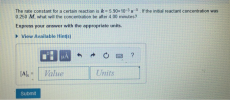 The rate constant for a certain reaction is k = 5.90x10⁻³ s1 If the initial reactant concentration was 0.250 M, what will the concentration be after 4.00 minutes? Express your answer with the appropriate units. View Available Hint(s) ? HA Units Value [Al Submit
The initial rates method can be used to determine the rate law for a reaction. Using...
The initial rates method can be used to determine the rate law for a reaction. Using the data for the reaction shown below, what is the rate law expression for the reaction? A+B→C Trial123[A](molL)0.0650.0650.078[B](molL)0.0650.0780.065−Δ[A]Δt(molL s)2.29311875×10−72.29311875×10−73.9625092×10⁻⁷ Write the rate law expression using two significant figures for the rate constant. Use brackets for any needed concentrations ([A], [B], or [C]). Simplify the...
Part A Afirst-order reaction (A + B) has a hallife of 25 minutes. If the initial...
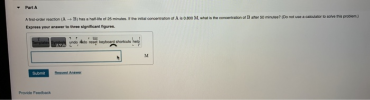 Part A Afirst-order reaction (A + B) has a hallife of 25 minutes. If the initial concentration of Als 0.800 M. what is the concentration of B after 50 minutes? (Do not use a calculator to solve this problem.) Express your answer to three significant figures. Template boundo do reset keyboard shortcuts is help AX M Submit Request Answer Provide...
3.8 points An initial state before reaction of CH4 and Cl2 is shown in the figure....
 3.8 points An initial state before reaction of CH4 and Cl2 is shown in the figure. Based on the balanced equation and the figure, what is the excess reactant? CH (8) + 4 C12(g) → CCI.(g) + 4 HCl(g) HCI CCl4 CH4 Cl2
The following initial rate data are for the reaction of nitrogen dioxide with carbon monoxide NO2...
 The following initial rate data are for the reaction of nitrogen dioxide with carbon monoxide NO2 + CO >NO + CO2 [NO2lo, M 0.552 0.552 1.10 1.10 [COlo, M 0.461 0.922 0.461 0.922 Initial Rate, Ms1 0.193 0.193 0.768 0.768 Experiment 3 4 Complete the rate law for this reaction in the box below Use the form k[A]m[B]n , where...
The reaction between CO and H2 is carried out at a different temperature with initial concentrations...
The reaction between CO and H2 is carried out at a different temperature with initial concentrations of [CO] = 0.31 M and [H2]= 1.4 M . CO(g)+2H2(g)⇌CH3OH(g) At equilibrium, the concentration of CH3OH is 0.09 M Find the equilibrium constant at this temperature.
QUESTION 18.1 POINT The initial concentrations of Na+ and Cl” in the reaction below are each...
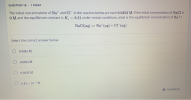 QUESTION 18.1 POINT The initial concentrations of Na+ and Cl” in the reaction below are each 0.0434 M. If the initial concentration of NaCl is OM and the equilibrium constant is K-8.21 under certain conditions, what is the equilibrium concentration of Nat? NaCl(aq) Na+ (aq) + Cl(aq) Select the correct answer below: O 0.0281 M O 0.0354 M O 0.0432...
The equilibrium constant () of the reaction below is K-6.0 x 10 with initial concentrations as...
 The equilibrium constant () of the reaction below is K-6.0 x 10 with initial concentrations as follows: [H2] = 1.0 x 10² M. [Na] - 4.0 M, and (NH) - 1.0 x 10* M. N (8) + 3H,() 2NH3(e) 3. Consider the chemical reaction: N2 + 3H2 yields 2NH3. If the concentration of the reactant Hy was increased from 1.0...
Determine the rate law given for the following reaction given the initial rate data in the...
 Determine the rate law given for the following reaction given the initial rate data in the table: 2A + 2BC+2D Experiment [A] (M) [B] (M) Initial rate (M/s) 0.0211 0.113 2.00 x 10⁻⁵ 2 0.0422 0.113 8.00 x 10⁻⁵ 3 0.0422 0.226 1.60 x 10 1 Rate = K[A] [B] Rate = K[A] [B] Rate - AllB12 Rate - [A]...
 The rate constant for a certain reaction is k = 5.90x10⁻³ s1 If the initial reactant concentration was 0.250 M, what will the concentration be after 4.00 minutes? Express your answer with the appropriate units. View Available Hint(s) ? HA Units Value [Al Submit
 Part A Afirst-order reaction (A + B) has a hallife of 25 minutes. If the initial concentration of Als 0.800 M. what is the concentration of B after 50 minutes? (Do not use a calculator to solve this problem.) Express your answer to three significant figures. Template boundo do reset keyboard shortcuts is help AX M Submit Request Answer Provide...
 3.8 points An initial state before reaction of CH4 and Cl2 is shown in the figure. Based on the balanced equation and the figure, what is the excess reactant? CH (8) + 4 C12(g) → CCI.(g) + 4 HCl(g) HCI CCl4 CH4 Cl2
 The following initial rate data are for the reaction of nitrogen dioxide with carbon monoxide NO2 + CO >NO + CO2 [NO2lo, M 0.552 0.552 1.10 1.10 [COlo, M 0.461 0.922 0.461 0.922 Initial Rate, Ms1 0.193 0.193 0.768 0.768 Experiment 3 4 Complete the rate law for this reaction in the box below Use the form k[A]m[B]n , where...
 QUESTION 18.1 POINT The initial concentrations of Na+ and Cl” in the reaction below are each 0.0434 M. If the initial concentration of NaCl is OM and the equilibrium constant is K-8.21 under certain conditions, what is the equilibrium concentration of Nat? NaCl(aq) Na+ (aq) + Cl(aq) Select the correct answer below: O 0.0281 M O 0.0354 M O 0.0432...
 The equilibrium constant () of the reaction below is K-6.0 x 10 with initial concentrations as follows: [H2] = 1.0 x 10² M. [Na] - 4.0 M, and (NH) - 1.0 x 10* M. N (8) + 3H,() 2NH3(e) 3. Consider the chemical reaction: N2 + 3H2 yields 2NH3. If the concentration of the reactant Hy was increased from 1.0...
 Determine the rate law given for the following reaction given the initial rate data in the table: 2A + 2BC+2D Experiment [A] (M) [B] (M) Initial rate (M/s) 0.0211 0.113 2.00 x 10⁻⁵ 2 0.0422 0.113 8.00 x 10⁻⁵ 3 0.0422 0.226 1.60 x 10 1 Rate = K[A] [B] Rate = K[A] [B] Rate - AllB12 Rate - [A]...
Most questions answered within 3 hours.