1.) You have isolated mitochondria and are testing various substrates by measuring the oxygen consumption with...
1.) You have isolated mitochondria and are testing various substrates by measuring the oxygen consumption with a special electrode. You add the inhibitor rotenone. What must be the substrate you add? Why?
A charged isolated metal sphere of diameter 11 cm has a potential of 12000 V relative...
A charged isolated metal sphere of diameter 11 cm has a potential of 12000 V relative to V = 0 at infinity. Calculate the energy density in the electric field near the surface of the sphere.
A charged isolated metal sphere of diameter 14 cm has a potential of 6400 V relative...
A charged isolated metal sphere of diameter 14 cm has a potential of 6400 V relative to V = 0 at infinity. Calculate the energy density in the electric field near the surface of the sphere.
An isolated metal sphere of radius 10 cm is immersed in a material with permittivity Epsilon=...
An isolated metal sphere of radius 10 cm is immersed in a material with permittivity Epsilon= 1.0 x 10⁻¹⁰ F/m. If the material fills all space, what is the capacitance of the sphere?
(65) Consider the following reaction of benzene (CoHo) with air at 25 C and 150 kPa total pressur...
 (65) Consider the following reaction of benzene (CoHo) with air at 25 C and 150 kPa total pressure: CoHs+ 8 (02 +3.76 N2) products a. Find the air-fuel mass ratio. b. Find the percent excess or deficient air (specify which). c. Find the product distribution and dewpoint. If there is excess air assume the additional product is oxygen, while if...
UULUUI VULL I TULU Cui suujell wiele we just memorize a collection of facts. That is...
 UULUUI VULL I TULU Cui suujell wiele we just memorize a collection of facts. That is almost useless. To learn science, to succeed in scientific fields is to see how all of the ideas relate to each other. The more connections you can establish, the more you can use what you know and the easier it is to remember. Indulge...
At 450°C, ammonia gas will decompose according to the following equation 2 NHa (g)N2 (g)3 H2...
 At 450°C, ammonia gas will decompose according to the following equation 2 NHa (g)N2 (g)3 H2 (g) Kc 6.30 at 450.C An unknown quantity of NH3 is placed in a reaction flask (with no N2 or Hz) and is allowed to come to equilibrium at 450.0°C. The equilibrium concentration of H2 is then determined to be 0.111 M. Determine the...
The following initial rate data are for the ozonization of pentene in carbon tetrachloride solution at...
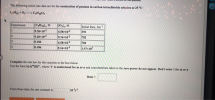 The following initial rate data are for the ozonization of pentene in carbon tetrachloride solution at 25°C C5H10 +03 -CH1003 Experiment [CHM Initial Rate, M 9.28x10⁻² Complete the rate law for this reaction in the box below. Use the form k[A]"B". where '1' is understood for mor n and concentrations taken to the zero power do not appear. Don't enter...
4. An enzyme hydrolyzed a substrate concentration of 0.03mmol/L, the initial velocity was 0.5 X 10⁻³...
 4. An enzyme hydrolyzed a substrate concentration of 0.03mmol/L, the initial velocity was 0.5 X 10⁻³ mmol/L.min' and the maximum velocity was 4.5 x 10⁻³ mmol/L.min.l. Calculate the Km value. 5. Urease hydrolyzed urea at [s]=0.03mmol/L with a km of 0.06 mmol/L. The initial velocity observed was 1.5X10⁻³ mmol/L.min-1 Calculate the maximum velocity of the enzyme reaction.
* PLEASE WRITE OUT ANSWER STEP BY STEP! CONSIDER THE FOLLOWING REACTION: Fe3+(aq)+SCN−(aq)⇌FeSCN2+(aq) A solution is...
* PLEASE WRITE OUT ANSWER STEP BY STEP! CONSIDER THE FOLLOWING REACTION: Fe3+(aq)+SCN−(aq)⇌FeSCN2+(aq) A solution is made containing an initial [Fe3+] of 1.2×10⁻³ M and an initial [SCN−] of 8.2×10⁻⁴ M. At equilibrium, [FeSCN2+] = 1.6×10⁻⁴ M . PART A: Calculate the value of the equilibrium constant (Kc): [Express your answer using two significant figures] KC = _____________________________
 (65) Consider the following reaction of benzene (CoHo) with air at 25 C and 150 kPa total pressure: CoHs+ 8 (02 +3.76 N2) products a. Find the air-fuel mass ratio. b. Find the percent excess or deficient air (specify which). c. Find the product distribution and dewpoint. If there is excess air assume the additional product is oxygen, while if...
 UULUUI VULL I TULU Cui suujell wiele we just memorize a collection of facts. That is almost useless. To learn science, to succeed in scientific fields is to see how all of the ideas relate to each other. The more connections you can establish, the more you can use what you know and the easier it is to remember. Indulge...
 At 450°C, ammonia gas will decompose according to the following equation 2 NHa (g)N2 (g)3 H2 (g) Kc 6.30 at 450.C An unknown quantity of NH3 is placed in a reaction flask (with no N2 or Hz) and is allowed to come to equilibrium at 450.0°C. The equilibrium concentration of H2 is then determined to be 0.111 M. Determine the...
 The following initial rate data are for the ozonization of pentene in carbon tetrachloride solution at 25°C C5H10 +03 -CH1003 Experiment [CHM Initial Rate, M 9.28x10⁻² Complete the rate law for this reaction in the box below. Use the form k[A]"B". where '1' is understood for mor n and concentrations taken to the zero power do not appear. Don't enter...
 4. An enzyme hydrolyzed a substrate concentration of 0.03mmol/L, the initial velocity was 0.5 X 10⁻³ mmol/L.min' and the maximum velocity was 4.5 x 10⁻³ mmol/L.min.l. Calculate the Km value. 5. Urease hydrolyzed urea at [s]=0.03mmol/L with a km of 0.06 mmol/L. The initial velocity observed was 1.5X10⁻³ mmol/L.min-1 Calculate the maximum velocity of the enzyme reaction.
Most questions answered within 3 hours.