A 31.2 gram sample of C6H6 (benzene) is reacted with excess HNO3 (nitric acid). 36.0 grams...
A 31.2 gram sample of C6H6 (benzene) is reacted with excess HNO3 (nitric acid). 36.0 grams of the desired product, nitrobenzene C6H5NO2, is isolated from this reaction. Water is the by-product. A. Write a balanced chemical equation for this reaction B. What is the percent yield of nitrobenzene?
HV U SIBILHIL Styles Shapel Font Paragraph Drawing Practice Problems Cyclohexanes are not the only occasions...
 HV U SIBILHIL Styles Shapel Font Paragraph Drawing Practice Problems Cyclohexanes are not the only occasions for the formation of anti-Zaitsev products in an E2 reaction. Consider (2R,3S)-2-chloro-3-methylpentane. Draw it in a Newman projection looking down the C2-C3 bond, being careful to preserve the stereochemistry. Then use the Newman projection and the requirement for anti-periplanar geometry in the elimination to...
Predict the product and propose a mechanism for the elimination reaction that results when (S)-(1-chloropropylbenzene i...
 Predict the product and propose a mechanism for the elimination reaction that results when (S)-(1-chloropropylbenzene is heated in the presence of HOCH2CH3- СІН CH Draw all missing reactants and/or products in the appropriate boxes by placing atoms on the canvas and connecting them with bonds. Add charges where needed. Electron-flow arrows should start on an atom or a bond and...
(S)-3-Chlorooctane m DMSO S SN2 Factors Nucleophile Strength Leaving Group Solvent d) Cla . NaBrº DMSO...
 (S)-3-Chlorooctane m DMSO S SN2 Factors Nucleophile Strength Leaving Group Solvent d) Cla . NaBrº DMSO Syl SN2 Factors Nucleophile Strength Leaving Group Solvent SN1 and SN2 Reactions 1. For each of the following reactions • Provide a complete detailed mechanism and predict the products. Indicate if the reaction proceeds via a Snl or Sn2 mechanism • Include the specific...
3) Solid magnesium and nitrogen gas combine to form solid magnesium nitride. a. Write the balanced...
 3) Solid magnesium and nitrogen gas combine to form solid magnesium nitride. a. Write the balanced chemical equation for this reaction. b. How many grams of magnesium nitride can be produced from the reaction of 10.0 g of magnesium and 12.0 g of nitrogen? c. What is the percent yield for this reaction if 7.159 g of magnesium nitride are...
A 21.0-kg cannonball is fired from a cannon with muzzle speed of 900 m/s at an...
 A 21.0-kg cannonball is fired from a cannon with muzzle speed of 900 m/s at an angle of 33.0° with the horizontal. A second ball is fired with the same initial speed at an angle of 90.0°. Let y = 0 at the cannon. (a) Use the isolated system model to find the maximum height reached by each ball hfirst...
A certain second-order reaction (B→products) has a rate constant of 1.20×10⁻³ M−1⋅s−1 at 27 ∘C and...
A certain second-order reaction (B→products) has a rate constant of 1.20×10⁻³ M−1⋅s−1 at 27 ∘C and an initial half-life of 260 s . What is the concentration of the reactant B after one half-life?
A certain second-order reaction (B→products) has a rate constant of 1.45×10⁻³ M−1⋅s−1 at 27 ∘C and...
A certain second-order reaction (B→products) has a rate constant of 1.45×10⁻³ M−1⋅s−1 at 27 ∘C and an initial half-life of 208 s . What is the concentration of the reactant B after one half-life?
What Rasthe plL of the soap solution? Using structures write a chemical reaction of the soap and ...
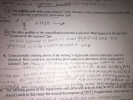 What Rasthe plL of the soap solution? Using structures write a chemical reaction of the soap and water that explains this observation. 2pts 2.W (R The other prodoct of the saponification reaction is glycerol. What happens to the glycerol produced in the reaction? 2pts olento Frn ucerol wilth vscal to pic pat a Soa p, identical. How could you use...
Addition Reaction (Ch. 8. primarily) Learning Outcomes: By successfully completing this assignment, the student will demonstrate...
 Addition Reaction (Ch. 8. primarily) Learning Outcomes: By successfully completing this assignment, the student will demonstrate the ability to: (A) Provide proper curved-arrow mechanisms for addition reactions involving alkene reactants. (B) Predict the correct structure of the products of addition reactions, including correct regiochemistry and stereochemistry. (C) Provide reasonable explanations for mechanistic steps in addition reactions based on energy considerations...
 HV U SIBILHIL Styles Shapel Font Paragraph Drawing Practice Problems Cyclohexanes are not the only occasions for the formation of anti-Zaitsev products in an E2 reaction. Consider (2R,3S)-2-chloro-3-methylpentane. Draw it in a Newman projection looking down the C2-C3 bond, being careful to preserve the stereochemistry. Then use the Newman projection and the requirement for anti-periplanar geometry in the elimination to...
 Predict the product and propose a mechanism for the elimination reaction that results when (S)-(1-chloropropylbenzene is heated in the presence of HOCH2CH3- СІН CH Draw all missing reactants and/or products in the appropriate boxes by placing atoms on the canvas and connecting them with bonds. Add charges where needed. Electron-flow arrows should start on an atom or a bond and...
 (S)-3-Chlorooctane m DMSO S SN2 Factors Nucleophile Strength Leaving Group Solvent d) Cla . NaBrº DMSO Syl SN2 Factors Nucleophile Strength Leaving Group Solvent SN1 and SN2 Reactions 1. For each of the following reactions • Provide a complete detailed mechanism and predict the products. Indicate if the reaction proceeds via a Snl or Sn2 mechanism • Include the specific...
 3) Solid magnesium and nitrogen gas combine to form solid magnesium nitride. a. Write the balanced chemical equation for this reaction. b. How many grams of magnesium nitride can be produced from the reaction of 10.0 g of magnesium and 12.0 g of nitrogen? c. What is the percent yield for this reaction if 7.159 g of magnesium nitride are...
 A 21.0-kg cannonball is fired from a cannon with muzzle speed of 900 m/s at an angle of 33.0° with the horizontal. A second ball is fired with the same initial speed at an angle of 90.0°. Let y = 0 at the cannon. (a) Use the isolated system model to find the maximum height reached by each ball hfirst...
 What Rasthe plL of the soap solution? Using structures write a chemical reaction of the soap and water that explains this observation. 2pts 2.W (R The other prodoct of the saponification reaction is glycerol. What happens to the glycerol produced in the reaction? 2pts olento Frn ucerol wilth vscal to pic pat a Soa p, identical. How could you use...
 Addition Reaction (Ch. 8. primarily) Learning Outcomes: By successfully completing this assignment, the student will demonstrate the ability to: (A) Provide proper curved-arrow mechanisms for addition reactions involving alkene reactants. (B) Predict the correct structure of the products of addition reactions, including correct regiochemistry and stereochemistry. (C) Provide reasonable explanations for mechanistic steps in addition reactions based on energy considerations...
Most questions answered within 3 hours.