QUESTION 1 The reaction 3 H2(g)+ N2g)2 NH3(g) is slightly reactant-favored at a certain temperature. Starting...
 QUESTION 1 The reaction 3 H2(g)+ N2g)2 NH3(g) is slightly reactant-favored at a certain temperature. Starting from the reaction at equilibrium concentration of reactants and products, which of the following actions will increase the concentration of NH3 that can be obtained.? Increase concentration of hydrogen gas. Decrease concentration of hydrogen gas. Increase concentration of nitrogen gas. Decrease concentration of nitrogen...
Question 1 1 pts Standard heats of formation for reactants and products in the reaction below...
 Question 1 1 pts Standard heats of formation for reactants and products in the reaction below are provided. 2 HA(aq) + MX2(aq) → MA2(aq) + 2 HX(1) Substance AHf° (kJ/mol) HA(aq) 436.115 HX(0) 323.735 MA2(aq) -491.794 MX2(aq) 132.96 What is the standard enthalpy of reaction, in kJ? Report your answer to three digits after the decimal.
2. The necessary chemical reagents (or reactants) and reaction conditions are respectively filled in the reaction...
 2. The necessary chemical reagents (or reactants) and reaction conditions are respectively filled in the reaction formulas of the following specified raw materials and products. a PROHLCHGH OH P RCH-CHOH O CHO L =C(CH G CH.CO.CH CH OH H.CO CAN CH.CO.CH сно H.CO.C-N CONH CONH CHICHI CH.CH 110) H.C.CHCHOC, H.) HCCHCHOCH он он - сно, сност, CHCH.CH OCP
Explain the differences in the observed reaction outcome of the following reactions: A. Unequally substituted epoxides,...
 Explain the differences in the observed reaction outcome of the following reactions: A. Unequally substituted epoxides, like 1,1-dimethyloxirane, produce two different regiochemical products under acidic and basic conditions. Briefly justify/rationalize each result. O: NaOMe HO .Me HOMe O: H2S04 Me. OH HOMe B. Rationalize the stereochemical outcome of the following reaction Me Me Me Me mCPBA, DCM (00
The following are partial equations representing acid-base reactions. Looking carefully at the connectivity of the atoms...
 The following are partial equations representing acid-base reactions. Looking carefully at the connectivity of the atoms shown in the equation and at the conjugate acid-base pairs found in the pKa table, construct structural formulas for the missing species designated by letters. Indicate the direction of the equilibrium in each case by the relative sizes of the reaction arrows. For each...
A) Write the overall reaction for step 5 of the TCA Cycle (succinyl-CoA -> succinate), showing structures for succiny...
A) Write the overall reaction for step 5 of the TCA Cycle (succinyl-CoA -> succinate), showing structures for succinyl- CoA and succinate. Be sure to include the other molecules that take part in this step (there should be another reactant besides succinyl-CoA and two other products besides succinate). B) Step 5 is an example of an acyl transfer reaction. Circle...
3. Consider the unbalanced reaction NO3- (aq) + Sn2+ (aq) +Snº+(aq) + NO(g) a. Atom In...
 3. Consider the unbalanced reaction NO3- (aq) + Sn2+ (aq) +Snº+(aq) + NO(g) a. Atom In the following table, identify which atom is oxidized, which atom is reduced, and their oxidation states in the reactants and products. (12 points) Oxidation State in Oxidation State in Reactant Product Oxidized Reduced b. Balance the reaction under BASIC conditions. (15 points) NO3- (aq)...
Data is collected for the gas phase reaction 2 A + B + 3 C →...
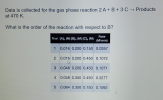 Data is collected for the gas phase reaction 2 A + B + 3 C → Products at 470 K. What is the order of the reaction with respect to B? Trial [A]. (M) [B]. (M) (C). (M) Rate (M/min) 1 0.016 0.200 0.150 0.0357 2 0.016 0.200 0.450 0.1072 3 0.048 0.200 0.450 0.1071 4 0.048 0.350 0.450 0.3277...
What statement is TRUE about the mechanism for the reaction shown here? CHỊ(CH4)2COẠCH, CH,(CHỊ) CO,CH 2,...
 What statement is TRUE about the mechanism for the reaction shown here? CHỊ(CH4)2COẠCH, CH,(CHỊ) CO,CH 2, CO,CH NAOH excess heat CHỊ(CH) CÓ CH, Water attacks the carbonyl carbon to form a tetrahedral intermediate. The first step of the reaction involves protonation of the ester carbonyl oxygen. One of the products formed is CH3(CH2)2CO2Na. Water deprotonates the alpha carbon.
The rate constant for this second-order reaction is 0.430 M-'.s at 300 °C. A- products How...
 The rate constant for this second-order reaction is 0.430 M-'.s at 300 °C. A- products How long, in seconds, would it take for the concentration of A to decrease from 0.670 M to 0.310 M? 1 = 6.355 Incorrect Calculate the rate constant, k, for a reaction at 56,0 °C that has an activation energy of 88.6 kJ/mol and a...
 QUESTION 1 The reaction 3 H2(g)+ N2g)2 NH3(g) is slightly reactant-favored at a certain temperature. Starting from the reaction at equilibrium concentration of reactants and products, which of the following actions will increase the concentration of NH3 that can be obtained.? Increase concentration of hydrogen gas. Decrease concentration of hydrogen gas. Increase concentration of nitrogen gas. Decrease concentration of nitrogen...
 Question 1 1 pts Standard heats of formation for reactants and products in the reaction below are provided. 2 HA(aq) + MX2(aq) → MA2(aq) + 2 HX(1) Substance AHf° (kJ/mol) HA(aq) 436.115 HX(0) 323.735 MA2(aq) -491.794 MX2(aq) 132.96 What is the standard enthalpy of reaction, in kJ? Report your answer to three digits after the decimal.
 2. The necessary chemical reagents (or reactants) and reaction conditions are respectively filled in the reaction formulas of the following specified raw materials and products. a PROHLCHGH OH P RCH-CHOH O CHO L =C(CH G CH.CO.CH CH OH H.CO CAN CH.CO.CH сно H.CO.C-N CONH CONH CHICHI CH.CH 110) H.C.CHCHOC, H.) HCCHCHOCH он он - сно, сност, CHCH.CH OCP
 Explain the differences in the observed reaction outcome of the following reactions: A. Unequally substituted epoxides, like 1,1-dimethyloxirane, produce two different regiochemical products under acidic and basic conditions. Briefly justify/rationalize each result. O: NaOMe HO .Me HOMe O: H2S04 Me. OH HOMe B. Rationalize the stereochemical outcome of the following reaction Me Me Me Me mCPBA, DCM (00
 The following are partial equations representing acid-base reactions. Looking carefully at the connectivity of the atoms shown in the equation and at the conjugate acid-base pairs found in the pKa table, construct structural formulas for the missing species designated by letters. Indicate the direction of the equilibrium in each case by the relative sizes of the reaction arrows. For each...
 3. Consider the unbalanced reaction NO3- (aq) + Sn2+ (aq) +Snº+(aq) + NO(g) a. Atom In the following table, identify which atom is oxidized, which atom is reduced, and their oxidation states in the reactants and products. (12 points) Oxidation State in Oxidation State in Reactant Product Oxidized Reduced b. Balance the reaction under BASIC conditions. (15 points) NO3- (aq)...
 Data is collected for the gas phase reaction 2 A + B + 3 C → Products at 470 K. What is the order of the reaction with respect to B? Trial [A]. (M) [B]. (M) (C). (M) Rate (M/min) 1 0.016 0.200 0.150 0.0357 2 0.016 0.200 0.450 0.1072 3 0.048 0.200 0.450 0.1071 4 0.048 0.350 0.450 0.3277...
 What statement is TRUE about the mechanism for the reaction shown here? CHỊ(CH4)2COẠCH, CH,(CHỊ) CO,CH 2, CO,CH NAOH excess heat CHỊ(CH) CÓ CH, Water attacks the carbonyl carbon to form a tetrahedral intermediate. The first step of the reaction involves protonation of the ester carbonyl oxygen. One of the products formed is CH3(CH2)2CO2Na. Water deprotonates the alpha carbon.
 The rate constant for this second-order reaction is 0.430 M-'.s at 300 °C. A- products How long, in seconds, would it take for the concentration of A to decrease from 0.670 M to 0.310 M? 1 = 6.355 Incorrect Calculate the rate constant, k, for a reaction at 56,0 °C that has an activation energy of 88.6 kJ/mol and a...
Most questions answered within 3 hours.