For a general first order reaction, A+ products, 35.0% of A has reacted after 14.2 hours....
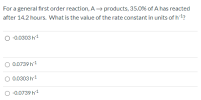 For a general first order reaction, A+ products, 35.0% of A has reacted after 14.2 hours. What is the value of the rate constant in units of h-1? 0 -0.0303 h 1 0.0739 h 1 0.0303 h 1 -0.0739h-1
6. Polylethylene terephthalate) can be synthesized from terephthalic acid and ethylene glycol in the presence of...
 6. Polylethylene terephthalate) can be synthesized from terephthalic acid and ethylene glycol in the presence of an acid catalyst and heat. acid C-OH OHCH2CH2OH catalyst heat ??-? (a) What are the two products of the reaction? (b) What is the acronym of Poly(ethylene terephthalate)?
For A - products, time and concentration data were collected and plotted as shown. 1/[A] [A]...
 For A - products, time and concentration data were collected and plotted as shown. 1/[A] [A] (M) t(s) 0.600 00.0 0.484 30.0 In[A] 0.405 60.0 0.349 90.0 Determine the reaction order, the rate constant, and the units of the rate constant. order units
1. Provide a reasonable mechanism to account for the following reaction. 3. Propose a reasonable mechanism...
 1. Provide a reasonable mechanism to account for the following
reaction.
3. Propose a reasonable mechanism for the following
reactions.
7. Propose a mechanism for the formation of the
following products.
NO2 H2SO4 HNO; Br Br AICI: + CI Br FeBrz AICI: -CI
1. Provide a reasonable mechanism to account for the following
reaction.
3. Propose a reasonable mechanism for the following
reactions.
7. Propose a mechanism for the formation of the
following products.
NO2 H2SO4 HNO; Br Br AICI: + CI Br FeBrz AICI: -CI
Give the structure of the products you would expect from the reaction (if any) of 2-butyne...
Give the structure of the products you would expect from the reaction (if any) of 2-butyne with one molar equivalent of Br2. If there is no product, simply draw the reactant, 2-butyne. Note: All structures should be drawn with no bonds between carbon and hydrogen.
1) Give the products of the synthetic sequence below. a) b) 2) What kind of selectivity...
 1) Give the products of the synthetic sequence below.
a)
b)
2) What kind of selectivity is effective in the reaction below,
give the mechanism for each step. Excess of BuLi will deprotonate
the two hydrogens (terminal alkyne and alcohol)?
CHO 2. dilydropyran. H
1) Give the products of the synthetic sequence below.
a)
b)
2) What kind of selectivity is effective in the reaction below,
give the mechanism for each step. Excess of BuLi will deprotonate
the two hydrogens (terminal alkyne and alcohol)?
CHO 2. dilydropyran. H
(2) Retrosynthesis. Provide the starting materials needed to yield the following products through either an aldol...
 (2) Retrosynthesis. Provide the starting materials needed to yield the following products through either an aldol reaction/condensation, a Michael addition, or a Robinson annulation. If a specific base must be used to aid selectivity of any step, please specify. (20 pts)
What products may form if the EAS reaction of acetanilide to form p-nitroacetanilide is not performed...
What products may form if the EAS reaction of acetanilide to form p-nitroacetanilide is not performed correctly? A) 2,3,4,5,6-pentanitroacetanilide B) 2,4-dinitroacetanilide C) 2,4,6-trinitroacetanilide D) 3,4-dinitroacetanilide E) Both 2,4-dinitroacetanilide and 2,4,6-trinitroacetanilide are possible
5. If you did not stop the reaction, would products continue to be produced indefinitely? Explain....
 5. If you did not stop the reaction, would products continue to be produced indefinitely? Explain. 6. Cells often use the product as an inhibitor to slow or stop enzymatic activity. What is an advantage to doing so? Ilon many liters is 1 mL?
3. You find that the Asotn Hº of a solution is 105.2 kJ/mol and the Asoins...
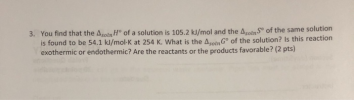 3. You find that the Asotn Hº of a solution is 105.2 kJ/mol and the Asoins of the same solution is found to be 54.1 kJ/molk at 254 K. What is the Agon Gº of the solution? Is this reaction exothermic or endothermic? Are the reactants or the products favorable? (2 pts)
 For a general first order reaction, A+ products, 35.0% of A has reacted after 14.2 hours. What is the value of the rate constant in units of h-1? 0 -0.0303 h 1 0.0739 h 1 0.0303 h 1 -0.0739h-1
 6. Polylethylene terephthalate) can be synthesized from terephthalic acid and ethylene glycol in the presence of an acid catalyst and heat. acid C-OH OHCH2CH2OH catalyst heat ??-? (a) What are the two products of the reaction? (b) What is the acronym of Poly(ethylene terephthalate)?
 For A - products, time and concentration data were collected and plotted as shown. 1/[A] [A] (M) t(s) 0.600 00.0 0.484 30.0 In[A] 0.405 60.0 0.349 90.0 Determine the reaction order, the rate constant, and the units of the rate constant. order units
 1. Provide a reasonable mechanism to account for the following
reaction.
3. Propose a reasonable mechanism for the following
reactions.
7. Propose a mechanism for the formation of the
following products.
NO2 H2SO4 HNO; Br Br AICI: + CI Br FeBrz AICI: -CI
1. Provide a reasonable mechanism to account for the following
reaction.
3. Propose a reasonable mechanism for the following
reactions.
7. Propose a mechanism for the formation of the
following products.
NO2 H2SO4 HNO; Br Br AICI: + CI Br FeBrz AICI: -CI
 1) Give the products of the synthetic sequence below.
a)
b)
2) What kind of selectivity is effective in the reaction below,
give the mechanism for each step. Excess of BuLi will deprotonate
the two hydrogens (terminal alkyne and alcohol)?
CHO 2. dilydropyran. H
1) Give the products of the synthetic sequence below.
a)
b)
2) What kind of selectivity is effective in the reaction below,
give the mechanism for each step. Excess of BuLi will deprotonate
the two hydrogens (terminal alkyne and alcohol)?
CHO 2. dilydropyran. H
 (2) Retrosynthesis. Provide the starting materials needed to yield the following products through either an aldol reaction/condensation, a Michael addition, or a Robinson annulation. If a specific base must be used to aid selectivity of any step, please specify. (20 pts)
 5. If you did not stop the reaction, would products continue to be produced indefinitely? Explain. 6. Cells often use the product as an inhibitor to slow or stop enzymatic activity. What is an advantage to doing so? Ilon many liters is 1 mL?
 3. You find that the Asotn Hº of a solution is 105.2 kJ/mol and the Asoins of the same solution is found to be 54.1 kJ/molk at 254 K. What is the Agon Gº of the solution? Is this reaction exothermic or endothermic? Are the reactants or the products favorable? (2 pts)
Most questions answered within 3 hours.