need help with parts b c d and e. 5. Fill in the blanks with the...
 need help with parts b c d and e.
5. Fill in the blanks with the correct reagent or major organic product. If mutiple products are formed in equal amounts, draw them all. Be sure to include stereochemistry, if applicable. Write NR if no reaction has occured. (5 pts each) *"For each reaction, label whether it is proceeding through Syl,...
need help with parts b c d and e.
5. Fill in the blanks with the correct reagent or major organic product. If mutiple products are formed in equal amounts, draw them all. Be sure to include stereochemistry, if applicable. Write NR if no reaction has occured. (5 pts each) *"For each reaction, label whether it is proceeding through Syl,...
1. Identify the solubility of the following compounds by circling: (2 pts each) Iron (IlIl) phosphate...
 1. Identify the solubility of the following compounds by circling: (2 pts each) Iron (IlIl) phosphate soluble insoluble а. b. sodium carbonate soluble insoluble 2. Aqueous copper (l) nitride reacts with ammonium sulfate to form solid ammonium nitride and aqueous copper (I) sulfate. Write a balanced equation for the reaction (8 pts.) 3. First, complete and balance the followiing equations...
Draw the Grignard reagent you'd expect to form from the following reaction. CI Mg ether Provide...
 Draw the Grignard reagent you'd expect to form from the following reaction. CI Mg ether Provide the product you'd expect from the following reaction? OH SOCI2 e pyridine pyridine Draw the Grignard reagent you'd expect to form from the following reaction. Mg ether Draw the major product you'd expect from the radical bromination of methylcyclohexane. Draw the major product you'd...
qual 5 In this case? Why or why not? 5.8. The hemoglobin in blood establishes an...
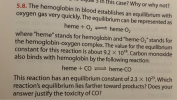 qual 5 In this case? Why or why not? 5.8. The hemoglobin in blood establishes an equilibrium with oxygen gas very quickly. The equilibrium can be represented as heme + 02 = heme-Oz where "heme" stands for hemoglobin and "heme-O," stands for the hemoglobin-oxygen complex. The value for the equilibrium constant for this reaction is about 9.2 X 10¹⁸. Carbon...
1. Classify each reaction by type. +Br a. b. сH,CH,сHсH сн, Cн,CH3CHCHсн, он c. 2. Draw...
 1. Classify each reaction by type. +Br a. b. сH,CH,сHсH сн, Cн,CH3CHCHсн, он c. 2. Draw an energy diagram for a two- step reaction where the first step is endothermic, second is exothermic and overall is endothermic. The first step is rate limiting. Label reactants, products and intermediates 3. The treatment of t-butyl alcohol with HCl gives t-butyl chloride as...
6) Refer to the following information for parts a-e: Solid sodium metal reacts with chlorine gas to produce solid s...
 6) Refer to the following information for parts a-e: Solid sodium metal reacts with chlorine gas to produce solid sodium chloride in a spontaneous exothermic reaction. a Write and balance the equation for the reaction. b. For the above reaction, identify: i The oxidation state of each atom in the reactants and products: j. The species that is oxidized: k....
Please explain Free Energy Changes in Chemical Reactions: Calculating. Below you will find key questions. 1....
Please explain Free Energy Changes in Chemical Reactions: Calculating. Below you will find key questions. 1. Calculate the standard free energy change for a reaction using the temperature, the standard enthalpy change, and the standard entropy change. 2. Interpret the meaning of the mathematical sign for the standard free energy change. 3. Calculate the standard free energy change for a...
what is the name of the enzyme that catalyzes the reaction shown below? 14.) (4 pts)...
 what is the name of the enzyme that catalyzes the reaction shown
below?
14.) (4 pts) What is the name of the enzyme that catalyzes the reaction shown below? Glyceraldehyde 3-P + Sedoheptulose 7-P. Xylulose 5-P + Ribose 5-P. This enzyme requires the following coenzyme. What is it? Draw the mechanism of this reaction converting reactants into products. Draw the...
what is the name of the enzyme that catalyzes the reaction shown
below?
14.) (4 pts) What is the name of the enzyme that catalyzes the reaction shown below? Glyceraldehyde 3-P + Sedoheptulose 7-P. Xylulose 5-P + Ribose 5-P. This enzyme requires the following coenzyme. What is it? Draw the mechanism of this reaction converting reactants into products. Draw the...
The rate constant for this first-order reaction is 0.610 s–1 at 400 °C. A--->products How long...
The rate constant for this first-order reaction is 0.610 s–1 at 400 °C. A--->products How long (in seconds) would it take for the concentration of A to decrease from 0.690 M to 0.260 M? The rate constant for this second-order reaction is 0.590 M–1·s–1 at 300 °C. How long (in seconds) would it take for the concentration of A to...
17&18. And why you chose that answer. . 17. What is (are) the major products(s) of...
 17&18.
And why you chose that answer.
. 17. What is (are) the major products(s) of the following reaction using the heavy isotope of hydrogen (D) chloride for labeling purposes? DCI A. L. II and III B. Only I and II Only III D.Only II 18. Hydration of conjugated alkene will also do an electrophilic addition with H20 and H2SO4...
17&18.
And why you chose that answer.
. 17. What is (are) the major products(s) of the following reaction using the heavy isotope of hydrogen (D) chloride for labeling purposes? DCI A. L. II and III B. Only I and II Only III D.Only II 18. Hydration of conjugated alkene will also do an electrophilic addition with H20 and H2SO4...
 need help with parts b c d and e.
5. Fill in the blanks with the correct reagent or major organic product. If mutiple products are formed in equal amounts, draw them all. Be sure to include stereochemistry, if applicable. Write NR if no reaction has occured. (5 pts each) *"For each reaction, label whether it is proceeding through Syl,...
need help with parts b c d and e.
5. Fill in the blanks with the correct reagent or major organic product. If mutiple products are formed in equal amounts, draw them all. Be sure to include stereochemistry, if applicable. Write NR if no reaction has occured. (5 pts each) *"For each reaction, label whether it is proceeding through Syl,...
 1. Identify the solubility of the following compounds by circling: (2 pts each) Iron (IlIl) phosphate soluble insoluble а. b. sodium carbonate soluble insoluble 2. Aqueous copper (l) nitride reacts with ammonium sulfate to form solid ammonium nitride and aqueous copper (I) sulfate. Write a balanced equation for the reaction (8 pts.) 3. First, complete and balance the followiing equations...
 Draw the Grignard reagent you'd expect to form from the following reaction. CI Mg ether Provide the product you'd expect from the following reaction? OH SOCI2 e pyridine pyridine Draw the Grignard reagent you'd expect to form from the following reaction. Mg ether Draw the major product you'd expect from the radical bromination of methylcyclohexane. Draw the major product you'd...
 qual 5 In this case? Why or why not? 5.8. The hemoglobin in blood establishes an equilibrium with oxygen gas very quickly. The equilibrium can be represented as heme + 02 = heme-Oz where "heme" stands for hemoglobin and "heme-O," stands for the hemoglobin-oxygen complex. The value for the equilibrium constant for this reaction is about 9.2 X 10¹⁸. Carbon...
 1. Classify each reaction by type. +Br a. b. сH,CH,сHсH сн, Cн,CH3CHCHсн, он c. 2. Draw an energy diagram for a two- step reaction where the first step is endothermic, second is exothermic and overall is endothermic. The first step is rate limiting. Label reactants, products and intermediates 3. The treatment of t-butyl alcohol with HCl gives t-butyl chloride as...
 6) Refer to the following information for parts a-e: Solid sodium metal reacts with chlorine gas to produce solid sodium chloride in a spontaneous exothermic reaction. a Write and balance the equation for the reaction. b. For the above reaction, identify: i The oxidation state of each atom in the reactants and products: j. The species that is oxidized: k....
 what is the name of the enzyme that catalyzes the reaction shown
below?
14.) (4 pts) What is the name of the enzyme that catalyzes the reaction shown below? Glyceraldehyde 3-P + Sedoheptulose 7-P. Xylulose 5-P + Ribose 5-P. This enzyme requires the following coenzyme. What is it? Draw the mechanism of this reaction converting reactants into products. Draw the...
what is the name of the enzyme that catalyzes the reaction shown
below?
14.) (4 pts) What is the name of the enzyme that catalyzes the reaction shown below? Glyceraldehyde 3-P + Sedoheptulose 7-P. Xylulose 5-P + Ribose 5-P. This enzyme requires the following coenzyme. What is it? Draw the mechanism of this reaction converting reactants into products. Draw the...
 17&18.
And why you chose that answer.
. 17. What is (are) the major products(s) of the following reaction using the heavy isotope of hydrogen (D) chloride for labeling purposes? DCI A. L. II and III B. Only I and II Only III D.Only II 18. Hydration of conjugated alkene will also do an electrophilic addition with H20 and H2SO4...
17&18.
And why you chose that answer.
. 17. What is (are) the major products(s) of the following reaction using the heavy isotope of hydrogen (D) chloride for labeling purposes? DCI A. L. II and III B. Only I and II Only III D.Only II 18. Hydration of conjugated alkene will also do an electrophilic addition with H20 and H2SO4...
Most questions answered within 3 hours.