Suppose for the following reaction the initial pressures are: 2 CO2(g) = 2 CO(g) + O2(g)...
 Suppose for the following reaction the initial pressures are: 2 CO2(g) = 2 CO(g) + O2(g) Initial 9.1 atm 1.7 atm 0 If P(O2) = 2.3 atm at equilibrium, what is the value of Keg? 0.102 O4.75 O 9.82 0.719 0.225 Question 32 3 pts The isotope Cl decays to Ar. Which of the following processes can produce this change?...
Lab Questions 1. Use the Method of Initial Rates to determine the complete rate law for...
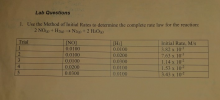 Lab Questions 1. Use the Method of Initial Rates to determine the complete rate law for the reaction: 2 NOg)+ H2(g)-> N24g) +2 H20g) Trial [H2] 0.0100 0.0200 0.0300 0.0100 0.0100 NO Initial Rate, M/s 3.82 x 10- 7.63 x 10³ 1.14 x 10² 1.53 x 10² 3.43 x 10² 20.0100 2 00100 30.0100 0.0200 0.0300 4
The drawing below shows a mixture of molecules: key carbon hydrogen nitrogen sulfur oxygen chlorine Suppose...
 The drawing below shows a mixture of molecules: key carbon hydrogen nitrogen sulfur oxygen chlorine Suppose the following chemical reaction can take place in this mixture: 2C(s)+O2(g) → 2 CO(g) Of which reactant are there the most initial moles? Enter its chemical formula: 0 | Of which reactant are there the least initial moles? Enter its chemical formula: 1 x...
Suppose that 0.1000 mole each of H2 and I2 are placed in 1.000-L flask, stoppered, and...
Suppose that 0.1000 mole each of H2 and I2 are placed in 1.000-L flask, stoppered, and the mixture is heated to 425oC. At equilibrium, the concentration of I2 is found to be 0.0210 M. a) What are the equilibrium concentrations of H2 and HI, respectively? Calculate Kc for the following reaction at 425oC. H2(g) + I2(g) ⇄ 2 HI(g) b)...
plz show work LIONS <Chapter 7 Yield Calculations Simulation - Limiting Reagent and Theoretical Yield with...
 plz show work
LIONS <Chapter 7 Yield Calculations Simulation - Limiting Reagent and Theoretical Yield with Masses www. ③ 7013 Extended applications for the law of conservation of mass Although it serves as the principle by which we establish the stoichiometric relationships between reactants and products, the law of conservation of mass can be used more rechy to determine values...
plz show work
LIONS <Chapter 7 Yield Calculations Simulation - Limiting Reagent and Theoretical Yield with Masses www. ③ 7013 Extended applications for the law of conservation of mass Although it serves as the principle by which we establish the stoichiometric relationships between reactants and products, the law of conservation of mass can be used more rechy to determine values...
Calculate AU of a gas for a process in which the gas absorbs 29 J of...
 Calculate AU of a gas for a process in which the gas absorbs 29 J of heat and does 31 J of work by expanding A. 21 B. 60) C. -60J D. -2J Which of the following statements is not true for an exothermic reaction? A. Heat passes from the reaction system to the surroundings. B. The products have a...
The rate constant for a certain reaction is k = 2.50×10⁻³ s−1 . If the initial...
The rate constant for a certain reaction is k = 2.50×10⁻³ s−1 . If the initial reactant concentration was 0.950 M, what will the concentration be after 12.0 minutes? Please help ASAP- I'm also confused about the units? Thanks in advance!
For a particular zero-order reaction, the value of the rate constant is 0.075 M·s-1. If the...
For a particular zero-order reaction, the value of the rate constant is 0.075 M·s-1. If the initial concentration of reactant was 0.540 M, how many seconds does it take for the concentration to decrease to 0.150 M? Report your answer to two significant figures.
Kinetics. The rate constant for a particular second-order reaction is 0.47 M-1s-1. If the initial concentration...
Kinetics. The rate constant for a particular second-order reaction is 0.47 M-1s-1. If the initial concentration of reactant is 0.25 mol/L, what concentration will remain after 12.0 s? SHOW ALL WORK - SHOW ALL STEPS (WITH UNITS)
For the simple decomposition reaction AB(g) → A(g) + B(g) rate = k[AB]2and k = 0.90...
For the simple decomposition reaction AB(g) → A(g) + B(g) rate = k[AB]2and k = 0.90 L/mol·s. How long will it take for [AB] to reach 1/3 of its initial concentration of 1.50 M? t = ___ s
 Suppose for the following reaction the initial pressures are: 2 CO2(g) = 2 CO(g) + O2(g) Initial 9.1 atm 1.7 atm 0 If P(O2) = 2.3 atm at equilibrium, what is the value of Keg? 0.102 O4.75 O 9.82 0.719 0.225 Question 32 3 pts The isotope Cl decays to Ar. Which of the following processes can produce this change?...
 Lab Questions 1. Use the Method of Initial Rates to determine the complete rate law for the reaction: 2 NOg)+ H2(g)-> N24g) +2 H20g) Trial [H2] 0.0100 0.0200 0.0300 0.0100 0.0100 NO Initial Rate, M/s 3.82 x 10- 7.63 x 10³ 1.14 x 10² 1.53 x 10² 3.43 x 10² 20.0100 2 00100 30.0100 0.0200 0.0300 4
 The drawing below shows a mixture of molecules: key carbon hydrogen nitrogen sulfur oxygen chlorine Suppose the following chemical reaction can take place in this mixture: 2C(s)+O2(g) → 2 CO(g) Of which reactant are there the most initial moles? Enter its chemical formula: 0 | Of which reactant are there the least initial moles? Enter its chemical formula: 1 x...
 plz show work
LIONS <Chapter 7 Yield Calculations Simulation - Limiting Reagent and Theoretical Yield with Masses www. ③ 7013 Extended applications for the law of conservation of mass Although it serves as the principle by which we establish the stoichiometric relationships between reactants and products, the law of conservation of mass can be used more rechy to determine values...
plz show work
LIONS <Chapter 7 Yield Calculations Simulation - Limiting Reagent and Theoretical Yield with Masses www. ③ 7013 Extended applications for the law of conservation of mass Although it serves as the principle by which we establish the stoichiometric relationships between reactants and products, the law of conservation of mass can be used more rechy to determine values...
 Calculate AU of a gas for a process in which the gas absorbs 29 J of heat and does 31 J of work by expanding A. 21 B. 60) C. -60J D. -2J Which of the following statements is not true for an exothermic reaction? A. Heat passes from the reaction system to the surroundings. B. The products have a...
Most questions answered within 3 hours.