Please complete. Will rate 25. Predict the major organic product(s) for each reaction below. Note: some...
 Please complete. Will rate
25. Predict the major organic product(s) for each reaction below. Note: some questions have multiple steps associated with them. (2 points each) a. O 1.Ph Culi CI 2. H20 1. CH3Li 2. H30* b. O NaBH4 OCHs CH3OH C. 1. PBr3 OH 2. NaCN 1. DIBAL-H 78 C H2SO4 OEt 2. H20 Pd(PPh3) Br FeBr3 B(OR)2
Please complete. Will rate
25. Predict the major organic product(s) for each reaction below. Note: some questions have multiple steps associated with them. (2 points each) a. O 1.Ph Culi CI 2. H20 1. CH3Li 2. H30* b. O NaBH4 OCHs CH3OH C. 1. PBr3 OH 2. NaCN 1. DIBAL-H 78 C H2SO4 OEt 2. H20 Pd(PPh3) Br FeBr3 B(OR)2
( 2 of 6 Constants Periodic Table Predict the sign of the entropy change, AS, for...
 ( 2 of 6 Constants Periodic Table Predict the sign of the entropy change, AS, for each of the reaction displayed. Drag the appropriate items to their respective bins. View Available Hint(s) Reset Help P«(8) + 509 (8)–P,010 (8) 2002(8)=+N3(8) + 202(8) Ba?+ (aq) +50,- (aq) --BaSO. (*) CaCO3(s)+CaO (s) + CO2(g) CH3(g) +502(g) → 3C02(g) + 4H2O(g) H20(1) --H2O(g)...
Interpretation of Reactions by Ionic Type Equations. Aqueous solutions of the following substances or their mixtures...
Interpretation of Reactions by Ionic Type Equations. Aqueous solutions of the following substances or their mixtures with water if they are only slightly soluble, are mixed. Write first the conventional equation, second the total ionic equation, and lastly the net ionic equation. If you predict no appreciable reaction, indicate this, and state why. a. Magnesium chloride and sodium carbonate b.Aqueous...
A voltaic cell is constructed with two silver-silver chloride electrodes, each of which is based on...
 A voltaic cell is constructed with two silver-silver chloride electrodes, each of which is based on the following half-reaction: AgCI(s) teAg(s) + CI (aq) The two cell compartments have [CI] = 0.0 150 mol L-i and [Cl]-2.55 mol Li, respectively. 1. Which electrode is the cathode of the cell? 2. What is the standard EMF of the cell? 3. What...
Predict the Product. (5 pts each; 20 pts TOTAL) Provide the stable organic product(s) that would...
 Predict the Product. (5 pts each; 20 pts TOTAL) Provide the stable organic product(s) that would result for each reaction below. Label the product formed in highest yield as “major" and include stereochemistry whenever appropriate. _0H HCI (catalytic) THE 65 °C mol. sieves Enter Full Screen CH2ONa (1 equiv.) 3-bromo-1,1,1-trifluoroacetone CHOH 25 °C - H (1 equiv.) THF 25 °C...
4. Calculate the cell potential for the half cells Fe3+/Fe2+ and MnO4- /Mn2+, where the Mn...
4. Calculate the cell potential for the half cells Fe3+/Fe2+ and MnO4- /Mn2+, where the Mn process occurs at the cathode, under the following conditions and predict whether the reaction is spontaneous: [Fe3+] = 1.0 M, [Fe2+] = 0.1 M, [MnO4 - ] = 0.01 M [Mn2+] = 1 x 10⁻⁴ M [H+ ] = 1 x 10⁻³ M Fe3+...
1. For the balanced chemical reaction: 4 NH3(g) + 5 O2(g) → 4 NO(g) + 6...
1. For the balanced chemical reaction: 4 NH3(g) + 5 O2(g) → 4 NO(g) + 6 H2O(ℓ), how many moles of H2O are produced when 0.669 mol of NH3 react? 2.For the balanced chemical reaction: 4 KO2(s) + 2 CO2(g) → 2 K2CO3(s) + 3 O2(g) determine the number of moles of each of the products that are formed when...
Limiting Reactant, Theoretical Yield and Percent Yield 2. Pentane combusts with en to form carbon dioxide...
 Limiting Reactant, Theoretical Yield and Percent Yield 2. Pentane combusts with en to form carbon dioxide and water by the following reaction: CsHız(1) + 8 O2(g) → 5 CO2(g) + 6H2O(g) a. If 8.00 g of pentane is mixed with 10.0 g of oxy compare it to either of the products). he is mixed with 10.0 g of oxygen, which...
18.. Based on selectivity factors, one can calculate the ratio of products expected from a monohalogenation...
 18.. Based on selectivity factors, one can calculate the ratio of products expected from a monohalogenation reaction. For the monochlorination reaction below, calculate the expected percent yields given that 30 hydrogens are 5 times more reactive than 1° hydrogens toward abstraction by chlorine atoms and 2° hydrogens are 3.8 times more reactive than 1° hydrogens toward abstraction by chlorine atoms...
Question 1 1 pts Standard heats of formation for reactants and products in the reaction below...
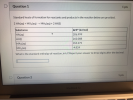 Question 1 1 pts Standard heats of formation for reactants and products in the reaction below are provided. 2 HA(aq) + MX2(aq) → MA2(aq) + 2 HX(0) Substance HA(aq) HX(1) MA2(aq) MX2(aq) AHf° (kJ/mol) 206.999 262.088 355.275 -4.824 What is the standard enthalpy of reaction, in kJ? Report your answer to three digits after the decimal. 1 pts Question 2
 Please complete. Will rate
25. Predict the major organic product(s) for each reaction below. Note: some questions have multiple steps associated with them. (2 points each) a. O 1.Ph Culi CI 2. H20 1. CH3Li 2. H30* b. O NaBH4 OCHs CH3OH C. 1. PBr3 OH 2. NaCN 1. DIBAL-H 78 C H2SO4 OEt 2. H20 Pd(PPh3) Br FeBr3 B(OR)2
Please complete. Will rate
25. Predict the major organic product(s) for each reaction below. Note: some questions have multiple steps associated with them. (2 points each) a. O 1.Ph Culi CI 2. H20 1. CH3Li 2. H30* b. O NaBH4 OCHs CH3OH C. 1. PBr3 OH 2. NaCN 1. DIBAL-H 78 C H2SO4 OEt 2. H20 Pd(PPh3) Br FeBr3 B(OR)2
 ( 2 of 6 Constants Periodic Table Predict the sign of the entropy change, AS, for each of the reaction displayed. Drag the appropriate items to their respective bins. View Available Hint(s) Reset Help P«(8) + 509 (8)–P,010 (8) 2002(8)=+N3(8) + 202(8) Ba?+ (aq) +50,- (aq) --BaSO. (*) CaCO3(s)+CaO (s) + CO2(g) CH3(g) +502(g) → 3C02(g) + 4H2O(g) H20(1) --H2O(g)...
 A voltaic cell is constructed with two silver-silver chloride electrodes, each of which is based on the following half-reaction: AgCI(s) teAg(s) + CI (aq) The two cell compartments have [CI] = 0.0 150 mol L-i and [Cl]-2.55 mol Li, respectively. 1. Which electrode is the cathode of the cell? 2. What is the standard EMF of the cell? 3. What...
 Predict the Product. (5 pts each; 20 pts TOTAL) Provide the stable organic product(s) that would result for each reaction below. Label the product formed in highest yield as “major" and include stereochemistry whenever appropriate. _0H HCI (catalytic) THE 65 °C mol. sieves Enter Full Screen CH2ONa (1 equiv.) 3-bromo-1,1,1-trifluoroacetone CHOH 25 °C - H (1 equiv.) THF 25 °C...
 Limiting Reactant, Theoretical Yield and Percent Yield 2. Pentane combusts with en to form carbon dioxide and water by the following reaction: CsHız(1) + 8 O2(g) → 5 CO2(g) + 6H2O(g) a. If 8.00 g of pentane is mixed with 10.0 g of oxy compare it to either of the products). he is mixed with 10.0 g of oxygen, which...
 18.. Based on selectivity factors, one can calculate the ratio of products expected from a monohalogenation reaction. For the monochlorination reaction below, calculate the expected percent yields given that 30 hydrogens are 5 times more reactive than 1° hydrogens toward abstraction by chlorine atoms and 2° hydrogens are 3.8 times more reactive than 1° hydrogens toward abstraction by chlorine atoms...
 Question 1 1 pts Standard heats of formation for reactants and products in the reaction below are provided. 2 HA(aq) + MX2(aq) → MA2(aq) + 2 HX(0) Substance HA(aq) HX(1) MA2(aq) MX2(aq) AHf° (kJ/mol) 206.999 262.088 355.275 -4.824 What is the standard enthalpy of reaction, in kJ? Report your answer to three digits after the decimal. 1 pts Question 2
Most questions answered within 3 hours.