1. Blood chemistry (again). The chemical equation for the binding of oxygen in your blood can...
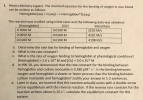 1. Blood chemistry (again). The chemical equation for the binding of oxygen in your blood can be written as follows: Hemoglobin(aq) + O2(aq) → Hemoglobin* O2(aq) The reaction was studied using initial rates and the following data was obtained: [Hemoglobin] [02] Initial Rate 0.0050 M 0.0100 M 2105 M/s 0.0050 M 0.0200 M 4201 M/s 0.0100 M 0.0100 M 4198...
The reaction of cobalt(II) nitrate and potassium thiocyanate produces a coloured complex, [Co(SCN)4]2-(aq). The initial concentrations...
 The
reaction of cobalt(II) nitrate and potassium thiocyanate produces a
coloured complex, [Co(SCN)4]2-(aq). The initial concentrations of
the reactants after mixing (before any reaction) were 0.250 mol/L
Co(NO3)2(aq) and 0.500 mol/L KSCN (aq). After 20 minutes, the
absorbance of the solution was 0.825. The complex, [Co(SCN)4]2-, is
the only absorbing species (ε b = 9.29 (mol/L)-1). Determine the
concentration of...
The
reaction of cobalt(II) nitrate and potassium thiocyanate produces a
coloured complex, [Co(SCN)4]2-(aq). The initial concentrations of
the reactants after mixing (before any reaction) were 0.250 mol/L
Co(NO3)2(aq) and 0.500 mol/L KSCN (aq). After 20 minutes, the
absorbance of the solution was 0.825. The complex, [Co(SCN)4]2-, is
the only absorbing species (ε b = 9.29 (mol/L)-1). Determine the
concentration of...
To use the Arrhenius equation to calculate the activation energy. As temperature rises, the average kinetic...
To use the Arrhenius equation to calculate the activation energy. As temperature rises, the average kinetic energy of molecules increases. In a chemical reaction, this means that a higher percentage of the molecules possess the required activation energy, and the reaction goes faster. This relationship is shown by the Arrhenius equation k=Ae−Ea/RT where k is the rate constant, A is...
True or False t. For an exothermic reaction, the equilibrium constant, Kc, becomes smaller as the...
 True or False
t. For an exothermic reaction, the equilibrium constant, Kc, becomes smaller as the temperature increases and larger as the temperature decreases. u. The gas-phase equilibrium shown below is used to produce ammonia, NH3, for commercial applications. The NH3 yield can be increased by decreasing the temperature, increasing the pressure, and removing some NH; from the mixture. N2(g)...
True or False
t. For an exothermic reaction, the equilibrium constant, Kc, becomes smaller as the temperature increases and larger as the temperature decreases. u. The gas-phase equilibrium shown below is used to produce ammonia, NH3, for commercial applications. The NH3 yield can be increased by decreasing the temperature, increasing the pressure, and removing some NH; from the mixture. N2(g)...
The Arrhenius equation shows the relationship between the rate constant k and the temperature T in...
The Arrhenius equation shows the relationship between the rate constant k and the temperature T in kelvins and is typically written as k=A e − E a /RT where R is the gas constant ( 8.314 J/mol⋅K ), A is a constant called the frequency factor, and E a is the activation energy for the reaction. However, a more practical...
A biochemist studies the properties of a metabolic enzyme she has just isolated. She obtains kinetic data in the presen...
 A biochemist studies the properties of a metabolic enzyme she
has just isolated. She obtains kinetic data in the presence and in
the absence of two different inhibitors (A and B). The identity of
the inhibitors is unknown but we know that one of these is an
substrate analog while the other is an alkylating agent.
From the plot above...
A biochemist studies the properties of a metabolic enzyme she
has just isolated. She obtains kinetic data in the presence and in
the absence of two different inhibitors (A and B). The identity of
the inhibitors is unknown but we know that one of these is an
substrate analog while the other is an alkylating agent.
From the plot above...
H2SO4 Heat нас 2 CH-OH H₂ CH-0 2 H3C-OH + H2C CR A C | CH3...
 H2SO4 Heat нас 2 CH-OH H₂ CH-0 2 H3C-OH + H2C CR A C | CH3 0-CH. нас CH3 dimethyl terephthalate 194.19 g/mol d = 1.075 g/mL bp = 288°C isopropanol 60.10 g/mol 0.7855 g/mL bp = 82.3 °C methanol 32.04 g/mol d = 0.7914 g/mL 64.6 °C diisopropyl terephthalate 250.29 g/mol d = 1.076 g/ml (est.) bp > 300...
Synthesis Based Experiment 1: Free Radical Bromination of 1,2-Diphenylethane 1. If the R,R and S,S enantiomers...
 Synthesis Based Experiment 1: Free Radical Bromination of 1,2-Diphenylethane 1. If the R,R and S,S enantiomers of 1,2-dibromo-1,2-diphenylethane have an observed melting point range of 113 -114'C and the meso 1,2-dibromo-1,2-diphenylethane has an observed melting point range of 236-237 C, which stereoisomer did you isolate? TLC 2. All three of these dibromo stereoisomers were produced in this reaction but you...
H2SO4 Heat нас 2 CH-OH H₂ CH-0 2 H3C-OH + H2C CR A C | CH3 0-CH. нас CH3 dimethyl terephthalate 194.19 g/mol d = 1.075...
 H2SO4 Heat нас 2 CH-OH H₂ CH-0 2 H3C-OH + H2C CR A C | CH3 0-CH. нас CH3 dimethyl terephthalate 194.19 g/mol d = 1.075 g/mL bp = 288°C isopropanol 60.10 g/mol 0.7855 g/mL bp = 82.3 °C methanol 32.04 g/mol d = 0.7914 g/mL 64.6 °C diisopropyl terephthalate 250.29 g/mol d = 1.076 g/ml (est.) bp > 300...
Ty Bookmarks People Tab Window Help x + K. Course Home 10 Multiple Choice Qu... One...
 Ty Bookmarks People Tab Window Help x + K. Course Home 10 Multiple Choice Qu... One of the best col... QUESTION Zpes An unknown microorganism is contaminating your fish tank. You would like to quantify the amount of the unknown microbe in the water. You are currently taking microbiology and your professor allows you to use the resources in the...
 1. Blood chemistry (again). The chemical equation for the binding of oxygen in your blood can be written as follows: Hemoglobin(aq) + O2(aq) → Hemoglobin* O2(aq) The reaction was studied using initial rates and the following data was obtained: [Hemoglobin] [02] Initial Rate 0.0050 M 0.0100 M 2105 M/s 0.0050 M 0.0200 M 4201 M/s 0.0100 M 0.0100 M 4198...
 The
reaction of cobalt(II) nitrate and potassium thiocyanate produces a
coloured complex, [Co(SCN)4]2-(aq). The initial concentrations of
the reactants after mixing (before any reaction) were 0.250 mol/L
Co(NO3)2(aq) and 0.500 mol/L KSCN (aq). After 20 minutes, the
absorbance of the solution was 0.825. The complex, [Co(SCN)4]2-, is
the only absorbing species (ε b = 9.29 (mol/L)-1). Determine the
concentration of...
The
reaction of cobalt(II) nitrate and potassium thiocyanate produces a
coloured complex, [Co(SCN)4]2-(aq). The initial concentrations of
the reactants after mixing (before any reaction) were 0.250 mol/L
Co(NO3)2(aq) and 0.500 mol/L KSCN (aq). After 20 minutes, the
absorbance of the solution was 0.825. The complex, [Co(SCN)4]2-, is
the only absorbing species (ε b = 9.29 (mol/L)-1). Determine the
concentration of...
 True or False
t. For an exothermic reaction, the equilibrium constant, Kc, becomes smaller as the temperature increases and larger as the temperature decreases. u. The gas-phase equilibrium shown below is used to produce ammonia, NH3, for commercial applications. The NH3 yield can be increased by decreasing the temperature, increasing the pressure, and removing some NH; from the mixture. N2(g)...
True or False
t. For an exothermic reaction, the equilibrium constant, Kc, becomes smaller as the temperature increases and larger as the temperature decreases. u. The gas-phase equilibrium shown below is used to produce ammonia, NH3, for commercial applications. The NH3 yield can be increased by decreasing the temperature, increasing the pressure, and removing some NH; from the mixture. N2(g)...
 A biochemist studies the properties of a metabolic enzyme she
has just isolated. She obtains kinetic data in the presence and in
the absence of two different inhibitors (A and B). The identity of
the inhibitors is unknown but we know that one of these is an
substrate analog while the other is an alkylating agent.
From the plot above...
A biochemist studies the properties of a metabolic enzyme she
has just isolated. She obtains kinetic data in the presence and in
the absence of two different inhibitors (A and B). The identity of
the inhibitors is unknown but we know that one of these is an
substrate analog while the other is an alkylating agent.
From the plot above...
 H2SO4 Heat нас 2 CH-OH H₂ CH-0 2 H3C-OH + H2C CR A C | CH3 0-CH. нас CH3 dimethyl terephthalate 194.19 g/mol d = 1.075 g/mL bp = 288°C isopropanol 60.10 g/mol 0.7855 g/mL bp = 82.3 °C methanol 32.04 g/mol d = 0.7914 g/mL 64.6 °C diisopropyl terephthalate 250.29 g/mol d = 1.076 g/ml (est.) bp > 300...
 Synthesis Based Experiment 1: Free Radical Bromination of 1,2-Diphenylethane 1. If the R,R and S,S enantiomers of 1,2-dibromo-1,2-diphenylethane have an observed melting point range of 113 -114'C and the meso 1,2-dibromo-1,2-diphenylethane has an observed melting point range of 236-237 C, which stereoisomer did you isolate? TLC 2. All three of these dibromo stereoisomers were produced in this reaction but you...
 H2SO4 Heat нас 2 CH-OH H₂ CH-0 2 H3C-OH + H2C CR A C | CH3 0-CH. нас CH3 dimethyl terephthalate 194.19 g/mol d = 1.075 g/mL bp = 288°C isopropanol 60.10 g/mol 0.7855 g/mL bp = 82.3 °C methanol 32.04 g/mol d = 0.7914 g/mL 64.6 °C diisopropyl terephthalate 250.29 g/mol d = 1.076 g/ml (est.) bp > 300...
 Ty Bookmarks People Tab Window Help x + K. Course Home 10 Multiple Choice Qu... One of the best col... QUESTION Zpes An unknown microorganism is contaminating your fish tank. You would like to quantify the amount of the unknown microbe in the water. You are currently taking microbiology and your professor allows you to use the resources in the...
Most questions answered within 3 hours.