By isolating the cost of unused capacity, Activity-Based Costing (ABC) helps management: a. investigate the underlying...
By isolating the cost of unused capacity, Activity-Based Costing (ABC) helps management: a. investigate the underlying reason for the unused capacity. b. include the cost of unused capacity in selling price decisions. c. find ways to increase unused capacity. e. a, b, and c.
Firm ABC issued 1 billion dollars in bonds to fund a share repurchase program. Assume that the share price before is $34...
Firm ABC issued 1 billion dollars in bonds to fund a share repurchase program. Assume that the share price before is $34.88 and that there are 185.5 million shares outstanding before the new bond issue. What is the share price at which UST will conduct the share repurchase?
S 5.4 Use R to Generate Fractional Factorials Use R and the FrF2 Package to create...
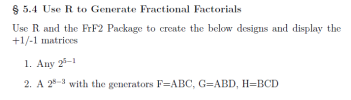 S 5.4 Use R to Generate Fractional Factorials Use R and the FrF2 Package to create the below designs and display the +1/-1 matrices 1. Any 25-1 2. A 28-3 with the generators F ABC, G-ABD, H-BCD
Suppose I am modeling a bank. For a CUSTOMER entity, explain why a customer's social security...
 Suppose I am modeling a bank. For a CUSTOMER entity, explain why a customer's social security number is a better identifier than (LastName, FirstName). ABC T T T Arial 3 (12pt) T M i Path: P Words:0
Given the quiz below, find the probabilities that follow. Round answers to four decimal places. 1,...
 Given the quiz below, find the probabilities that follow. Round answers to four decimal places. 1, А В С 2, A B C 3. ABC 4. A B C 5. A B C Find the probability of getting 2 questions right.
Determine the volumes in mm3 of the solids generated by revolving triangular plate ABC (shown) one...
 Determine the volumes in mm3 of the solids generated by revolving triangular plate ABC (shown) one revolution about the following axes. 105 mm 126 mm B 84 mm A 315 mm (a) the x-axis mm 3 (b) the y-axis mm3
ABC has a bond trading on the secondary market with a time to maturity of five...
ABC has a bond trading on the secondary market with a time to maturity of five years. The bond pays a semi-annual coupon and has a coupon rate of 7.6%. The bonds currently trade at $850 and have a face value of $1,000. What is the yield to maturity? (express as an APR)
Solve the triangle ABC if b = 120, c = 166, LB 40 a Preview ΖΑ...
 Solve the triangle ABC if b = 120, c = 166, LB 40 a Preview ΖΑ = Preview degrees: degrees; ZC = Preview Assume ZA is opposite side a, ZB is opposite side b, and 2C is opposite side c. State the law that you used.
ABC has $32 million of inventory and $31 million of accounts receivable. Its average daily sales...
ABC has $32 million of inventory and $31 million of accounts receivable. Its average daily sales are $851,000 and its gross profit margin is 22 percent. The company’s payables deferral period is 54.2 days. What is the length of the firm's cash conversion cycle?
3. What is the closure of {A, B} in R(A, B, C, D, E, F, G)...
 3. What is the closure of {A, B} in R(A, B, C, D, E, F, G) with respect to the following sets of func- tional dependencies: (a) A+ ABD ABDEF + CG D+E ABC (b) D+A D+EF ABG C A+B AB +D
 S 5.4 Use R to Generate Fractional Factorials Use R and the FrF2 Package to create the below designs and display the +1/-1 matrices 1. Any 25-1 2. A 28-3 with the generators F ABC, G-ABD, H-BCD
 Suppose I am modeling a bank. For a CUSTOMER entity, explain why a customer's social security number is a better identifier than (LastName, FirstName). ABC T T T Arial 3 (12pt) T M i Path: P Words:0
 Given the quiz below, find the probabilities that follow. Round answers to four decimal places. 1, А В С 2, A B C 3. ABC 4. A B C 5. A B C Find the probability of getting 2 questions right.
 Determine the volumes in mm3 of the solids generated by revolving triangular plate ABC (shown) one revolution about the following axes. 105 mm 126 mm B 84 mm A 315 mm (a) the x-axis mm 3 (b) the y-axis mm3
 Solve the triangle ABC if b = 120, c = 166, LB 40 a Preview ΖΑ = Preview degrees: degrees; ZC = Preview Assume ZA is opposite side a, ZB is opposite side b, and 2C is opposite side c. State the law that you used.
 3. What is the closure of {A, B} in R(A, B, C, D, E, F, G) with respect to the following sets of func- tional dependencies: (a) A+ ABD ABDEF + CG D+E ABC (b) D+A D+EF ABG C A+B AB +D
Most questions answered within 3 hours.