1. (10pts) Provide the missing reagents/conditions and the products for each reaction. Also please label which...
 1. (10pts) Provide the missing reagents/conditions and the products for each reaction. Also please label which product is made under thermodynamic and kinetic control. مل Br Br 2. 9pts) Identify all reagents necessary to form the following Robinson Ring annulation product. ? ?
C) Give the major organic products for the following reactions and show the mechanism for 1-3. Be sure to consider...
 C) Give the major organic products for the following reactions and show the mechanism for 1-3. Be sure to consider the regioselectivity of each reaction! Cн. Brz CHs н" 2 сн,он CHs Cl2 3 н,о но- CH Hа Pd/C Cн
18 In the following Fischer esterification reaction, a reagent containing (an isotope of oxygen) is used...
 18 In the following Fischer esterification reaction, a reagent containing (an isotope of oxygen) is used as a starting material. Where can theo be found in the products? Select all that apply. 180 H2SO4 + OH OH Select one or more: 180 a. + H2O b. + H2180 C. incon + H20
Choose all products that are formed when this ester is used in a Claisen reaction? ÇO2C2H5...
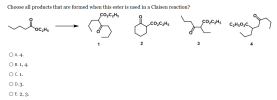 Choose all products that are formed when this ester is used in a Claisen reaction? ÇO2C2H5 CO2C2H5 _C02C2H5 C2H502C non foron Leak esagen OC2H5 o o O A. 4. O B.1, 4. O C.1. OD.3. O E. 2,3
2. Draw a detailed, stepwise mechanism to show how the products of this reaction form. Clearly...
 2. Draw a detailed, stepwise mechanism to show how the products of this reaction form. Clearly draw the structures of all reactive intermediates. Use curved arrows and include all formal charges. Hint: both Sy1 and SN2 chemistry is required. (2 pts) Oor 21Oo..mo
II. REACTION MECHANISMS Provide plausible arrow pushing mechanisms to explain how products are formed. WATCH THE...
 II. REACTION MECHANISMS Provide plausible arrow pushing mechanisms to explain how products are formed. WATCH THE DIRECTION (Nu- to E+). The hydrogen bond will NEVER (as in NEVER) move on its own. Make sure the arrows are clear so I can see them as a PDF file
A 5 MW gas turbine power plant is reported to have a thermodynamic efficiency of 35%....
 A 5 MW gas turbine power plant is reported to have a thermodynamic efficiency of 35%. Assume products of the combustion reaction exit at 750K with water in the gaseous phase. What is the corresponding heat rate of the power cycle? How much methane (kg/h) is required to power this plant?
Please show work. Thank you. Be sure to answer all parts. Balance the following skeleton reaction...
 Please show work. Thank you.
Be sure to answer all parts. Balance the following skeleton reaction and identify the oxidizing and reducing agents: Include the states of all reactants and products in your balanced equation. You do not need to include the states with the identifies of the oxidizing and reducing agents.
Please show work. Thank you.
Be sure to answer all parts. Balance the following skeleton reaction and identify the oxidizing and reducing agents: Include the states of all reactants and products in your balanced equation. You do not need to include the states with the identifies of the oxidizing and reducing agents.
The equilibrium constant, K, for the following reaction is 1.29x10⁻² at 600 K. COCI2(g) CO(g) +...
 The equilibrium constant, K, for the following reaction is 1.29x10⁻² at 600 K. COCI2(g) CO(g) + Cl2(g) Calculate the equilibrium concentrations of reactant and products when 0.252 moles of CoCl2(g) are introduced into a 1.00 L vessel at 600 K. [COCI2] = [Co] = (C12] =
QUESTION 6 Which products are formed in the reaction between the two reactants below? HC2H302(aq) +52...
 QUESTION 6 Which products are formed in the reaction between the two reactants below? HC2H302(aq) +52 (aq) → H2C2H302+ (aq) +53-(aq) OH30+ (aq) + OH"(aq) C2H302 (aq) + HS (aq) C2H302 (aq) + H2S"(aq) SC2H302 (aq) + H20(aq)
 1. (10pts) Provide the missing reagents/conditions and the products for each reaction. Also please label which product is made under thermodynamic and kinetic control. مل Br Br 2. 9pts) Identify all reagents necessary to form the following Robinson Ring annulation product. ? ?
 C) Give the major organic products for the following reactions and show the mechanism for 1-3. Be sure to consider the regioselectivity of each reaction! Cн. Brz CHs н" 2 сн,он CHs Cl2 3 н,о но- CH Hа Pd/C Cн
 18 In the following Fischer esterification reaction, a reagent containing (an isotope of oxygen) is used as a starting material. Where can theo be found in the products? Select all that apply. 180 H2SO4 + OH OH Select one or more: 180 a. + H2O b. + H2180 C. incon + H20
 Choose all products that are formed when this ester is used in a Claisen reaction? ÇO2C2H5 CO2C2H5 _C02C2H5 C2H502C non foron Leak esagen OC2H5 o o O A. 4. O B.1, 4. O C.1. OD.3. O E. 2,3
 2. Draw a detailed, stepwise mechanism to show how the products of this reaction form. Clearly draw the structures of all reactive intermediates. Use curved arrows and include all formal charges. Hint: both Sy1 and SN2 chemistry is required. (2 pts) Oor 21Oo..mo
 II. REACTION MECHANISMS Provide plausible arrow pushing mechanisms to explain how products are formed. WATCH THE DIRECTION (Nu- to E+). The hydrogen bond will NEVER (as in NEVER) move on its own. Make sure the arrows are clear so I can see them as a PDF file
 A 5 MW gas turbine power plant is reported to have a thermodynamic efficiency of 35%. Assume products of the combustion reaction exit at 750K with water in the gaseous phase. What is the corresponding heat rate of the power cycle? How much methane (kg/h) is required to power this plant?
 Please show work. Thank you.
Be sure to answer all parts. Balance the following skeleton reaction and identify the oxidizing and reducing agents: Include the states of all reactants and products in your balanced equation. You do not need to include the states with the identifies of the oxidizing and reducing agents.
Please show work. Thank you.
Be sure to answer all parts. Balance the following skeleton reaction and identify the oxidizing and reducing agents: Include the states of all reactants and products in your balanced equation. You do not need to include the states with the identifies of the oxidizing and reducing agents.
 The equilibrium constant, K, for the following reaction is 1.29x10⁻² at 600 K. COCI2(g) CO(g) + Cl2(g) Calculate the equilibrium concentrations of reactant and products when 0.252 moles of CoCl2(g) are introduced into a 1.00 L vessel at 600 K. [COCI2] = [Co] = (C12] =
 QUESTION 6 Which products are formed in the reaction between the two reactants below? HC2H302(aq) +52 (aq) → H2C2H302+ (aq) +53-(aq) OH30+ (aq) + OH"(aq) C2H302 (aq) + HS (aq) C2H302 (aq) + H2S"(aq) SC2H302 (aq) + H20(aq)
Most questions answered within 3 hours.