PROBLEM 7-24 1. Predict the elimination products of the following reactions. When two alkenes are possible,...
 PROBLEM 7-24 1. Predict the elimination products of the following reactions. When two alkenes are possible, predict which one will be the major product. Explain your answers showing the degree of substitution of each double bond in the products. 2. Which of these reactions are likely to produce both elimination and substitution products? (a) 2-bromopentane + NaOCH3 (b) 3-bromo-3-methylpentane NaO...
help me pleaseee Question 24 (1 point) A substance (A) reacts to form another substance (B):...
 help me pleaseee
Question 24 (1 point) A substance (A) reacts to form another substance (B): 3 A(g) = 2 B(8) The reaction is run at a particular temperature with the concentrations of A and B monitored over time and plotted in the graph. At what time was equilibrium first reached and what is the approximate value of the equilibrium...
help me pleaseee
Question 24 (1 point) A substance (A) reacts to form another substance (B): 3 A(g) = 2 B(8) The reaction is run at a particular temperature with the concentrations of A and B monitored over time and plotted in the graph. At what time was equilibrium first reached and what is the approximate value of the equilibrium...
For the following reaction PCl5(g) <-> PCl3(g) + Cl2(g) Kc=1.80. The starting concentration of PCl5 is...
For the following reaction PCl5(g) <-> PCl3(g) + Cl2(g) Kc=1.80. The starting concentration of PCl5 is 0.125 M inside a sealed container. What is the equilibrium concentration of PCl3? Show all work including an ICE table. 2. For the question above, what is the total pressure at equilibrium inside the container? 3. For the following cases (a-d), predict if the...
Predict the product or products from the hydroformylation of cyclohexene
Predict the product or products from the hydroformylation of cyclohexene
Predict the products of the following reactions. a)b)c)
 Predict the products of the following reactions.
a)b)c)
Predict the products of the following reactions.
a)b)c)
D. Predict the products from the following reactions:
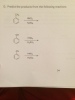 D. Predict the products from the following reactions:
Predict the major organic products of the following reactions
 Predict the major organic products of the following reactions
Predict the products Chlorocyclopentane and sodium ethoxide in methanol.
 Predict the products
Chlorocyclopentane and sodium ethoxide in methanol.
Predict the products
Chlorocyclopentane and sodium ethoxide in methanol.
Ammonia (NH3) reacts with oxygen (O2) to form nitric oxide (NO) and water (H20). Consider the...
 Ammonia (NH3) reacts with oxygen (O2) to form nitric oxide (NO) and water (H20). Consider the reaction of 100 moles/s of ammonia at 25°C with 50% excess air also at 25°C. The reaction reaches 75% conversion of the limiting reagent and the products leave at 200°C. The entire process is conducted isobarically at 1 atm. Determine the following: a) Write...
Consider the following pair of reactions. Predict the type of elimination mechanism, predict which reaction of...
 Consider the following pair of reactions. Predict the type of
elimination mechanism, predict which reaction of the pair will
occur at the fastest rate, and draw the correct organic
product.
Consider the following pair of reactions. Predict the type of elimination mechanism, predict which reaction of the pair will occur at the fastest rate, and draw the correct organic product....
Consider the following pair of reactions. Predict the type of
elimination mechanism, predict which reaction of the pair will
occur at the fastest rate, and draw the correct organic
product.
Consider the following pair of reactions. Predict the type of elimination mechanism, predict which reaction of the pair will occur at the fastest rate, and draw the correct organic product....
 PROBLEM 7-24 1. Predict the elimination products of the following reactions. When two alkenes are possible, predict which one will be the major product. Explain your answers showing the degree of substitution of each double bond in the products. 2. Which of these reactions are likely to produce both elimination and substitution products? (a) 2-bromopentane + NaOCH3 (b) 3-bromo-3-methylpentane NaO...
 help me pleaseee
Question 24 (1 point) A substance (A) reacts to form another substance (B): 3 A(g) = 2 B(8) The reaction is run at a particular temperature with the concentrations of A and B monitored over time and plotted in the graph. At what time was equilibrium first reached and what is the approximate value of the equilibrium...
help me pleaseee
Question 24 (1 point) A substance (A) reacts to form another substance (B): 3 A(g) = 2 B(8) The reaction is run at a particular temperature with the concentrations of A and B monitored over time and plotted in the graph. At what time was equilibrium first reached and what is the approximate value of the equilibrium...
 Predict the products of the following reactions.
a)b)c)
Predict the products of the following reactions.
a)b)c)
 D. Predict the products from the following reactions:
 Predict the major organic products of the following reactions
 Predict the products
Chlorocyclopentane and sodium ethoxide in methanol.
Predict the products
Chlorocyclopentane and sodium ethoxide in methanol.
 Ammonia (NH3) reacts with oxygen (O2) to form nitric oxide (NO) and water (H20). Consider the reaction of 100 moles/s of ammonia at 25°C with 50% excess air also at 25°C. The reaction reaches 75% conversion of the limiting reagent and the products leave at 200°C. The entire process is conducted isobarically at 1 atm. Determine the following: a) Write...
 Consider the following pair of reactions. Predict the type of
elimination mechanism, predict which reaction of the pair will
occur at the fastest rate, and draw the correct organic
product.
Consider the following pair of reactions. Predict the type of elimination mechanism, predict which reaction of the pair will occur at the fastest rate, and draw the correct organic product....
Consider the following pair of reactions. Predict the type of
elimination mechanism, predict which reaction of the pair will
occur at the fastest rate, and draw the correct organic
product.
Consider the following pair of reactions. Predict the type of elimination mechanism, predict which reaction of the pair will occur at the fastest rate, and draw the correct organic product....
Most questions answered within 3 hours.