Given the reaction below, H2 (g)+ I2 (g)⇌ 2 HI (g) Kc = 50.5 What was...
Given the reaction below, H2 (g)+ I2 (g)⇌ 2 HI (g) Kc = 50.5 What was the initial mass of HI (g) placed in a sealed 1.50 L flask which resulted in 0.025 mol of each of H2 (g) and I2 (g) being found in the flask at equilibrium?
The bar (m = 4 kg, l = 0.80 m) is pinned in the ground at...
 The bar (m = 4 kg, l = 0.80 m) is pinned in the ground at O and is released from rest at an inclination theta = pi/4 rad. If the applied force is F = -F j, with F = 12 N, find the initial angular acceleration of the bar, and the reaction force acting at O.
Question 13 1/1 point The first-order reaction, S02Cl2-502 Cly, has a rate constant equal to 2.20...
 Question 13 1/1 point The first-order reaction, S02Cl2-502 Cly, has a rate constant equal to 2.20 x 10⁻⁵-1 at 593 K. What percentage of the initial amount of SOC will remain after 5.00 hours? 6733 100% 32.7 35.15
At a particular temp. Ke=7.6 x 10 for 2 Hasigl 2 Ha Ha cg) + Sacq)....
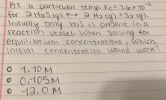 At a particular temp. Ke=7.6 x 10 for 2 Hasigl 2 Ha Ha cg) + Sacq). Initially only has is present in a reaction vessel. When solving for equilibrium concentrations, which initial concentration would work? o 1.10 M 0 0.105M 0 12.0M
Calculate the equilibrium concentrations of H2O, Cl, HCl, and O2 at 298 K if the initial...
 Calculate the equilibrium concentrations of H2O, Cl, HCl, and O2 at 298 K if the initial concentrations are (H2O) = 0.070 M and (Cl2] = 0.120 M. The equilibrium constant Kc for the reaction H2O(g) + Cl2(g) + 2HCl(g) + O2(g) is 8.96 x 10 -9 at 298 K
The reaction 2H2S(g)⇌2H2(g)+S2(g), Kc=1.67×10⁻⁷, at 800∘C is carried out with the following initial concentrations: [H2S] =...
The reaction 2H2S(g)⇌2H2(g)+S2(g), Kc=1.67×10⁻⁷, at 800∘C is carried out with the following initial concentrations: [H2S] = 0.375 M , [H2] =0.125 M , and [S2] = 0.000 M. Find the equilibrium [S2]. Express your answer with the appropriate units.
A particular second order reaction has a rate of 1.736 X 10⁻³ M/min when the initial...
A particular second order reaction has a rate of 1.736 X 10⁻³ M/min when the initial concentration is 1.250 M. How long will it take for the rate to drop from 1.736 X 10⁻³ M/min to 6.944 X 10⁻⁵ M/min?
Are the turnover rate (kcat) and equilibrium constant a state functions or path functions? This is...
Are the turnover rate (kcat) and equilibrium constant a state functions or path functions? This is related to invertase-catalyzed hydrolysis of sucrose. Used the Lineweaver-Burke Plot to calculate them. So y axis is the inverse of the rate of reaction and x axis is the inverse of the initial molar concentration of sucrose. This is Phys Chem.
6. 0.2/1 points | Previous Answers SCalcET8 9.4.009 My Notes Ask Your Suppose the population of the world was about 6.4 billion in 2000. Birth rates around that time ranged from 35 to 40 million per...
 6. 0.2/1 points | Previous Answers SCalcET8 9.4.009 My Notes Ask Your Suppose the population of the world was about 6.4 billion in 2000. Birth rates around that time ranged from 35 to 40 million per year and death rates ranged from 15 to 20 million per year. Let's assume that the carrying capacity for world population is 20 billion...
fari File Edit View History Bookmarks Window Help ?5450 Sat 1:22PM ao 3E: Collaions Section 3.12...
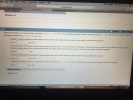 fari File Edit View History Bookmarks Window Help ?5450 Sat 1:22PM ao 3E: Collaions Section 3.12 MI4 312.053 Object A has mass mA- 9 kg and initial has initial momentum 7B 3,5, o> kg m/s momentum FA i 21,6,O> kg m/s, Just before it strikes object B, which has mass mo - 13 kg. Just before the collision object Consider...
 The bar (m = 4 kg, l = 0.80 m) is pinned in the ground at O and is released from rest at an inclination theta = pi/4 rad. If the applied force is F = -F j, with F = 12 N, find the initial angular acceleration of the bar, and the reaction force acting at O.
 Question 13 1/1 point The first-order reaction, S02Cl2-502 Cly, has a rate constant equal to 2.20 x 10⁻⁵-1 at 593 K. What percentage of the initial amount of SOC will remain after 5.00 hours? 6733 100% 32.7 35.15
 At a particular temp. Ke=7.6 x 10 for 2 Hasigl 2 Ha Ha cg) + Sacq). Initially only has is present in a reaction vessel. When solving for equilibrium concentrations, which initial concentration would work? o 1.10 M 0 0.105M 0 12.0M
 Calculate the equilibrium concentrations of H2O, Cl, HCl, and O2 at 298 K if the initial concentrations are (H2O) = 0.070 M and (Cl2] = 0.120 M. The equilibrium constant Kc for the reaction H2O(g) + Cl2(g) + 2HCl(g) + O2(g) is 8.96 x 10 -9 at 298 K
 6. 0.2/1 points | Previous Answers SCalcET8 9.4.009 My Notes Ask Your Suppose the population of the world was about 6.4 billion in 2000. Birth rates around that time ranged from 35 to 40 million per year and death rates ranged from 15 to 20 million per year. Let's assume that the carrying capacity for world population is 20 billion...
 fari File Edit View History Bookmarks Window Help ?5450 Sat 1:22PM ao 3E: Collaions Section 3.12 MI4 312.053 Object A has mass mA- 9 kg and initial has initial momentum 7B 3,5, o> kg m/s momentum FA i 21,6,O> kg m/s, Just before it strikes object B, which has mass mo - 13 kg. Just before the collision object Consider...
Most questions answered within 3 hours.