EXPERIMENT 4 Organic Families - Reactions and Identification of Functional Groups PART A. Reactions of Alkanes and Alkenes 1. Action of Bromine Water Observation Organic Compound cyclohexene c...
 EXPERIMENT 4 Organic Families - Reactions and Identification of Functional Groups PART A. Reactions of Alkanes and Alkenes 1. Action of Bromine Water Observation Organic Compound cyclohexene cyclohexane Equations: Write an equation for the above compounds which caused a decolourisation of bromine water. Name and draw all reactants and products. Distinguishing Test for Primary, Secondary and Tertiary Alcohols PART B....
question 12 & 13 12. The following reaction is second order in respect to CH3COOCH3. The...
 question 12 & 13
12. The following reaction is second order in respect to CH3COOCH3. The rate constant is 2.0 X 10³ L/(mol s), what is the concentration of the CH3COOCH3 after 4 minutes if the initial concentration of CH3COOCH3 is 0.25 M? CH3COOCH3 OH CH3COOCH3OH o inao si odool ni 00 o otil-lipd & aart noisassno shoo Aa noitbe...
question 12 & 13
12. The following reaction is second order in respect to CH3COOCH3. The rate constant is 2.0 X 10³ L/(mol s), what is the concentration of the CH3COOCH3 after 4 minutes if the initial concentration of CH3COOCH3 is 0.25 M? CH3COOCH3 OH CH3COOCH3OH o inao si odool ni 00 o otil-lipd & aart noisassno shoo Aa noitbe...
Using the GCU Library, locate a journal article about job-costing systems or how managerial accounting helps...
Using the GCU Library, locate a journal article about job-costing systems or how managerial accounting helps businesses make decisions. In the subject line of your post, include the name of the article that you read. Post a link to that article with your initial post, and provide a summary and a reaction to the article. The summary should be approximately...
i need the right answer with shown all work for my mistake 4. DETERMINATION OF THE...
 i need the right answer with shown all work for my
mistake
4. DETERMINATION OF THE RATE LAW For the same reaction problem 3 above, consider the following data for the kinetics of this reaction: 2 N2O3(g) ----4NO2(g) + O2(g) Experiment Intial [N, O1 (mol L') Initial Rate of Reaction (mol L's) 3.0 x 10 9.0 x 10 9. O...
i need the right answer with shown all work for my
mistake
4. DETERMINATION OF THE RATE LAW For the same reaction problem 3 above, consider the following data for the kinetics of this reaction: 2 N2O3(g) ----4NO2(g) + O2(g) Experiment Intial [N, O1 (mol L') Initial Rate of Reaction (mol L's) 3.0 x 10 9.0 x 10 9. O...
1. You have the following data for the following reaction at a particular temperature: H2PO. Mag)...
 1. You have the following data for the following reaction at a particular temperature: H2PO. Mag) + OH(aq) — HPO.2"(aq) + H20(1) Experiment (OH). (mol/L) [H2PO4) (mol/L) 0.0030 Initial Rate(mol/L min) 0.00040 0.0020 0.0030 0.00120 0.0180 0.0090 0.00040 0.0060 Write the rate law expression for this reaction and the value of the rate constant (with its appropriate units). 2. You...
A study of the rate of the reaction represented as 2AB gave the following data: Time...
 A study of the rate of the reaction represented as 2AB gave the following data: Time (s) 0.0 5.0 10.0 15.0 20.0 25.0 30.0 [A] (M) 1.00 0.775 0.625 0.465 0.360 0.285 0.230 3. Determine the average rate of disappearance of A between 0.0 and 10.0 s, and between 10.0 and 20.0 s. 4. What order is the above reaction?...
Initial Check certain catalyzed reaction is known to have an activation energy E 42.0 kJ/mol. Furthermore,...
 Initial Check certain catalyzed reaction is known to have an activation energy E 42.0 kJ/mol. Furthermore, the rate of this reaction is measured at 313. K and found to be 9.8 x 10 M/s. Use this information to answer the questions in the table below. (You may need to use the scrollbar to see all the choices.) the kept the...
Question 4 (1 point) Pandit et al. (2018) used an ecological approach to predict human vulnerability...
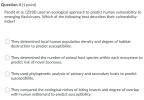 Question 4 (1 point) Pandit et al. (2018) used an ecological approach to predict human vulnerability to emerging flaviviruses. Which of the following best describes their vulnerability index? O They determined local human population density and degree of habitat destruction to predict susceptibility. They determined the number of animal host species within each ecosystem to predict risk of novel zoonoses....
IV. Heat of reaction of a weak acid with weak base Total mass of solution Final temp. of solution...
 need help
IV. Heat of reaction of a weak acid with weak base Total mass of solution Final temp. of solution Initial temp. of solutions AT Water AH reaction 40 9 29 C 22"C Calculation: Heat of reaction per mole water formed Moles of water formed AH reaction per mole H,O formed Calculation Heat of dissociation of weak acid and...
need help
IV. Heat of reaction of a weak acid with weak base Total mass of solution Final temp. of solution Initial temp. of solutions AT Water AH reaction 40 9 29 C 22"C Calculation: Heat of reaction per mole water formed Moles of water formed AH reaction per mole H,O formed Calculation Heat of dissociation of weak acid and...
a) Look at the reaction diagram for this reaction (Figure 9.2 in your textbook) and answer...
 a) Look at the reaction diagram for this reaction (Figure 9.2 in your textbook) and answer the following questions. 1) Is this diagram consistent with the rate law? Why or why not? 2) Experimental evidence shows that tertiary alkyl halides react the fastest and primary alkyl halides react the slowest with nucleophiles in this reaction. Explain why this is consistent...
 EXPERIMENT 4 Organic Families - Reactions and Identification of Functional Groups PART A. Reactions of Alkanes and Alkenes 1. Action of Bromine Water Observation Organic Compound cyclohexene cyclohexane Equations: Write an equation for the above compounds which caused a decolourisation of bromine water. Name and draw all reactants and products. Distinguishing Test for Primary, Secondary and Tertiary Alcohols PART B....
 question 12 & 13
12. The following reaction is second order in respect to CH3COOCH3. The rate constant is 2.0 X 10³ L/(mol s), what is the concentration of the CH3COOCH3 after 4 minutes if the initial concentration of CH3COOCH3 is 0.25 M? CH3COOCH3 OH CH3COOCH3OH o inao si odool ni 00 o otil-lipd & aart noisassno shoo Aa noitbe...
question 12 & 13
12. The following reaction is second order in respect to CH3COOCH3. The rate constant is 2.0 X 10³ L/(mol s), what is the concentration of the CH3COOCH3 after 4 minutes if the initial concentration of CH3COOCH3 is 0.25 M? CH3COOCH3 OH CH3COOCH3OH o inao si odool ni 00 o otil-lipd & aart noisassno shoo Aa noitbe...
 i need the right answer with shown all work for my
mistake
4. DETERMINATION OF THE RATE LAW For the same reaction problem 3 above, consider the following data for the kinetics of this reaction: 2 N2O3(g) ----4NO2(g) + O2(g) Experiment Intial [N, O1 (mol L') Initial Rate of Reaction (mol L's) 3.0 x 10 9.0 x 10 9. O...
i need the right answer with shown all work for my
mistake
4. DETERMINATION OF THE RATE LAW For the same reaction problem 3 above, consider the following data for the kinetics of this reaction: 2 N2O3(g) ----4NO2(g) + O2(g) Experiment Intial [N, O1 (mol L') Initial Rate of Reaction (mol L's) 3.0 x 10 9.0 x 10 9. O...
 1. You have the following data for the following reaction at a particular temperature: H2PO. Mag) + OH(aq) — HPO.2"(aq) + H20(1) Experiment (OH). (mol/L) [H2PO4) (mol/L) 0.0030 Initial Rate(mol/L min) 0.00040 0.0020 0.0030 0.00120 0.0180 0.0090 0.00040 0.0060 Write the rate law expression for this reaction and the value of the rate constant (with its appropriate units). 2. You...
 A study of the rate of the reaction represented as 2AB gave the following data: Time (s) 0.0 5.0 10.0 15.0 20.0 25.0 30.0 [A] (M) 1.00 0.775 0.625 0.465 0.360 0.285 0.230 3. Determine the average rate of disappearance of A between 0.0 and 10.0 s, and between 10.0 and 20.0 s. 4. What order is the above reaction?...
 Initial Check certain catalyzed reaction is known to have an activation energy E 42.0 kJ/mol. Furthermore, the rate of this reaction is measured at 313. K and found to be 9.8 x 10 M/s. Use this information to answer the questions in the table below. (You may need to use the scrollbar to see all the choices.) the kept the...
 Question 4 (1 point) Pandit et al. (2018) used an ecological approach to predict human vulnerability to emerging flaviviruses. Which of the following best describes their vulnerability index? O They determined local human population density and degree of habitat destruction to predict susceptibility. They determined the number of animal host species within each ecosystem to predict risk of novel zoonoses....
 need help
IV. Heat of reaction of a weak acid with weak base Total mass of solution Final temp. of solution Initial temp. of solutions AT Water AH reaction 40 9 29 C 22"C Calculation: Heat of reaction per mole water formed Moles of water formed AH reaction per mole H,O formed Calculation Heat of dissociation of weak acid and...
need help
IV. Heat of reaction of a weak acid with weak base Total mass of solution Final temp. of solution Initial temp. of solutions AT Water AH reaction 40 9 29 C 22"C Calculation: Heat of reaction per mole water formed Moles of water formed AH reaction per mole H,O formed Calculation Heat of dissociation of weak acid and...
 a) Look at the reaction diagram for this reaction (Figure 9.2 in your textbook) and answer the following questions. 1) Is this diagram consistent with the rate law? Why or why not? 2) Experimental evidence shows that tertiary alkyl halides react the fastest and primary alkyl halides react the slowest with nucleophiles in this reaction. Explain why this is consistent...
Most questions answered within 3 hours.