please help with 3 and 4! UquimulTum ll concentrations are correct following reaction does not proceed...
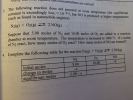 please help with 3 and 4!
UquimulTum ll concentrations are correct following reaction does not proceed at room temperature (the equilibrium nstant is exceedingly low, 10-31), but NO is produced at higher temperatures co h as found in automobile engines) (suc N2(g) + O2(g) 2 NO(g) Suppose that 5.00 moles of N2 and 10.00 moles of 02 are added to...
please help with 3 and 4!
UquimulTum ll concentrations are correct following reaction does not proceed at room temperature (the equilibrium nstant is exceedingly low, 10-31), but NO is produced at higher temperatures co h as found in automobile engines) (suc N2(g) + O2(g) 2 NO(g) Suppose that 5.00 moles of N2 and 10.00 moles of 02 are added to...
q 4 Be sure to answer all parts. The reaction of peroxydisulfate ion (S20s with iodide...
 q 4
Be sure to answer all parts. The reaction of peroxydisulfate ion (S20s with iodide ion (I) is S20s(aq) + 31(aq) - » 2sO4(aq) + I3 (aq) From the following data collected at a certain temperature, determine the rate law and calculate the rate constant. Experiment[S20sj(M IM Initial Rate [M/s] 0.0300 0.0300 0.0600 0.0440 0.0220 0.0220 8.40 × 10⁻⁴...
q 4
Be sure to answer all parts. The reaction of peroxydisulfate ion (S20s with iodide ion (I) is S20s(aq) + 31(aq) - » 2sO4(aq) + I3 (aq) From the following data collected at a certain temperature, determine the rate law and calculate the rate constant. Experiment[S20sj(M IM Initial Rate [M/s] 0.0300 0.0300 0.0600 0.0440 0.0220 0.0220 8.40 × 10⁻⁴...
need help eith part B Part A The reactant concentration in a zero-order reaction was 0.100...
 need help eith part B
Part A The reactant concentration in a zero-order reaction was 0.100 Matter 110 s and 1.00x10⁻² Mafter 360 s. What is the rate constant for this reaction? Express your answer with the appropriate units. Indicate the multiplication of units, as necessary, explicitly either with a multiplication dot or a dash. View Available Hint(s) kook Oth...
need help eith part B
Part A The reactant concentration in a zero-order reaction was 0.100 Matter 110 s and 1.00x10⁻² Mafter 360 s. What is the rate constant for this reaction? Express your answer with the appropriate units. Indicate the multiplication of units, as necessary, explicitly either with a multiplication dot or a dash. View Available Hint(s) kook Oth...
The rate constant for the reaction 2NO → O2 + N2 is 8.0×10⁻³ Atm−1min−1 at 800...
The rate constant for the reaction 2NO → O2 + N2 is 8.0×10⁻³ Atm−1min−1 at 800 K. How long will it take the concentration of NO to drop from 0.85 Atm to 0.35 Atm? a) 110 min b) 250 min c) 180 min d) 210 min e) 520 min For the second order reaction 2SiH4 → Si2H6 + H2 has...
In acidic aqueous solution, the purple complex ion Co(NH3)5Br2+ undergoes a slow reaction in which the...
In acidic aqueous solution, the purple complex ion Co(NH3)5Br2+ undergoes a slow reaction in which the bromide ion is replaced by a water molecule, yielding the pinkish-orange complex ion : Co(NH3)5(H2O)3+ Co(NH3)5Br2+Purple(aq)+H2O(l)→ Co(NH3)5(H2O)3+Pinkish−orange(aq)+Br−(aq) The reaction is first order in Co(NH3)5Br2+, the rate constant at 25 ∘C is 6.3×10⁻⁶ s−1, and the initial concentration of Co(NH3)5Br2+ is 0.100 M. What is...
I don't quite understand how to draw the shape and how the whole question will progress...
 I don't quite understand how to draw the shape and how
the whole question will progress please explain how it will look
and why and how to solve this question - thank you
HU (S)-(1-Bromoethyl) benzene Planar, achital Figure 7-3 Racemization upon SNT benzene. Initial ionization furnishes a p water, yields racemic alcohol. он (R)-1-Phenylethanol Racemic mixture nization upon Sn1...
I don't quite understand how to draw the shape and how
the whole question will progress please explain how it will look
and why and how to solve this question - thank you
HU (S)-(1-Bromoethyl) benzene Planar, achital Figure 7-3 Racemization upon SNT benzene. Initial ionization furnishes a p water, yields racemic alcohol. он (R)-1-Phenylethanol Racemic mixture nization upon Sn1...
1. From the following reaction, CH,6:9 HO – CH3OH + Họ methoxide water methanol hydroxide a....
 1. From the following reaction, CH,6:9 HO – CH3OH + Họ methoxide water methanol hydroxide a. choose the Bronsted-Lowry base and its conjugate acid b. choose the Bronsted-Lowry acid and its conjugate base 2. What is/are the product(s) of the following reaction? 3. Identify the most acidic and least acidic protons in this organic compound. 4. For the following pairs,...
Question 1 1 pts Below is an elimination reaction. Based on what you know regarding elimination reactions, predict the...
 Question 1 1 pts Below is an elimination reaction. Based on what you know regarding elimination reactions, predict the order of the product formation from major to minor product. Н,РО, Н,о heat HO A, bp 164-166 °C B, bp 110C c, bp 102°C D, bp 104 °c D C B C> D B ОВ>С>D ОС>В>D D> B> C B> D...
I need c,d,e, and f please. 2.00 g of Benzoic Acid arc burned in a bomb...
 I need c,d,e, and f please.
2.00 g of Benzoic Acid arc burned in a bomb calorimeter, and the temperature increases from 17.84 degree C to 23.34 degree C. What is the heat capacity of the calorimeter? You burn 4.08 g of Arginine in the bomb calorimeter. The temperature increases from 17.49 degree C to 23.83 degree C. Determine the...
I need c,d,e, and f please.
2.00 g of Benzoic Acid arc burned in a bomb calorimeter, and the temperature increases from 17.84 degree C to 23.34 degree C. What is the heat capacity of the calorimeter? You burn 4.08 g of Arginine in the bomb calorimeter. The temperature increases from 17.49 degree C to 23.83 degree C. Determine the...
Chem 2200 E1/E2 Practice Problems tn 1. Predict the major produc t in each of the...
 Chem 2200 E1/E2 Practice Problems tn 1. Predict the major produc t in each of the following reactions Ha OEt b) Br Ph 2. When 1-chloro-oox(Compound I) is treated with sodium methoxide in methanol, elimination readily occurs to give 1,2-x0oxd compound I). However, the two diastereomers of i (la and lb) each give one single isomer of il (either lla...
 please help with 3 and 4!
UquimulTum ll concentrations are correct following reaction does not proceed at room temperature (the equilibrium nstant is exceedingly low, 10-31), but NO is produced at higher temperatures co h as found in automobile engines) (suc N2(g) + O2(g) 2 NO(g) Suppose that 5.00 moles of N2 and 10.00 moles of 02 are added to...
please help with 3 and 4!
UquimulTum ll concentrations are correct following reaction does not proceed at room temperature (the equilibrium nstant is exceedingly low, 10-31), but NO is produced at higher temperatures co h as found in automobile engines) (suc N2(g) + O2(g) 2 NO(g) Suppose that 5.00 moles of N2 and 10.00 moles of 02 are added to...
 q 4
Be sure to answer all parts. The reaction of peroxydisulfate ion (S20s with iodide ion (I) is S20s(aq) + 31(aq) - » 2sO4(aq) + I3 (aq) From the following data collected at a certain temperature, determine the rate law and calculate the rate constant. Experiment[S20sj(M IM Initial Rate [M/s] 0.0300 0.0300 0.0600 0.0440 0.0220 0.0220 8.40 × 10⁻⁴...
q 4
Be sure to answer all parts. The reaction of peroxydisulfate ion (S20s with iodide ion (I) is S20s(aq) + 31(aq) - » 2sO4(aq) + I3 (aq) From the following data collected at a certain temperature, determine the rate law and calculate the rate constant. Experiment[S20sj(M IM Initial Rate [M/s] 0.0300 0.0300 0.0600 0.0440 0.0220 0.0220 8.40 × 10⁻⁴...
 need help eith part B
Part A The reactant concentration in a zero-order reaction was 0.100 Matter 110 s and 1.00x10⁻² Mafter 360 s. What is the rate constant for this reaction? Express your answer with the appropriate units. Indicate the multiplication of units, as necessary, explicitly either with a multiplication dot or a dash. View Available Hint(s) kook Oth...
need help eith part B
Part A The reactant concentration in a zero-order reaction was 0.100 Matter 110 s and 1.00x10⁻² Mafter 360 s. What is the rate constant for this reaction? Express your answer with the appropriate units. Indicate the multiplication of units, as necessary, explicitly either with a multiplication dot or a dash. View Available Hint(s) kook Oth...
 I don't quite understand how to draw the shape and how
the whole question will progress please explain how it will look
and why and how to solve this question - thank you
HU (S)-(1-Bromoethyl) benzene Planar, achital Figure 7-3 Racemization upon SNT benzene. Initial ionization furnishes a p water, yields racemic alcohol. он (R)-1-Phenylethanol Racemic mixture nization upon Sn1...
I don't quite understand how to draw the shape and how
the whole question will progress please explain how it will look
and why and how to solve this question - thank you
HU (S)-(1-Bromoethyl) benzene Planar, achital Figure 7-3 Racemization upon SNT benzene. Initial ionization furnishes a p water, yields racemic alcohol. он (R)-1-Phenylethanol Racemic mixture nization upon Sn1...
 1. From the following reaction, CH,6:9 HO – CH3OH + Họ methoxide water methanol hydroxide a. choose the Bronsted-Lowry base and its conjugate acid b. choose the Bronsted-Lowry acid and its conjugate base 2. What is/are the product(s) of the following reaction? 3. Identify the most acidic and least acidic protons in this organic compound. 4. For the following pairs,...
 Question 1 1 pts Below is an elimination reaction. Based on what you know regarding elimination reactions, predict the order of the product formation from major to minor product. Н,РО, Н,о heat HO A, bp 164-166 °C B, bp 110C c, bp 102°C D, bp 104 °c D C B C> D B ОВ>С>D ОС>В>D D> B> C B> D...
 I need c,d,e, and f please.
2.00 g of Benzoic Acid arc burned in a bomb calorimeter, and the temperature increases from 17.84 degree C to 23.34 degree C. What is the heat capacity of the calorimeter? You burn 4.08 g of Arginine in the bomb calorimeter. The temperature increases from 17.49 degree C to 23.83 degree C. Determine the...
I need c,d,e, and f please.
2.00 g of Benzoic Acid arc burned in a bomb calorimeter, and the temperature increases from 17.84 degree C to 23.34 degree C. What is the heat capacity of the calorimeter? You burn 4.08 g of Arginine in the bomb calorimeter. The temperature increases from 17.49 degree C to 23.83 degree C. Determine the...
 Chem 2200 E1/E2 Practice Problems tn 1. Predict the major produc t in each of the following reactions Ha OEt b) Br Ph 2. When 1-chloro-oox(Compound I) is treated with sodium methoxide in methanol, elimination readily occurs to give 1,2-x0oxd compound I). However, the two diastereomers of i (la and lb) each give one single isomer of il (either lla...
Most questions answered within 3 hours.