EXPERIMENT #9 DETERMINING THE ENTHALPY OF A CHEMICAL REACTION Used 50ml of NaOH. Reactions are pr...
 EXPERIMENT #9 DETERMINING THE ENTHALPY OF A CHEMICAL
REACTION
Used 50ml of NaOH. Reactions are provided in second
picture.
Computer 13 14. Conduct this reaction in a fume hood or in a well-ventilated area. Repeat Step 10 to conduct the reaction and collect temperature data. DATA TABLE Reaction 2 Reaction 3 Reaction 1 Maximum temperature ('c) 35.5 C 322.47 35,6C...
EXPERIMENT #9 DETERMINING THE ENTHALPY OF A CHEMICAL
REACTION
Used 50ml of NaOH. Reactions are provided in second
picture.
Computer 13 14. Conduct this reaction in a fume hood or in a well-ventilated area. Repeat Step 10 to conduct the reaction and collect temperature data. DATA TABLE Reaction 2 Reaction 3 Reaction 1 Maximum temperature ('c) 35.5 C 322.47 35,6C...
Rate Laws (Section)Consider the reaction of peroxydisulfate ion (S2O8 2-) with iodide ion (I - )...
Rate Laws (Section)Consider the reaction of peroxydisulfate ion (S2O8 2-) with iodide ion (I - ) in aqueous solution:S2O82 - (aq) + 3 I - (aq)→2 SO42 - (aq) + I3- (aq)At a particular temperature the initial rate of disappearance of S2O8 2 - varies with reactant concentrations in the following manner:Experiment[S2O82‑] (M)[I_] (M)Initial Rate (M/S)10.0180.0362.6 × 10-620.0270.0363.9 × 10-630.0360.0547.8...
4. Consider the reaction: 2 NO(g) + Br2 (g) 2 NOB (g) Kp = 31.8 at...
 4. Consider the reaction: 2 NO(g) + Br2 (g) 2 NOB (g) Kp = 31.8 at 302 K a) If the initial partial pressures are Pro = 108 torr, Per; = 126 torr, ProBr = 275 torr, find Qp and determine which direction the reaction proceeds in to reach equilibrium. 139.17 b) When a mixture of NO, Bra, and H,...
The East Hartford WWTP discharges 150 MGD of treated wastewater into the CT river. The treated was tested in the lab and found to have aBOD5 of 17.5 mg/L and an ultimate BOD (Lo) of 92 mg/L at 20oC....
The East Hartford WWTP discharges 150 MGD of treated wastewater into the CT river. The treated was tested in the lab and found to have aBOD5 of 17.5 mg/L and an ultimate BOD (Lo) of 92 mg/L at 20oC. Find the reaction rate K, for the treated wastewater. The CT river has a flow of 250 m2/s and an ultimate...
QUESTION1 A 15-mL sample is added to à 300-ml 8OD bottle. Dilution water is added to the sample bottle and the initi...
 QUESTION1 A 15-mL sample is added to à 300-ml 8OD bottle. Dilution water is added to the sample bottle and the initial dissoved axygen concentration is measured as 8.5 mg/L. After the sample is sealed, the laboratory incorrectly takes a measurement of dissolved oxygen reading on day 6 of 3 mg/L. If the BOD reaction rate coefticient for the sample...
Question 4 Concentration of free active chlorine changes according to the trend shown in the following table. Time...
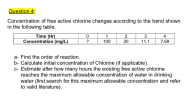 Question 4 Concentration of free active chlorine changes according to the trend shown in the following table. Time (Hr) 2 3 11.1 4 7.69 Concentration (mg/L)100 20 a- Find the order of reaction. b- Calculate initial concentration of Chlorine (if applicable). c- Estimate after how many hours the existing free active chlorine reaches the maximum allowable concentration of water in...
6. In the following list the numbers represent the spin and parity J" for three particles A, B, C. We consider a de...
 6. In the following list the numbers represent the spin and parity J" for three particles A, B, C. We consider a decay of particle A in the initial state to particles B plus C in the final state. Indicate, for each case, what the value of the orbital angular momentum quantum number, £, should be to allow for conservation...
3. The rate constant has been determined at several different temperatures. When the data is graphed...
 3. The rate constant has been determined at several different temperatures. When the data is graphed as in k vs. 1/T (K-!), the slope of the line is -1.48 x 10⁴ and the y-intercept is 24.6. What is the activation energy, E, for this reaction? a. 9.62 kJ b. 15.0 kJ c. 123 kJ d. 205 kJ e. 1214 kJ...
PLEASE ANSWER FAST hydrocarbon C10H16 (limonene) dissociates into two molecules of 2-dimethylbutadiene (isoprene C5H8). When this...
PLEASE ANSWER FAST hydrocarbon C10H16 (limonene) dissociates into two molecules of 2-dimethylbutadiene (isoprene C5H8). When this reaction was run at 400k the initial concentration of C10H16 (0.120 mol/L) decreased to 0.030 mol/L at t = 180s. and to 0.001875 mol/L at t=540s. The initial reaction rate for this dissososition was a) 9.125 x 10 -5 mol^2 L^-2 s^-1 b) 6.825x...
The rate constant of a chemical reaction increased from 0.100 s−1s−1 to 3.00 s−1s−1 upon raising...
The rate constant of a chemical reaction increased from 0.100 s−1s−1 to 3.00 s−1s−1 upon raising the temperature from 25.0 ∘C∘C to 37.0 ∘C∘C . Part A Calculate the value of (1T2−1T1)(1T2−1T1) where T1T1 is the initial temperature and T2T2 is the final temperature. Express your answer numerically. View Available Hint(s) (1T2−1T1)(1T2−1T1) = K−1K−1 SubmitPrevious Answers Incorrect; Try Again; 5...
 EXPERIMENT #9 DETERMINING THE ENTHALPY OF A CHEMICAL
REACTION
Used 50ml of NaOH. Reactions are provided in second
picture.
Computer 13 14. Conduct this reaction in a fume hood or in a well-ventilated area. Repeat Step 10 to conduct the reaction and collect temperature data. DATA TABLE Reaction 2 Reaction 3 Reaction 1 Maximum temperature ('c) 35.5 C 322.47 35,6C...
EXPERIMENT #9 DETERMINING THE ENTHALPY OF A CHEMICAL
REACTION
Used 50ml of NaOH. Reactions are provided in second
picture.
Computer 13 14. Conduct this reaction in a fume hood or in a well-ventilated area. Repeat Step 10 to conduct the reaction and collect temperature data. DATA TABLE Reaction 2 Reaction 3 Reaction 1 Maximum temperature ('c) 35.5 C 322.47 35,6C...
 4. Consider the reaction: 2 NO(g) + Br2 (g) 2 NOB (g) Kp = 31.8 at 302 K a) If the initial partial pressures are Pro = 108 torr, Per; = 126 torr, ProBr = 275 torr, find Qp and determine which direction the reaction proceeds in to reach equilibrium. 139.17 b) When a mixture of NO, Bra, and H,...
 QUESTION1 A 15-mL sample is added to à 300-ml 8OD bottle. Dilution water is added to the sample bottle and the initial dissoved axygen concentration is measured as 8.5 mg/L. After the sample is sealed, the laboratory incorrectly takes a measurement of dissolved oxygen reading on day 6 of 3 mg/L. If the BOD reaction rate coefticient for the sample...
 Question 4 Concentration of free active chlorine changes according to the trend shown in the following table. Time (Hr) 2 3 11.1 4 7.69 Concentration (mg/L)100 20 a- Find the order of reaction. b- Calculate initial concentration of Chlorine (if applicable). c- Estimate after how many hours the existing free active chlorine reaches the maximum allowable concentration of water in...
 6. In the following list the numbers represent the spin and parity J" for three particles A, B, C. We consider a decay of particle A in the initial state to particles B plus C in the final state. Indicate, for each case, what the value of the orbital angular momentum quantum number, £, should be to allow for conservation...
 3. The rate constant has been determined at several different temperatures. When the data is graphed as in k vs. 1/T (K-!), the slope of the line is -1.48 x 10⁴ and the y-intercept is 24.6. What is the activation energy, E, for this reaction? a. 9.62 kJ b. 15.0 kJ c. 123 kJ d. 205 kJ e. 1214 kJ...
Most questions answered within 3 hours.