Draw the structure of the major organic product(s) of the reaction. -CI H2O • You do not have to consider stereochemist...
 Draw the structure of the major organic product(s) of the reaction. -CI H2O • You do not have to consider stereochemistry. • All carboxyl and amino groups should be drawn in the neutral form. • Draw one structure per sketcher. Add additional sketchers using the drop-down menu in the bottom right corner. • Separate multiple products using the sign from...
References) Draw the structure of the bromohydrin formed when (E)-3-methyl-3-hexene reacts with Br2/H20. Use the we...
 References) Draw the structure of the bromohydrin formed when (E)-3-methyl-3-hexene reacts with Br2/H20. Use the wedge/hash bond tools to indicate stereochemistry where it exists. If the reaction produces a racemic mixture, draw both stereoisomers. Separate multiple products using the + sign from the drop-down menu. е CH3 H,с Br CHy ChemDoodle ChemDoodle"
84. What two products are formed in the hydrolysis reaction shown below? heat CH-C-NHCHCH, + NaOH...
 84. What two products are formed in the hydrolysis reaction shown below? heat CH-C-NHCHCH, + NaOH 0 CH, —C—OH A) + NHẠCH CHI B) CH3 -C-NH2 + Na+ "CH,CH; L. C) CH-C-NH, + CH,CH 0 D) CH,-0-0- Nat + NH CHỊCH __ + CH3-C-NH E) HOCH.CH
Problem 5: Draw the reaction products for the two schemes shown below. 0 (1) N cat.H*...
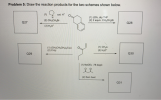 Problem 5: Draw the reaction products for the two schemes shown below. 0 (1) N cat.H* (2) CH3CHBr (3) H,09 (1) LDA, dry THF (2) 2 equiv. CH3CH2Br Q27 (1) (CH3CH2CH2),Culi (2) CHgi (1) CH3LI (2) H30* Q29 Q30 (1) NaOET, -78 degC 0 0 (2) then heat Q31
Complete the following reaction by drawing the structure of the major product(s) expected. CHз H2804 CH—снссНз...
 Complete the following reaction by drawing the structure of the major product(s) expected. CHз H2804 CH—снссНз Н20 ? CH3 You do not have to consider stereochemistry You do not have to explicitly draw H atoms. If there is more than one major product possible, draw all of them. Separate multiple products using the sign from the drop-down menu. . ChemDoodle
Conceptual checkpoint 19.04 Conceptual Checkpoint 19.04 Draw a mechanism for the following reaction and make sure...
 Conceptual checkpoint 19.04
Conceptual Checkpoint 19.04 Draw a mechanism for the following reaction and make sure to draw all three resonance structures of the sigma complex. For the mechanism, draw the curved arrows as needed. Include lone pairs and charges in your answer. Do not draw out any hydrogen explicitly in your products. Do not use abbreviations such as Me...
Conceptual checkpoint 19.04
Conceptual Checkpoint 19.04 Draw a mechanism for the following reaction and make sure to draw all three resonance structures of the sigma complex. For the mechanism, draw the curved arrows as needed. Include lone pairs and charges in your answer. Do not draw out any hydrogen explicitly in your products. Do not use abbreviations such as Me...
IW 09 instein's equation A certain chemical reaction requires 5 81x10 J of energy p lot...
 IW 09 instein's equation A certain chemical reaction requires 5 81x10 J of energy p lot to go Part A What is the increase in mass of the products over the reactants? 80 ALDO ? Am D Sub och 23 p m ) 519.out. pd x m3_F16 solutio pdf a IYU 0 Pis G H J K L :
Complete and balance the following skeleton reaction and identify the oxidizing and reducing agents. Include the...
 Complete and balance the following skeleton reaction and identify the oxidizing and reducing agents. Include the states of all reactants and products in your balanced equation. You do not need to include the states with the identities of the oxidizing and reducing agents. CrO^2-_4 (aq) + Cu(s) rightarrow Cr(OH)_3 (s) + Cu(OH)_2(s) [basic] The oxidizing agent is The reducing agent...
Can someone explain why the answer is not cis-1,2-cyclohexanediol and ethanol? Question 7 What are the...
 Can someone explain why the answer is not
cis-1,2-cyclohexanediol and ethanol?
Question 7 What are the products of the reaction shown below? O CH heat O IH OA. cyclohexanone and ethanol O B. cis-1,2-cyclohexanediol and ethanol O C. trans-1,2-cyclohexanediol and ethanol O D. cyclohexanone and ethanal 0 E. cis-1,2-cyclohexanediol and ethanal
Can someone explain why the answer is not
cis-1,2-cyclohexanediol and ethanol?
Question 7 What are the products of the reaction shown below? O CH heat O IH OA. cyclohexanone and ethanol O B. cis-1,2-cyclohexanediol and ethanol O C. trans-1,2-cyclohexanediol and ethanol O D. cyclohexanone and ethanal 0 E. cis-1,2-cyclohexanediol and ethanal
What happens when you remove a catalyst from Haber process? N2 (g)+ 3H2 (g) 2NH3(g) if...
What happens when you remove a catalyst from Haber process? N2 (g)+ 3H2 (g) 2NH3(g) if the process has deltaG rxn= -4000 kJ/mol Kp= 8200 A) How would the values of deltaG and Kp change when you remove a catalyst? (decrease, increase, stay the same) B) If catalyst is removed, is reaction going to favour reactants or products?
 Draw the structure of the major organic product(s) of the reaction. -CI H2O • You do not have to consider stereochemistry. • All carboxyl and amino groups should be drawn in the neutral form. • Draw one structure per sketcher. Add additional sketchers using the drop-down menu in the bottom right corner. • Separate multiple products using the sign from...
 References) Draw the structure of the bromohydrin formed when (E)-3-methyl-3-hexene reacts with Br2/H20. Use the wedge/hash bond tools to indicate stereochemistry where it exists. If the reaction produces a racemic mixture, draw both stereoisomers. Separate multiple products using the + sign from the drop-down menu. е CH3 H,с Br CHy ChemDoodle ChemDoodle"
 84. What two products are formed in the hydrolysis reaction shown below? heat CH-C-NHCHCH, + NaOH 0 CH, —C—OH A) + NHẠCH CHI B) CH3 -C-NH2 + Na+ "CH,CH; L. C) CH-C-NH, + CH,CH 0 D) CH,-0-0- Nat + NH CHỊCH __ + CH3-C-NH E) HOCH.CH
 Problem 5: Draw the reaction products for the two schemes shown below. 0 (1) N cat.H* (2) CH3CHBr (3) H,09 (1) LDA, dry THF (2) 2 equiv. CH3CH2Br Q27 (1) (CH3CH2CH2),Culi (2) CHgi (1) CH3LI (2) H30* Q29 Q30 (1) NaOET, -78 degC 0 0 (2) then heat Q31
 Complete the following reaction by drawing the structure of the major product(s) expected. CHз H2804 CH—снссНз Н20 ? CH3 You do not have to consider stereochemistry You do not have to explicitly draw H atoms. If there is more than one major product possible, draw all of them. Separate multiple products using the sign from the drop-down menu. . ChemDoodle
 Conceptual checkpoint 19.04
Conceptual Checkpoint 19.04 Draw a mechanism for the following reaction and make sure to draw all three resonance structures of the sigma complex. For the mechanism, draw the curved arrows as needed. Include lone pairs and charges in your answer. Do not draw out any hydrogen explicitly in your products. Do not use abbreviations such as Me...
Conceptual checkpoint 19.04
Conceptual Checkpoint 19.04 Draw a mechanism for the following reaction and make sure to draw all three resonance structures of the sigma complex. For the mechanism, draw the curved arrows as needed. Include lone pairs and charges in your answer. Do not draw out any hydrogen explicitly in your products. Do not use abbreviations such as Me...
 IW 09 instein's equation A certain chemical reaction requires 5 81x10 J of energy p lot to go Part A What is the increase in mass of the products over the reactants? 80 ALDO ? Am D Sub och 23 p m ) 519.out. pd x m3_F16 solutio pdf a IYU 0 Pis G H J K L :
 Complete and balance the following skeleton reaction and identify the oxidizing and reducing agents. Include the states of all reactants and products in your balanced equation. You do not need to include the states with the identities of the oxidizing and reducing agents. CrO^2-_4 (aq) + Cu(s) rightarrow Cr(OH)_3 (s) + Cu(OH)_2(s) [basic] The oxidizing agent is The reducing agent...
 Can someone explain why the answer is not
cis-1,2-cyclohexanediol and ethanol?
Question 7 What are the products of the reaction shown below? O CH heat O IH OA. cyclohexanone and ethanol O B. cis-1,2-cyclohexanediol and ethanol O C. trans-1,2-cyclohexanediol and ethanol O D. cyclohexanone and ethanal 0 E. cis-1,2-cyclohexanediol and ethanal
Can someone explain why the answer is not
cis-1,2-cyclohexanediol and ethanol?
Question 7 What are the products of the reaction shown below? O CH heat O IH OA. cyclohexanone and ethanol O B. cis-1,2-cyclohexanediol and ethanol O C. trans-1,2-cyclohexanediol and ethanol O D. cyclohexanone and ethanal 0 E. cis-1,2-cyclohexanediol and ethanal
Most questions answered within 3 hours.