In the graph, there are three distinct Hamiltonian circuits up to the edges used. Find the total cost of these three circuits.
6. HAMILTONIAN CIRCUITS
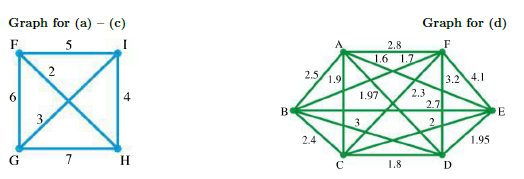
(a) In the graph, there are three distinct Hamiltonian circuits up to the edges used. Find the total cost of these three circuits.
(b) If the edge costs represent the distance, in miles, between cities, then which Hamiltonian circuit represents the solution to the traveling salesperson problem?
(c) Use the Nearest| Neighbor algorithm starting from vertex H to determine a low cost Hamiltonian circuit. What is the total cost of this circuit?
(d) Use the Nearest Neighbor algorithm starting from vertex B to determine a low cost Hamiltonian circuit. What is the total cost of this circuit?
Homework Answers


Add Answer to:
In the graph, there are three distinct Hamiltonian circuits up to the edges used. Find the total cost of these three circuits.
(1) How many distinct Hamilton circuits are there in this graph starting at vertex A?
 (1) How many distinct Hamilton circuits are there in this graph starting at vertex A? (2) Find the minimum-cost Hamilton circuit using the brute force method starting at A. (3) Use the nearest-neighbor algorithm to find a Hamilton circuit for this graph starting at C. What is the total weight?
Consider the graph given above. Use the nearest neighbor algorithm to find the Hamiltonian circuit starting at vertex E.
 Consider the graph given above. Use the nearest neighbor algorithm to find the Hamiltonian circuit starting at vertex E. a. List the vertices in this Hamiltonian circuit in the order they are visited. Do not forget to include the starting vertex at both ends. b. What is the total weight along this Hamiltonian circuit?
Consider the graph given above. Use the nearest neighbor algorithm to find the Hamiltonian circuit starting at vertex C.
 Consider the graph given above. Use the nearest neighbor algorithm to find the Hamiltonian circuit starting at vertex C. a. List the vertices in the Hamiltonian circuit in the order they are visited. Do not forget to include the starting vertex at both ends. b. What is the total weight along the Hamiltonian circuit?
Apply the repeated nearest neighbor algorithm to the graph above. Starting at which vertex or vertices produces the circuit of lowest cost?
 Apply the repeated nearest neighbor algorithm to the graph above. Starting at which vertex or vertices produces the circuit of lowest cost? А B C DE
Consider the following weighted, directed graph G. There are 7 vertices and 10 edges. The edge list E is as follows:
 Consider the following weighted, directed graph G. There are 7 vertices and 10 edges. The edge list E is as follows:The Bellman-Ford algorithm makes |V|-1 = 7-1 = 6 passes through the edge list E. Each pass relaxes the edges in the order they appear in the edge list. As with Dijkstra's algorithm, we record the current best known cost D[V] to reach each vertex V from the start vertex S. Initially D[A]=0 and D[V]=+oo for all the other vertices...
Question 5# This question introduces the idea of using a traveling salesman algo- rithm to search for a Hamilton circui...
 Question 5# This question introduces the idea of using a traveling salesman algo- rithm to search for a Hamilton circuit in any simple graph. (a) Find a Hamilton circuit for the graph G in dicated by the diagram at right. Do this by eye', without using any particular algo- rithm. Answer by drawing heavy lines over each edge on your circuit. There are many correct answers. (b) TSP algorithms usually work on a complete V(G)V(G) weighted graph. One wayEG)-[lu.v :...
Given the following weighted graph G. use Prim's algorithm to determine the Minimum-Cost Spanning Tree (MCST)...
 Given the following weighted graph G. use Prim's algorithm to determine the Minimum-Cost Spanning Tree (MCST) with node 1 as the "root". List the vertices in the order in which the algorithm adds them to the solution, along with the edge and its weight used to make the selection, one per line. Each line should look like this: add vertex y: edge = (x,y), weight = 5 When the algorithm ends there are, generally, edges left in the heap. List...
1. In the following graph, suppose that the vertices A, B, C, D, E, and F represent towns, and th...
 question 1 and 2 please, thank
you.
1. In the following graph, suppose that the vertices A, B, C, D, E, and F represent towns, and the edges between those vertices represent roads. And suppose that you want to start traveling from town A, pass through each town exactly once, and then end at town F. List all the different paths that you could take Hin: For instance, one of the paths is A, B, C, E, D, F. (These...
question 1 and 2 please, thank
you.
1. In the following graph, suppose that the vertices A, B, C, D, E, and F represent towns, and the edges between those vertices represent roads. And suppose that you want to start traveling from town A, pass through each town exactly once, and then end at town F. List all the different paths that you could take Hin: For instance, one of the paths is A, B, C, E, D, F. (These...
This week Discussion please must be in the document Initial Post: Remind your classmates of your real-world situation presented in the Unit 7 Discussion including the graph that you drew to model this...
 This week Discussion please must be in the
document
Initial Post: Remind your classmates of your
real-world situation presented in the Unit 7 Discussion including
the graph that you drew to model this situation.
1) Describe in the context of your situation and how you can
modify your graph into a spanning tree.
2) Draw a spanning tree from your initial graph.
3) Add appropriate weights to each of your edges for the context
of your situation.
Unit 7 Discussion...
This week Discussion please must be in the
document
Initial Post: Remind your classmates of your
real-world situation presented in the Unit 7 Discussion including
the graph that you drew to model this situation.
1) Describe in the context of your situation and how you can
modify your graph into a spanning tree.
2) Draw a spanning tree from your initial graph.
3) Add appropriate weights to each of your edges for the context
of your situation.
Unit 7 Discussion...
3. (50%) Use a programming language you familiar with to implement the brute force method and...
 3. (50%) Use a programming language you familiar with to implement the brute force method and the branch and bound algorithm, both of which were already introduced in the class, for solving the traveling salesperson problem (35%). Compare their running time when the input size n is from 5 to 15 in steps of 1 (15%). Note that for each n, you should generate three problem instances and average the running time of solving these three instances. To verify the...
 Question 5# This question introduces the idea of using a traveling salesman algo- rithm to search for a Hamilton circuit in any simple graph. (a) Find a Hamilton circuit for the graph G in dicated by the diagram at right. Do this by eye', without using any particular algo- rithm. Answer by drawing heavy lines over each edge on your circuit. There are many correct answers. (b) TSP algorithms usually work on a complete V(G)V(G) weighted graph. One wayEG)-[lu.v :...
 Given the following weighted graph G. use Prim's algorithm to determine the Minimum-Cost Spanning Tree (MCST) with node 1 as the "root". List the vertices in the order in which the algorithm adds them to the solution, along with the edge and its weight used to make the selection, one per line. Each line should look like this: add vertex y: edge = (x,y), weight = 5 When the algorithm ends there are, generally, edges left in the heap. List...
 question 1 and 2 please, thank
you.
1. In the following graph, suppose that the vertices A, B, C, D, E, and F represent towns, and the edges between those vertices represent roads. And suppose that you want to start traveling from town A, pass through each town exactly once, and then end at town F. List all the different paths that you could take Hin: For instance, one of the paths is A, B, C, E, D, F. (These...
question 1 and 2 please, thank
you.
1. In the following graph, suppose that the vertices A, B, C, D, E, and F represent towns, and the edges between those vertices represent roads. And suppose that you want to start traveling from town A, pass through each town exactly once, and then end at town F. List all the different paths that you could take Hin: For instance, one of the paths is A, B, C, E, D, F. (These...
 This week Discussion please must be in the
document
Initial Post: Remind your classmates of your
real-world situation presented in the Unit 7 Discussion including
the graph that you drew to model this situation.
1) Describe in the context of your situation and how you can
modify your graph into a spanning tree.
2) Draw a spanning tree from your initial graph.
3) Add appropriate weights to each of your edges for the context
of your situation.
Unit 7 Discussion...
This week Discussion please must be in the
document
Initial Post: Remind your classmates of your
real-world situation presented in the Unit 7 Discussion including
the graph that you drew to model this situation.
1) Describe in the context of your situation and how you can
modify your graph into a spanning tree.
2) Draw a spanning tree from your initial graph.
3) Add appropriate weights to each of your edges for the context
of your situation.
Unit 7 Discussion...
 3. (50%) Use a programming language you familiar with to implement the brute force method and the branch and bound algorithm, both of which were already introduced in the class, for solving the traveling salesperson problem (35%). Compare their running time when the input size n is from 5 to 15 in steps of 1 (15%). Note that for each n, you should generate three problem instances and average the running time of solving these three instances. To verify the...
Most questions answered within 3 hours.
-
Where is the error in this code sequence?
String s1 = "Hello";
String s2 = "ello";...
asked 10 months ago -
Financial data for Joel de Paris, Inc., for last year
follow:
Joel de Paris, Inc.
Balance...
asked 10 months ago -
Consider this reaction:
Al2(SO4)3 (aq)+ BaCl3
(aq) Al2Cl6 (aq)- +
3BaSO4(s) . What is the...
asked 10 months ago -
Suppose that Savneet is considering increasing her
recent random sample from 20 car rentals to 40...
asked 10 months ago -
Trucks arrive at an unloading terminal at an average rate of 120
per hour.
Trucks arrive...
asked 10 months ago -
Why are methanol and ethanol completely soluble in water while
octanol is not very little soluble....
asked 10 months ago -
A facilities manager at a university reads in a research report
that the mean amount of...
asked 10 months ago -
When the CuSO4 is rehydrated by adding water to the anhydrous
compound, is this an endothermic...
asked 10 months ago -
A ray of sunlight is passing from diamond into crown glass; the
angle of incidence is...
asked 10 months ago -
A block of mass 0.249 kg is placed on top of a light, vertical
spring of...
asked 10 months ago -
how do the kidneys compensate in the presences of acidosis
a) trigger hyperventilate
b) reserve acid...
asked 10 months ago -
Question 501 pts
The rental rate of capital to the firm increases. Which of the
following...
asked 10 months ago