The distance d of a point P to the line through points A and B is the length of the component of AP that is orthogonal to AB, as indicated in the diagram.
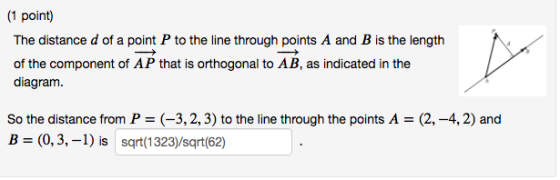
The distance d of a point P to the line through points A and B is the length of the component of AP that is orthogonal to AB, as indicated in the diagram.
So the distance from P = (-3,2,3) to the line through the points A = (2, -4, 2) and B = (0,3,-1) is _______
Homework Answers
 For any queries comment...
Add Answer to:
The distance d of a point P to the line through points A and B is the length of the component of AP that is orthogonal to AB, as indicated in the diagram.
The distance d of point P to the line through points A and B is the length of the component of AP that is orthogonal to AB, as indicated in the diagram.
 The distance d of point P to the line through points A and B is the length of the component of AP that is orthogonal to AB, as indicated in the diagram. So the distance from P = (4,3) to the line through the points A = (-2,5) and B (-3, -5) is _______
(1 point) The distance d of a point P to the line through points A and...
 (1 point) The distance d of a point P to the line through points A and B is the length of the component of AP that is orthogonal to AB, as indicated in the diagram. = So the distance from P (-4,-5, -4) to the line through the points A = (1, -2, 3) and B = (-3, 2, -3) is | (1 point) The distance d of a point P to the line through points A and B is...
(1 point) The distance d of a point P to the line through points A and...
 (1 point) The distance d of a point P to the line through points A and B is the length of the component of AP that is orthogonal to AB, as indicated in the diagram. So the distance from P = (0, 2) to the line through the points A = (-1,-1) and B=(3,0) is
Problem-1 (10 points): The line L through the point p(-1,0,1) is orthogonal to the surface S-((r,...
 Problem-1 (10 points): The line L through the point p(-1,0,1) is orthogonal to the surface S-((r, y.3)r In:+sin(y:)- 0 at p. Then L intersects the plane :-0 at the point
Problem-1 (10 points): The line L through the point p(-1,0,1) is orthogonal to the surface S-((r, y.3)r In:+sin(y:)- 0 at p. Then L intersects the plane :-0 at the point
Problem-1 (10 points): The line L through the point p(-1,0,1) is orthogonal to the surface S-((r, y.3)r In:+sin(y:)- 0 at p. Then L intersects the plane :-0 at the point
Where should the point P be chosen on line segment AB so as to maximize the...
 Where should the point P be chosen
on line segment AB so as to maximize the angle θ?
(Assume a = 2 units, b = 4 units, and c
= 6 units. Round your answer to two decimal places.)
____ units from A
***THE ANSWER IS NOT 2.90***
Where should the point P be chosen on line segment AB so as to maximize the angle O? (Assume a = 2 units, b = 4 units, and c = 6 units....
Where should the point P be chosen
on line segment AB so as to maximize the angle θ?
(Assume a = 2 units, b = 4 units, and c
= 6 units. Round your answer to two decimal places.)
____ units from A
***THE ANSWER IS NOT 2.90***
Where should the point P be chosen on line segment AB so as to maximize the angle O? (Assume a = 2 units, b = 4 units, and c = 6 units....
Question B Diagram NOT accurately drawn 2 2b APB is a triangle. N is a point on AP. AB- a AN 2b NP-b (a) Find the vector PB, in terms of a and b. 3b 10 B is the midpoint of AC. M is the midpoint o...
 Question B
Diagram NOT accurately drawn 2 2b APB is a triangle. N is a point on AP. AB- a AN 2b NP-b (a) Find the vector PB, in terms of a and b. 3b 10 B is the midpoint of AC. M is the midpoint of PB. *(b) Show that NMC is a straight line.
Diagram NOT accurately drawn 2 2b APB is a triangle. N is a point on AP. AB- a AN 2b NP-b (a) Find the...
Question B
Diagram NOT accurately drawn 2 2b APB is a triangle. N is a point on AP. AB- a AN 2b NP-b (a) Find the vector PB, in terms of a and b. 3b 10 B is the midpoint of AC. M is the midpoint of PB. *(b) Show that NMC is a straight line.
Diagram NOT accurately drawn 2 2b APB is a triangle. N is a point on AP. AB- a AN 2b NP-b (a) Find the...
Determine the slope (g) and deflection (AB) of Point B in terms of El. P =...
 Determine the slope (g) and deflection (AB) of Point B in terms of El. P = 12 kN and L = 9 m. Use the Moment-Area Method. Theorem 1: The angle between the tangents at any two points on the elastic curve equals the area under the M EI diagram between these two points. ALI Theorem 2: The vertical distance between the tangent at a point (A) on the elastic curve and the tangent extended from another point (B) equals...
(1 point) Determine the sign of fe and fy at each indicated point using the contour diagram of shown below. (The point P is that in the first quadrant, at a positive z and y value; Q through T are lo...
 (1 point) Determine the sign of fe and fy at each indicated point using the contour diagram of shown below. (The point P is that in the first quadrant, at a positive z and y value; Q through T are located clockwise from P, so that Q is at a positive r value and negative y. etc.) 6 2 P 8 (a) At point Q f is? and fy is (b) At point R is and fy is (c) At...
for problem 2, part b, perpendocular to rod ABC not ABD! Problem 1. The force P is applied to the cable at the frict...
 for problem 2, part b, perpendocular to rod ABC not
ABD!
Problem 1. The force P is applied to the cable at the frictionless pulley C to hold the 1200N weight in the equilibrium position shown in the figure. Determine: (a) the magnitude of the force P, (b) tension in cable AB, and (c) tension in cable BC, Please draw the free body diagram of the particle under consideration clearly. B 28 200N Problem 2. A force F of magnitude...
for problem 2, part b, perpendocular to rod ABC not
ABD!
Problem 1. The force P is applied to the cable at the frictionless pulley C to hold the 1200N weight in the equilibrium position shown in the figure. Determine: (a) the magnitude of the force P, (b) tension in cable AB, and (c) tension in cable BC, Please draw the free body diagram of the particle under consideration clearly. B 28 200N Problem 2. A force F of magnitude...
B (2,4) A (-2,3) C (11,2) 0 3y+ 2x+5-0 In the diagram, the points A, Band C have coordinates (-2,3), (2,4) and (11,2) respectively. D is a point such that DA is perpendicular to AB, and Dlies on...
 B (2,4) A (-2,3) C (11,2) 0 3y+ 2x+5-0 In the diagram, the points A, Band C have coordinates (-2,3), (2,4) and (11,2) respectively. D is a point such that DA is perpendicular to AB, and Dlies on the line 3y+ 2x+ 5 = 0. 141 Find the coordinates of D. Point E lies on DC and the ratio of the length of DE to the length of DCis 2:3 (i) 141 (ii) Find the area of triangle DBE. (ii)...
 The distance d of point P to the line through points A and B is the length of the component of AP that is orthogonal to AB, as indicated in the diagram. So the distance from P = (4,3) to the line through the points A = (-2,5) and B (-3, -5) is _______
 (1 point) The distance d of a point P to the line through points A and B is the length of the component of AP that is orthogonal to AB, as indicated in the diagram. = So the distance from P (-4,-5, -4) to the line through the points A = (1, -2, 3) and B = (-3, 2, -3) is | (1 point) The distance d of a point P to the line through points A and B is...
 (1 point) The distance d of a point P to the line through points A and B is the length of the component of AP that is orthogonal to AB, as indicated in the diagram. So the distance from P = (0, 2) to the line through the points A = (-1,-1) and B=(3,0) is
 Problem-1 (10 points): The line L through the point p(-1,0,1) is orthogonal to the surface S-((r, y.3)r In:+sin(y:)- 0 at p. Then L intersects the plane :-0 at the point
Problem-1 (10 points): The line L through the point p(-1,0,1) is orthogonal to the surface S-((r, y.3)r In:+sin(y:)- 0 at p. Then L intersects the plane :-0 at the point
Problem-1 (10 points): The line L through the point p(-1,0,1) is orthogonal to the surface S-((r, y.3)r In:+sin(y:)- 0 at p. Then L intersects the plane :-0 at the point
 Where should the point P be chosen
on line segment AB so as to maximize the angle θ?
(Assume a = 2 units, b = 4 units, and c
= 6 units. Round your answer to two decimal places.)
____ units from A
***THE ANSWER IS NOT 2.90***
Where should the point P be chosen on line segment AB so as to maximize the angle O? (Assume a = 2 units, b = 4 units, and c = 6 units....
Where should the point P be chosen
on line segment AB so as to maximize the angle θ?
(Assume a = 2 units, b = 4 units, and c
= 6 units. Round your answer to two decimal places.)
____ units from A
***THE ANSWER IS NOT 2.90***
Where should the point P be chosen on line segment AB so as to maximize the angle O? (Assume a = 2 units, b = 4 units, and c = 6 units....
 Question B
Diagram NOT accurately drawn 2 2b APB is a triangle. N is a point on AP. AB- a AN 2b NP-b (a) Find the vector PB, in terms of a and b. 3b 10 B is the midpoint of AC. M is the midpoint of PB. *(b) Show that NMC is a straight line.
Diagram NOT accurately drawn 2 2b APB is a triangle. N is a point on AP. AB- a AN 2b NP-b (a) Find the...
Question B
Diagram NOT accurately drawn 2 2b APB is a triangle. N is a point on AP. AB- a AN 2b NP-b (a) Find the vector PB, in terms of a and b. 3b 10 B is the midpoint of AC. M is the midpoint of PB. *(b) Show that NMC is a straight line.
Diagram NOT accurately drawn 2 2b APB is a triangle. N is a point on AP. AB- a AN 2b NP-b (a) Find the...
 Determine the slope (g) and deflection (AB) of Point B in terms of El. P = 12 kN and L = 9 m. Use the Moment-Area Method. Theorem 1: The angle between the tangents at any two points on the elastic curve equals the area under the M EI diagram between these two points. ALI Theorem 2: The vertical distance between the tangent at a point (A) on the elastic curve and the tangent extended from another point (B) equals...
 (1 point) Determine the sign of fe and fy at each indicated point using the contour diagram of shown below. (The point P is that in the first quadrant, at a positive z and y value; Q through T are located clockwise from P, so that Q is at a positive r value and negative y. etc.) 6 2 P 8 (a) At point Q f is? and fy is (b) At point R is and fy is (c) At...
 for problem 2, part b, perpendocular to rod ABC not
ABD!
Problem 1. The force P is applied to the cable at the frictionless pulley C to hold the 1200N weight in the equilibrium position shown in the figure. Determine: (a) the magnitude of the force P, (b) tension in cable AB, and (c) tension in cable BC, Please draw the free body diagram of the particle under consideration clearly. B 28 200N Problem 2. A force F of magnitude...
for problem 2, part b, perpendocular to rod ABC not
ABD!
Problem 1. The force P is applied to the cable at the frictionless pulley C to hold the 1200N weight in the equilibrium position shown in the figure. Determine: (a) the magnitude of the force P, (b) tension in cable AB, and (c) tension in cable BC, Please draw the free body diagram of the particle under consideration clearly. B 28 200N Problem 2. A force F of magnitude...
 B (2,4) A (-2,3) C (11,2) 0 3y+ 2x+5-0 In the diagram, the points A, Band C have coordinates (-2,3), (2,4) and (11,2) respectively. D is a point such that DA is perpendicular to AB, and Dlies on the line 3y+ 2x+ 5 = 0. 141 Find the coordinates of D. Point E lies on DC and the ratio of the length of DE to the length of DCis 2:3 (i) 141 (ii) Find the area of triangle DBE. (ii)...
Most questions answered within 3 hours.
-
Where is the error in this code sequence?
String s1 = "Hello";
String s2 = "ello";...
asked 11 months ago -
Financial data for Joel de Paris, Inc., for last year
follow:
Joel de Paris, Inc.
Balance...
asked 11 months ago -
Consider this reaction:
Al2(SO4)3 (aq)+ BaCl3
(aq) Al2Cl6 (aq)- +
3BaSO4(s) . What is the...
asked 11 months ago -
Suppose that Savneet is considering increasing her
recent random sample from 20 car rentals to 40...
asked 11 months ago -
Trucks arrive at an unloading terminal at an average rate of 120
per hour.
Trucks arrive...
asked 11 months ago -
Why are methanol and ethanol completely soluble in water while
octanol is not very little soluble....
asked 11 months ago -
A facilities manager at a university reads in a research report
that the mean amount of...
asked 11 months ago -
When the CuSO4 is rehydrated by adding water to the anhydrous
compound, is this an endothermic...
asked 11 months ago -
A ray of sunlight is passing from diamond into crown glass; the
angle of incidence is...
asked 11 months ago -
A block of mass 0.249 kg is placed on top of a light, vertical
spring of...
asked 11 months ago -
how do the kidneys compensate in the presences of acidosis
a) trigger hyperventilate
b) reserve acid...
asked 11 months ago -
Question 501 pts
The rental rate of capital to the firm increases. Which of the
following...
asked 11 months ago