A heat engine takes for 0.40 mol of ideal H2 gas around the cycle shown in the pV- diagram.
A heat engine takes for 0.40 mol of ideal H2 gas around the cycle shown in the pV- diagram.
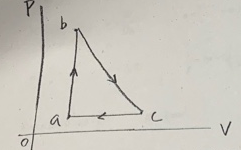
Ta=400K
Tb=800K
Tc=592K
Process a→b is at constant volume, process b→c is adiabatic, and process c-> a is at constant pressure of 2 atm. The value of y for this gas is 1.40.
(a) Find the pressure and volume at points a, b and c
(b) Calculate Q, W, and AU for each of the processes.
(c) Find the net work done by the gas in the cycle
(d) find the net heat flow into the engine in one cycle,
(e) What is the thermal efficiency of the engine?
Homework Answers


Add Answer to:
A heat engine takes for 0.40 mol of ideal H2 gas around the cycle shown in the pV- diagram.
A heat engine takes 0.262 mol of a diatomic deal gas around the cycle shown in the pV-diagram bel...
 A heat engine takes 0.262 mol of a diatomic deal gas around the cycle shown in the pV-diagram below. Process 1 → 2 is at constant volume, process 2-) 3 is adiabatic, and process 3-1 is at a constant pressure of P = 2.00 atm. The value of r for this gas is 1.4 2,7-600K T,-300 K T, 492 K 0 (a) Find the pressure and volume at points 1, 2, and 3. pressure (Pa) volume (m3) point 1 point...
The PV - diagram in the figure below shows a cycle of a heat engine that uses 0.250 mol of an ideal gas with γ = 1.40....
 The PV - diagram in the figure below shows a cycle of a heat engine that uses 0.250 mol of an ideal gas with γ=1.40. The process a b is adiabatic. (1 atm=105 Pa)(i) Calculate the pressure of the gas at point a.(ii) Calculate how much heat enters this gas per cycle. Indicate the process(es) where this happens.(iii) Calculate how much heat leaves this gas in a cycle. Indicate the process(es) where this occurs.(iv) Calculate how much work the engine...
Three moles of an ideal gas are taken around the cycle abc shown in the figure...
Three moles of an ideal gas are taken around the cycle abc shown in the figure (Figure 1) . For this gas, Cp=29.1 J/(mol?K). Process ac is at constant pressure, process ba is at constant volume, and process cb is adiabatic. The temperatures of the gas in states a, c, and b are Ta=300K, Tc= 492 K, and Tb= 600 K. Calculate the total work W for the cycle
The pV diagram in the figure shows a cycle of a heat engine that uses 0.250...
 The pV diagram in the figure shows a cycle of
a heat engine that uses 0.250 mole of an ideal gas having
?=1.40. The curved part ab of the cycle
is adiabatic.
Part A
Find the pressure of the gas at point a.
(SOLVED)
Pa = 12.3 atm
----
Part B
How much heat enters this gas per cycle?
Qin = J
----
Part C
Where does the entering of heat happen?
----
Part D
How much heat leaves this...
The pV diagram in the figure shows a cycle of
a heat engine that uses 0.250 mole of an ideal gas having
?=1.40. The curved part ab of the cycle
is adiabatic.
Part A
Find the pressure of the gas at point a.
(SOLVED)
Pa = 12.3 atm
----
Part B
How much heat enters this gas per cycle?
Qin = J
----
Part C
Where does the entering of heat happen?
----
Part D
How much heat leaves this...
2. Isochoric/Adiabatic/Isobaric Cycle (10 pts) A heat engine using a monatomic gas follows the cycle shown in the PV diagram to the right. Between stages 1 and 2 the gas is at a constant volume,...
 2. Isochoric/Adiabatic/Isobaric Cycle (10 pts) A heat engine using a monatomic gas follows the cycle shown in the PV diagram to the right. Between stages 1 and 2 the gas is at a constant volume, and between 2 and 3 no heat is transferred in or out, between 3 and 1 the pressure is held constant (a) For each stage of this process, calculate in Joules the heat, Q, transferred to the gas, and the work, W, done by the...
Consider a monoatomic ideal gas undergoing the following cycle: starting point (a), pressure increases at a...
Consider a monoatomic ideal gas undergoing the following cycle: starting point (a), pressure increases at a constant volume reaching point (b), then the gas expands adiabatically until pressure reaches the initial value (point c), and then the gas is compressed at a constant pressure until the volume reaches the initial value back to point (a). The amount of gas is 1 mole. Monoatomic gas means it has only 3 degrees of freedom and the adiabatic constant gamma is 5/3. Sketch...
An engine works on the cycle shown in the diagram below, using 0.1 moles of a...
 An engine works on the cycle shown in the diagram below, using 0.1 moles of a monatomic ideal gas. The processes A, B and C are isothermal, isovolumetric and adiabatic respectively. The maximum and minimum volumes are 8 litres and 2 litres, and the temperatures are as shown on the diagram. T=1000K Pressure (kPa) T=397K 0 8 2 4 6 Volume (litres) a) b) c) d) e) Calculate the work done on the gas in processes A and B. Calculate...
1.08 mol of a monatomic ideal gas undergoes a cyclic process in a reversible engine, as...
 1.08 mol of a monatomic ideal gas undergoes a cyclic process in
a reversible engine, as shown in the PV diagram. The gas is
initially at STP at point a. The curved path is an isotherm at T =
411 K, and the straight paths represent processes at constant
pressure or constant volume. Determine the heat added in process
c-a.
1.08 mol of a monatomic ideal gas undergoes a cyclic process in
a reversible engine, as shown in the PV diagram. The gas is
initially at STP at point a. The curved path is an isotherm at T =
411 K, and the straight paths represent processes at constant
pressure or constant volume. Determine the heat added in process
c-a.
Problem 4: The figure is a PV diagram for a reversible heat engine in which 1.0...
 Problem 4: The figure is a PV diagram for a reversible heat engine in which 1.0 mol of argon, a nearly ideal monatomic gas, is initially at STP (point a). Points b and e are on an isotherm at T-423 K. Process ab is at constant volume, process ac at constant pressure. (a) Is the path of the cycle carried out clockwise or counterclockwise? (b) What is the efficiency of this engine? 120pts
2. The graph in the shows a pV diagram with reversible work for 3.0 moles of...
 2. The graph in the shows a pV diagram with reversible work for 3.0 moles of ideal argon gas. Process ab is isobaric, bc ischoric, and ca adiabatic. p(Pa X 105) 2.0 0 0.010 0.040 a. What is the pressure pa, and what are the temperatures Ta,Tb, and T? b. For each of the three processes: ab, bc, ca find Q, AU and W. c. For the entire circuit a + b + c + a what are Q, AU...
 A heat engine takes 0.262 mol of a diatomic deal gas around the cycle shown in the pV-diagram below. Process 1 → 2 is at constant volume, process 2-) 3 is adiabatic, and process 3-1 is at a constant pressure of P = 2.00 atm. The value of r for this gas is 1.4 2,7-600K T,-300 K T, 492 K 0 (a) Find the pressure and volume at points 1, 2, and 3. pressure (Pa) volume (m3) point 1 point...
 The pV diagram in the figure shows a cycle of
a heat engine that uses 0.250 mole of an ideal gas having
?=1.40. The curved part ab of the cycle
is adiabatic.
Part A
Find the pressure of the gas at point a.
(SOLVED)
Pa = 12.3 atm
----
Part B
How much heat enters this gas per cycle?
Qin = J
----
Part C
Where does the entering of heat happen?
----
Part D
How much heat leaves this...
The pV diagram in the figure shows a cycle of
a heat engine that uses 0.250 mole of an ideal gas having
?=1.40. The curved part ab of the cycle
is adiabatic.
Part A
Find the pressure of the gas at point a.
(SOLVED)
Pa = 12.3 atm
----
Part B
How much heat enters this gas per cycle?
Qin = J
----
Part C
Where does the entering of heat happen?
----
Part D
How much heat leaves this...
 2. Isochoric/Adiabatic/Isobaric Cycle (10 pts) A heat engine using a monatomic gas follows the cycle shown in the PV diagram to the right. Between stages 1 and 2 the gas is at a constant volume, and between 2 and 3 no heat is transferred in or out, between 3 and 1 the pressure is held constant (a) For each stage of this process, calculate in Joules the heat, Q, transferred to the gas, and the work, W, done by the...
 An engine works on the cycle shown in the diagram below, using 0.1 moles of a monatomic ideal gas. The processes A, B and C are isothermal, isovolumetric and adiabatic respectively. The maximum and minimum volumes are 8 litres and 2 litres, and the temperatures are as shown on the diagram. T=1000K Pressure (kPa) T=397K 0 8 2 4 6 Volume (litres) a) b) c) d) e) Calculate the work done on the gas in processes A and B. Calculate...
 1.08 mol of a monatomic ideal gas undergoes a cyclic process in
a reversible engine, as shown in the PV diagram. The gas is
initially at STP at point a. The curved path is an isotherm at T =
411 K, and the straight paths represent processes at constant
pressure or constant volume. Determine the heat added in process
c-a.
1.08 mol of a monatomic ideal gas undergoes a cyclic process in
a reversible engine, as shown in the PV diagram. The gas is
initially at STP at point a. The curved path is an isotherm at T =
411 K, and the straight paths represent processes at constant
pressure or constant volume. Determine the heat added in process
c-a.
 Problem 4: The figure is a PV diagram for a reversible heat engine in which 1.0 mol of argon, a nearly ideal monatomic gas, is initially at STP (point a). Points b and e are on an isotherm at T-423 K. Process ab is at constant volume, process ac at constant pressure. (a) Is the path of the cycle carried out clockwise or counterclockwise? (b) What is the efficiency of this engine? 120pts
 2. The graph in the shows a pV diagram with reversible work for 3.0 moles of ideal argon gas. Process ab is isobaric, bc ischoric, and ca adiabatic. p(Pa X 105) 2.0 0 0.010 0.040 a. What is the pressure pa, and what are the temperatures Ta,Tb, and T? b. For each of the three processes: ab, bc, ca find Q, AU and W. c. For the entire circuit a + b + c + a what are Q, AU...
Most questions answered within 3 hours.
-
Where is the error in this code sequence?
String s1 = "Hello";
String s2 = "ello";...
asked 11 months ago -
Financial data for Joel de Paris, Inc., for last year
follow:
Joel de Paris, Inc.
Balance...
asked 11 months ago -
Consider this reaction:
Al2(SO4)3 (aq)+ BaCl3
(aq) Al2Cl6 (aq)- +
3BaSO4(s) . What is the...
asked 11 months ago -
Suppose that Savneet is considering increasing her
recent random sample from 20 car rentals to 40...
asked 11 months ago -
Trucks arrive at an unloading terminal at an average rate of 120
per hour.
Trucks arrive...
asked 11 months ago -
Why are methanol and ethanol completely soluble in water while
octanol is not very little soluble....
asked 11 months ago -
A facilities manager at a university reads in a research report
that the mean amount of...
asked 11 months ago -
When the CuSO4 is rehydrated by adding water to the anhydrous
compound, is this an endothermic...
asked 11 months ago -
A ray of sunlight is passing from diamond into crown glass; the
angle of incidence is...
asked 11 months ago -
A block of mass 0.249 kg is placed on top of a light, vertical
spring of...
asked 11 months ago -
how do the kidneys compensate in the presences of acidosis
a) trigger hyperventilate
b) reserve acid...
asked 11 months ago -
Question 501 pts
The rental rate of capital to the firm increases. Which of the
following...
asked 11 months ago