An infinite straight wire carries current I1 = 3 A in the positive y-direction as shown....
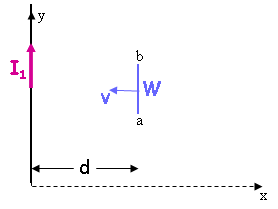
An infinite straight wire carries current I1 = 3 A in the positive y-direction as shown. At time t = 0, a conducting wire, aligned with the y-direction is located a distance d = 50 cm from the y-axis and moves with velocity v = 12 cm/s in the negaitve x-direction as shown. The wire has length W = 24 cm.
)
What is ε(0), the emf induced in the moving wire at t = 0? Define the emf to be positive if the potential at point a is higher than that at point b.
V
2)
What is ε(t1), the emf induced in the moving wire at t = t1 = 2.8 s? Define the emf to be positive if the potential at point a is higher than that at point b.
V
3)
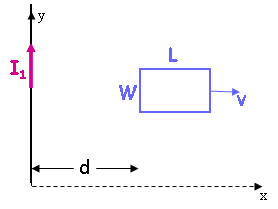
The wire is now replaced by a conducting rectangular loop as shown. The loop has length L = 55 cm and width W = 24 cm. At time t = 0, the loop moves with velocity v = 12 cm/s with its left end located a distance d = 50 cm from the y-axis. The resistance of the loop is R = 2.5 Ω. What is i(0), the induced current in the loop at time t = 0? Define the current to be positive if it flows in the counter-clockwise direction.
A
4)
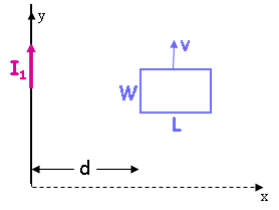
Suppose the loop now moves in the positive y-direction as shown. What is the direction of the induced current now?
The current flows counterclockwise
The current flows clockwise
There is no induced current now
5)
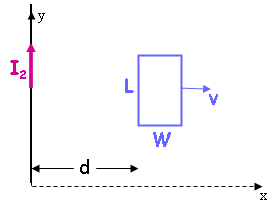
Suppose now that the loop is rotated 90o and moves with velocity v = 12 cm/s in the positive x-direction as shown. What is I2, the current in the infinite wire, if the induced current in the loop at the instant shown (d = 50 cm) is the same as it was in the third part of this problem (i.e., when the left end of loop was at a distance d = 50 cm from the y-axis)?
A
Homework Answers


Add Answer to:
An infinite straight wire carries current I1 = 3 A in
the positive y-direction as shown....
An infinite straight wire carries current I1 = 3 A in the positive y-direction as shown....
 An infinite straight wire carries current I1 = 3 A in
the positive y-direction as shown. At time t = 0, a conducting
wire, aligned with the y-direction is located a distance d = 41 cm
from the y-axis and moves with velocity v = 18 cm/s in the negaitve
x-direction as shown. The wire has length W = 28 cm.
1)What is ε(0), the emf induced in the moving wire at t = 0?
Define the emf to be...
An infinite straight wire carries current I1 = 3 A in
the positive y-direction as shown. At time t = 0, a conducting
wire, aligned with the y-direction is located a distance d = 41 cm
from the y-axis and moves with velocity v = 18 cm/s in the negaitve
x-direction as shown. The wire has length W = 28 cm.
1)What is ε(0), the emf induced in the moving wire at t = 0?
Define the emf to be...
An infinite straight wire carries a current I that varies with time as shown above. It...
 An infinite straight wire carries a current I that varies with time as shown above. It increases from 0 at t = 0 to a maximum value 11 2.1 A att = t1 = 15 s, remains constant at this value until t = t2 when it decreases linearly to a value 4 = -2.1 A at t = t4 = 31 s, passing through zero at t = t3 = 25.5 s. A conducting loop with sides W 22...
An infinite straight wire carries a current I that varies withtime as shown above. It...
 An infinite straight wire carries a current I that varies with
time as shown above. It increases from 0 at t = 0 to a maximum
value I1 = 5.5 A at t = t1 = 12 s, remains
constant at this value until t = t2 when it decreases
linearly to a value I4 = -5.5 A at t = t4 =
31 s, passing through zero at t = t3 = 24 s. A
conducting loop with sides...
An infinite straight wire carries a current I that varies with
time as shown above. It increases from 0 at t = 0 to a maximum
value I1 = 5.5 A at t = t1 = 12 s, remains
constant at this value until t = t2 when it decreases
linearly to a value I4 = -5.5 A at t = t4 =
31 s, passing through zero at t = t3 = 24 s. A
conducting loop with sides...
An infinite straight wire carries a current I that varies with time as shown above. It...
 An infinite straight wire carries a current I that varies with time as shown above. It increases from 0 at t = 0 to a maximum value l_1 = 2.7 A at t = t_1 = 14 s, remains constant at this value until t = t_2 when it decreases linearly to a value l_4 = -2.7 A at t = t_4 = 25 s, passing through zero at t = t_3 = 22 s. A conducting loop with sides...
Prome Along straight wire carries a current lo to the left as she n the picture...
 Prome Along straight wire carries a current lo to the left as she n the picture below. The closest side of leon with side s a distance a from the wire. All parts of the in the same p lace w hammad the loop, due to the current in the long wire? (10 points) Problem 3a: If the current in the long wire in Problem 2 follows the formula (0) = loe/. what is the induced em in the loop...
A long straight wire and rectangular thin wire loop shown in the figure below are in...
 A long straight wire and rectangular thin wire loop shown in the figure below are in the same plane with the geometrical dimensions specified as a=0.444 cm, b=2.75 cm and c=80.5 cm. The total resistance of the wire loop R=1.95 1. The long wire is driven by a triangle-wave generator resulting in the time-dependent current waveform I(t) also depicted in the figure. The magnitude of the waveform Io=13.24 A and the frequency f=56 Hz (temporal period of the waveform T=1/f)....
An infinite straight wire carries a current l that varies with time as shown above. It...
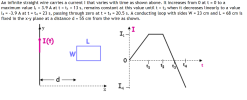 An infinite straight wire carries a current l that varies with time as shown above. It increases from 0 at t to a maximum value l! = 3.9 A at t = t1 = 13 s, remains constant at this value until t t2 when it decreases linearly to a value 43.9 A at tt 23 s, passing through zero at t t 20.5 s. A conducting loop with sides W 23 cm and L 68 cm is fixed in...
In the diagram below, the long straight wire carries a current to the right and the...
 In the diagram below, the long straight wire carries a current
to the right and the current is increasing with time. This changing
current produces an emf in the circular loop. What is the direction
of the induced emf?
a. Clockwise b. Counterclockwise. c. We need to know the
resistance of the loop
5. In the diagram below, the long straight wire carries a current to the right and the current is increasing with time. This changing current produces an...
In the diagram below, the long straight wire carries a current
to the right and the current is increasing with time. This changing
current produces an emf in the circular loop. What is the direction
of the induced emf?
a. Clockwise b. Counterclockwise. c. We need to know the
resistance of the loop
5. In the diagram below, the long straight wire carries a current to the right and the current is increasing with time. This changing current produces an...
3. A very long wire is along the z -‐ axis and carries current I in...
3. A very long wire is along the z -‐ axis and carries current I in the positive z direction. A wire segment of length L is parallel to the long wire and is initially a distance x 0 away from it along the positive x -‐ axis. The midpoint of the wire segment is on the x -‐ axis. At time t = 0, t he wire segment begins moving away from the long wire with constant velocity €...
The long, straight wire shown in the figure a carries constant current I. A metal bar with length L is moving at constant velocity v, as shown in the figure. Point a is a distance d from the wire.
 The long, straight wire shown in the figure a carries constant current I. A metal bar with length L is moving at constant velocity v, as shown in the figure. Point a is a distance d from the wire. Part A Calculate the emf induced in the bar. Part B Which point, a or b, is at higher potential? Part C If the bar is replaced by a rectangular wire loop of resistance R (the figure b), what is the magnitude of the current induced in...
 An infinite straight wire carries current I1 = 3 A in
the positive y-direction as shown. At time t = 0, a conducting
wire, aligned with the y-direction is located a distance d = 41 cm
from the y-axis and moves with velocity v = 18 cm/s in the negaitve
x-direction as shown. The wire has length W = 28 cm.
1)What is ε(0), the emf induced in the moving wire at t = 0?
Define the emf to be...
An infinite straight wire carries current I1 = 3 A in
the positive y-direction as shown. At time t = 0, a conducting
wire, aligned with the y-direction is located a distance d = 41 cm
from the y-axis and moves with velocity v = 18 cm/s in the negaitve
x-direction as shown. The wire has length W = 28 cm.
1)What is ε(0), the emf induced in the moving wire at t = 0?
Define the emf to be...
 An infinite straight wire carries a current I that varies with time as shown above. It increases from 0 at t = 0 to a maximum value 11 2.1 A att = t1 = 15 s, remains constant at this value until t = t2 when it decreases linearly to a value 4 = -2.1 A at t = t4 = 31 s, passing through zero at t = t3 = 25.5 s. A conducting loop with sides W 22...
 An infinite straight wire carries a current I that varies with
time as shown above. It increases from 0 at t = 0 to a maximum
value I1 = 5.5 A at t = t1 = 12 s, remains
constant at this value until t = t2 when it decreases
linearly to a value I4 = -5.5 A at t = t4 =
31 s, passing through zero at t = t3 = 24 s. A
conducting loop with sides...
An infinite straight wire carries a current I that varies with
time as shown above. It increases from 0 at t = 0 to a maximum
value I1 = 5.5 A at t = t1 = 12 s, remains
constant at this value until t = t2 when it decreases
linearly to a value I4 = -5.5 A at t = t4 =
31 s, passing through zero at t = t3 = 24 s. A
conducting loop with sides...
 An infinite straight wire carries a current I that varies with time as shown above. It increases from 0 at t = 0 to a maximum value l_1 = 2.7 A at t = t_1 = 14 s, remains constant at this value until t = t_2 when it decreases linearly to a value l_4 = -2.7 A at t = t_4 = 25 s, passing through zero at t = t_3 = 22 s. A conducting loop with sides...
 Prome Along straight wire carries a current lo to the left as she n the picture below. The closest side of leon with side s a distance a from the wire. All parts of the in the same p lace w hammad the loop, due to the current in the long wire? (10 points) Problem 3a: If the current in the long wire in Problem 2 follows the formula (0) = loe/. what is the induced em in the loop...
 A long straight wire and rectangular thin wire loop shown in the figure below are in the same plane with the geometrical dimensions specified as a=0.444 cm, b=2.75 cm and c=80.5 cm. The total resistance of the wire loop R=1.95 1. The long wire is driven by a triangle-wave generator resulting in the time-dependent current waveform I(t) also depicted in the figure. The magnitude of the waveform Io=13.24 A and the frequency f=56 Hz (temporal period of the waveform T=1/f)....
 An infinite straight wire carries a current l that varies with time as shown above. It increases from 0 at t to a maximum value l! = 3.9 A at t = t1 = 13 s, remains constant at this value until t t2 when it decreases linearly to a value 43.9 A at tt 23 s, passing through zero at t t 20.5 s. A conducting loop with sides W 23 cm and L 68 cm is fixed in...
 In the diagram below, the long straight wire carries a current
to the right and the current is increasing with time. This changing
current produces an emf in the circular loop. What is the direction
of the induced emf?
a. Clockwise b. Counterclockwise. c. We need to know the
resistance of the loop
5. In the diagram below, the long straight wire carries a current to the right and the current is increasing with time. This changing current produces an...
In the diagram below, the long straight wire carries a current
to the right and the current is increasing with time. This changing
current produces an emf in the circular loop. What is the direction
of the induced emf?
a. Clockwise b. Counterclockwise. c. We need to know the
resistance of the loop
5. In the diagram below, the long straight wire carries a current to the right and the current is increasing with time. This changing current produces an...
Most questions answered within 3 hours.
-
Where is the error in this code sequence?
String s1 = "Hello";
String s2 = "ello";...
asked 10 months ago -
Financial data for Joel de Paris, Inc., for last year
follow:
Joel de Paris, Inc.
Balance...
asked 10 months ago -
Consider this reaction:
Al2(SO4)3 (aq)+ BaCl3
(aq) Al2Cl6 (aq)- +
3BaSO4(s) . What is the...
asked 10 months ago -
Suppose that Savneet is considering increasing her
recent random sample from 20 car rentals to 40...
asked 10 months ago -
Trucks arrive at an unloading terminal at an average rate of 120
per hour.
Trucks arrive...
asked 10 months ago -
Why are methanol and ethanol completely soluble in water while
octanol is not very little soluble....
asked 10 months ago -
A facilities manager at a university reads in a research report
that the mean amount of...
asked 10 months ago -
When the CuSO4 is rehydrated by adding water to the anhydrous
compound, is this an endothermic...
asked 10 months ago -
A ray of sunlight is passing from diamond into crown glass; the
angle of incidence is...
asked 10 months ago -
A block of mass 0.249 kg is placed on top of a light, vertical
spring of...
asked 10 months ago -
how do the kidneys compensate in the presences of acidosis
a) trigger hyperventilate
b) reserve acid...
asked 10 months ago -
Question 501 pts
The rental rate of capital to the firm increases. Which of the
following...
asked 10 months ago