Copper wire has a resistivity ρ = 1.7 × 10⁻⁸ Ω⋅m when at 20°C and it...
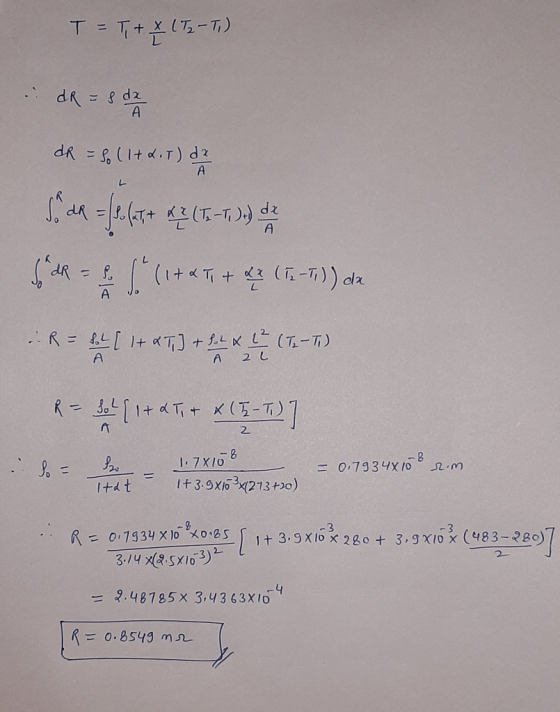
Copper wire has a resistivity ρ = 1.7 × 10⁻⁸ Ω⋅m when at 20°C and it has a temperature coefficient α = 3.9 × 10⁻³ K-1. A solid cylinder of copper of length L = 85 cm and diameter D = 2.5 mm has one end held at T1 = 7°C and the other end is held at T2 = 210°C. The temperature increases linearly between the two ends of the cylinder.
Given that T= T1 + ( x/L ) ( T2 - T1 )
Determine the total resistance in milliohms.
Homework Answers
Add Answer to:
Copper wire has a resistivity ρ = 1.7 × 10⁻⁸ Ω⋅m when at 20°C
and it...
Copper wire has a resistivity ρ =1.7 x 10⁻⁸ Ω·m when at 20°C and it has a temperature coefficient α = 3.9×10⁻³ K-1.
 Copper wire has a resistivity ρ =1.7 x 10⁻⁸ Ω·m when at 20°C and it has a temperature coefficient α = 3.9×10⁻³ K-1. A solid cylinder of copper of length L = 55 cm and diameter D = 2.5 mm has one end held at T1 = 0℃ and the other end is held at T2 =220 ℃. The temperature increases linearly between the two ends of the cylinder. Part (a) Consider a thin slice of the copper cylinder of thickness...
A 62.5 m length of insulated copper wire is wound to form a solenoid of radius 2.3 cm. The copper wire has a radius of 0.51mm. (Assume the resistivity of copper is ρ = 1.7 ✕ 10−8 Ω · m.) (a) What is t...
A 62.5 m length of insulated copper wire is wound to form a solenoid of radius 2.3 cm. The copper wire has a radius of 0.51mm. (Assume the resistivity of copper is ρ = 1.7 ✕ 10−8 Ω · m.) (a) What is the resistance of the wire? Ω (b) Treating each turn of the solenoid as a circle, how many turns can be made with the wire? turns (c) How long is the resulting solenoid? m (d) What is...
A solenoid is made from wire of resistivity ρ= 1.72 10 ^-8 m Ω⋅ and diameter...
A solenoid is made from wire of resistivity ρ= 1.72 10 ^-8 m Ω⋅ and diameter 0.8 mm that is wrapped into 200 loops of 4 cm diameter. The solenoid is 8 cm long. If an emf of 12 V is connected to the ends of the wire, what is the magnetic field that this solenoid produces? Determine the length of wire and calculate the resistance in the wire. R= ρ L/A Calculate the current in the solenoid. Calculate the...
A copper wire has a resistance of 0.500 Ω at 20.0°C, and an iron wire has...
A copper wire has a resistance of 0.500 Ω at 20.0°C, and an iron wire has a resistance of 0.520 Ω at the same temperature. At what temperature are their resistances equal? The temperature coefficient of resistivity for copper is 3.90 *10^-3(°C)−1 and for iron it is 5.00 *10^-3(°C)−1.
A copper wire has a resistance of 0.540 Ω at 20.0°C, and an iron wire has...
A copper wire has a resistance of 0.540 Ω at 20.0°C, and an iron wire has a resistance of 0.579 Ω at the same temperature. At what temperature are their resistances equal? The temperature coefficient of resistivity for copper is 3.90 10-3(°C)−1 and for iron it is 5.00 10-3(°C)−1.
Resistance in metals increases with increasing temperature according to the equation, ρ(T) = ρo(1 + α(T - To)) where α is the temperature coefficient of resistivity and ρo is the resistivity at temperature To. For a particular wire α = 1.5 × 10⁻³ 1/°C and
 Resistance in metals increases with increasing temperature according to the equation, ρ(T) = ρo(1 + α(T - To)) where α is the temperature coefficient of resistivity and ρo is the resistivity at temperature To. For a particular wire α = 1.5 × 10⁻³ 1/°C and the resistivity is ρo = 8.5 × 10⁻⁷ Ω⋅m at To = 125 °C.
(1 point) 8. At 20°C, a length of copper wire has a resistance of 5.0 Ω...
 (1 point) 8. At 20°C, a length of copper wire has a resistance of 5.0 Ω What is its resistance when the wire is heated to 80°C? Let α-0.004 at 20°C 01.2Ω 07.5 Ω 06.2 Ω 010 Ω
The resistance of a 50 m long copper wire is 0.267 Ω at 20 °C. Calculate...
The resistance of a 50 m long copper wire is 0.267 Ω at 20 °C. Calculate the diameter of the wire. The resistivity of copper is 1.68 x 10⁻⁸ Ωm.
A 5.0-m long, 1.0-mm diameter piece of copper wire (resistivity 1.7*10-8m)is woundinto a coil of many...
A 5.0-m long, 1.0-mm diameter piece of copper wire (resistivity 1.7*10-8m)is woundinto a coil of many turns that has a radius of 0.10 m. The ends of the wire are connected to a 1.5-V battery. Find:a) the magnetic field strength at the center of the coil.b) the magnitude and direction of the magnetic force on a proton placedat the center of the coil
Consider a wire with resistivity, ρ = (2.20 ) × 10 –7 Ω∙m, a diameter, D...
Consider a wire with resistivity, ρ = (2.20 ) × 10 –7 Ω∙m, a diameter, D = (1.50 ) mm, and a length, L = (23) m. Determine the current in amperes (A) that would flow through this resistor if it hooked up to a (10 ) V battery. Round your answer to two significant figures.
 (1 point) 8. At 20°C, a length of copper wire has a resistance of 5.0 Ω What is its resistance when the wire is heated to 80°C? Let α-0.004 at 20°C 01.2Ω 07.5 Ω 06.2 Ω 010 Ω
Most questions answered within 3 hours.
-
Where is the error in this code sequence?
String s1 = "Hello";
String s2 = "ello";...
asked 10 months ago -
Financial data for Joel de Paris, Inc., for last year
follow:
Joel de Paris, Inc.
Balance...
asked 10 months ago -
Consider this reaction:
Al2(SO4)3 (aq)+ BaCl3
(aq) Al2Cl6 (aq)- +
3BaSO4(s) . What is the...
asked 10 months ago -
Suppose that Savneet is considering increasing her
recent random sample from 20 car rentals to 40...
asked 10 months ago -
Trucks arrive at an unloading terminal at an average rate of 120
per hour.
Trucks arrive...
asked 10 months ago -
Why are methanol and ethanol completely soluble in water while
octanol is not very little soluble....
asked 10 months ago -
A facilities manager at a university reads in a research report
that the mean amount of...
asked 10 months ago -
When the CuSO4 is rehydrated by adding water to the anhydrous
compound, is this an endothermic...
asked 10 months ago -
A ray of sunlight is passing from diamond into crown glass; the
angle of incidence is...
asked 10 months ago -
A block of mass 0.249 kg is placed on top of a light, vertical
spring of...
asked 10 months ago -
how do the kidneys compensate in the presences of acidosis
a) trigger hyperventilate
b) reserve acid...
asked 10 months ago -
Question 501 pts
The rental rate of capital to the firm increases. Which of the
following...
asked 10 months ago