The solutions (x,y) of the equation x2 + 16y2 = 16 form an ellipse as pictured below
The solutions (x,y) of the equation x2 + 16y2 = 16 form an ellipse as pictured below.Consider the point P as pictured, with x-coordinate 3.
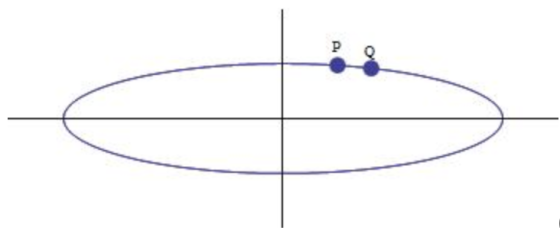
(a) Let h be a small non-zero number and form the point Q with x-coordinate 3+h, as pictured. The slope of the secant line through PQ, denoted s(h), is given by the formula = ?
(b) Rationalize the numerator of your formula in (a) to rewrite the expression so that it looks like f(h)/g(h), subject to these two conditions: (1) thenumerator f(h) defines a line of slope -1, (2) the function f(h)/g(h) is defined for h=0. When you do this
f(h)=
g(h)=
(c) The slope of the tangent line to the ellipse at the point P is =
=
Homework Answers
Consider the equation,
$$ \begin{aligned} x^{2}+16 y^{2} &=16 \\ y^{2} &=\frac{16-x^{2}}{16} \end{aligned} $$
\(y=\frac{\sqrt{16-x^{2}}}{4}\) (Consider the region in the first quadrant) Let \(y=F(x)=\frac{\sqrt{16-x^{2}}}{4}\)
The \(x\) -coordinate of the point \(P\) is 3 and the \(x\) -coordinate of \(Q\) is \(3+h\)
Therefore, the points are
$$ P(3, F(3)) \text { and } Q(3+h, F(3+h)) $$
(a) The slope of the secant line \(P Q\) is
$$ \begin{aligned} s(h) &=\frac{F(3+h)-F(3)}{3+h-3} \\ &=\frac{\sqrt{16-(3+h)^{2}}}{4}-\frac{\sqrt{16-3^{2}}}{4} \\ &=\frac{\sqrt{7-6 h-h^{2}}-\sqrt{7}}{4 h} \end{aligned} $$
(b) Rationalize the num erator of \(s(h)\)
$$ \begin{aligned} s(h) &=\frac{\sqrt{7-6 h-h^{2}}-\sqrt{7}}{4 h} \times \frac{\sqrt{7-6 h-h^{2}}+\sqrt{7}}{\sqrt{7-6 h-h^{2}}+\sqrt{7}} \\ &=\frac{\left(7-6 h-h^{2}\right)-(7)}{4 h\left(\sqrt{7-6 h-h^{2}}+\sqrt{7}\right)} \\ &=\frac{-6 h-h^{2}}{4 h\left(\sqrt{7-6 h-h^{2}}+\sqrt{7}\right)} \\ &=\frac{-6-h}{4\left(\sqrt{7-6 h-h^{2}}+\sqrt{7}\right)} \end{aligned} $$
Now rewrite the expression into: (1) the numerator \(f(h)\) defines a line of slope -1 and; (2) the function \(\frac{f(h)}{g(h)}\) is defined for \(h=0\). Clearly the above function \(s(h)\) satisfies the conditions. So, \(\quad f(h)=-6-h\) and
$$ g(h)=\sqrt{4\left(\sqrt{7-6 h-h^{2}}+\sqrt{7}\right)} $$
\((c)\)
The slope of the tangent line to the ellipse at \(P\) is
$$ \begin{aligned} \lim _{h \rightarrow 0} s(h) &=\lim _{h \rightarrow 0} \frac{-6-h}{4\left(\sqrt{7-6 h-h^{2}}+\sqrt{7}\right)} \\ &=\frac{-6-0}{4\left(\sqrt{7-6(0)-(0)^{2}}+\sqrt{7}\right)} \\ &=\frac{-6}{4(\sqrt{7}+\sqrt{7})} \\ &=\frac{-6}{4(2 \sqrt{7})} \\ &=\frac{-3}{4 \sqrt{7}} \end{aligned} $$
Add Answer to:
The solutions (x,y) of the equation x2 + 16y2 = 16 form an ellipse as pictured below
The solutions (x,y) of the equation x2 + 16y2 = 16 form an ellipse as pictured...
 The solutions (x,y) of the equation x2 + 16y2 = 16 form an ellipse as pictured below. Consider the point P as pictured, with x-coordinate 1. Let h be a small non-zero number and form the point Q with x-coordinate 1+h, as pictured. The slope of the secant line through PQ, denoted s(h), is given by the formula Rationalize the numerator of your formula in (a) to rewrite the expression so that it looks like f(h)/g(h), subject to these two...
y 1/(1-x) 5. The point P(2,-1) lies on the curve C If Q is the point...
 y 1/(1-x) 5. The point P(2,-1) lies on the curve C If Q is the point (x,1/(1-x), use your calculator to find the slope of the secant line PQ a. (correct to six decimal places) for the following values of x: 1.5 (ii) 1.9 (i) 1.99 (iv) 1.999 (v) 2.5 (vi) 2.1 (vii) 2.01 (vii) 2.001 Using the results of part (a), guess the value of the slope of the tangent line to the curve at P(2,-1) i. b. Using...
Refer to the graph of y=f(x)=x2 + x shown. Answer parts A-D as an integer or...
 Refer to the graph of y=f(x)=x2 + x shown. Answer
parts A-D as an integer or simplified fraction.
a) Find the slope of the secant line joining (2, f(2)) and (4, f(4)). b) Find the slope of the secant line joining (2, f(2)) and (2+h, f(2 + h)). c) Find the slope of the graph at (2, f(2)). d) Find the equation of the tangent line to the graph at (2, f(2)). 18- 16- 14 12 10- 8- 6- 49...
Refer to the graph of y=f(x)=x2 + x shown. Answer
parts A-D as an integer or simplified fraction.
a) Find the slope of the secant line joining (2, f(2)) and (4, f(4)). b) Find the slope of the secant line joining (2, f(2)) and (2+h, f(2 + h)). c) Find the slope of the graph at (2, f(2)). d) Find the equation of the tangent line to the graph at (2, f(2)). 18- 16- 14 12 10- 8- 6- 49...
Consider the function x) = 6x + x2 and the point P(-2,-8) on the graph of f (a) Graph f and the secant lines passing through P(-2, -8) and Q(x, f(x)) for x-values of -3, -2.5, -1.5 -10 -8 68 10 -10 -...
 Consider the function x) = 6x + x2 and the point P(-2,-8) on the graph of f (a) Graph f and the secant lines passing through P(-2, -8) and Q(x, f(x)) for x-values of -3, -2.5, -1.5 -10 -8 68 10 -10 -8 2 46 810 -2 -8 8 10 8 10 -10-8 -10-8 -8 (b) Find the slope of each secant line (line passing through Q(-3, f(x))) (line passing through Q(-2.5, f(x))) (line passing through Q(-1.5, f(x))) (c) Use...
2:45 webassign.net ASSnts A LCal 0 Consider the function f(x) and the point P(4,2) on the graph f (a) Graph fand th...
 2:45 webassign.net ASSnts A LCal 0 Consider the function f(x) and the point P(4,2) on the graph f (a) Graph fand the secant lines passing through the point P(4, 2) and Q(x, fx)) for x-values of 1, 6, and 8 (b) Find the slope of each secant line. (Round your answers to three decimal places.) (line passing through Q(1, f(x)) (line passing through Q(6, fx)) (line passing through Q(8, f(x)) (c) Use the results of part (b) to estimate the...
Consider the parabola y = 7x - x2. Find the slope m of the tangent line to the parabola at the point (1, 6). using t...
 Consider the parabola y = 7x - x2. Find the slope m of the tangent line to the parabola at the point (1, 6). using this definition: The tangent line to the curve y = f(x) at the point P(a, f(a)) is the line through P with slope m=lim x rightarrow a f(x)-f(a)/x-a provided that this limit exists. m = using this equation: m=lim h rightarrow 0 f(a+h)-f(a)/h m= Find an equation of the tangent line in part (a). y...
16. [10pts.) Find an equation of the tangent line to the curve y = 4x2 at...
 16. [10pts.) Find an equation of the tangent line to the curve y = 4x2 at the given point (1,1). Find the slope using the definition of the derivative: f'(x)= lim f(x+h)-f(x) h
2. We say that two curves intersect orthogonally if they intersect and their tangent lines are orthogonal at each point in the intersection. For example, the curve y = 0 intersects the curve x2 + y2-...
 2. We say that two curves intersect orthogonally if they intersect and their tangent lines are orthogonal at each point in the intersection. For example, the curve y = 0 intersects the curve x2 + y2-1 orthogonally at (-1,0) and (1,0). Let H be the set of curves y2b with b ER. (a) Prove that the tangent line of each curve in H at a point (r, y) with y / 0 has slope (b) Let y -f(x) be a...
2. We say that two curves intersect orthogonally if they intersect and their tangent lines are orthogonal at each point in the intersection. For example, the curve y = 0 intersects the curve x2 + y2-...
 2. We say that two curves intersect orthogonally if they intersect and their tangent lines are orthogonal at each point in the intersection. For example, the curve y = 0 intersects the curve x2 + y2-1 orthogonally at (-1,0) and (1,0). Let H be the set of curves y2-2.2-b with b є R. (a) Prove that the tangent line of each curve in H at a point (x, y) with y 0 has slope - (b) Let y-f(x) be a...
Use the equation m Subscript PQ Baseline equals StartFraction f left parenthesis x 1 plus h right parenthesis minus f left parenthesis x 1 right parenthesis Over h EndFraction mPQ= fx1+h−fx1 h to calc...
Use the equation m Subscript PQ Baseline equals StartFraction f left parenthesis x 1 plus h right parenthesis minus f left parenthesis x 1 right parenthesis Over h EndFraction mPQ= fx1+h−fx1 h to calculate the slope of a line tangent to the curve of the function y equals f left parenthesis x right parenthesis equals 2 x squared y=f(x)=2x2 at the point Upper P left parenthesis x 1 comma y 1 right parenthesis equals Upper P left parenthesis 3 comma...
 The solutions (x,y) of the equation x2 + 16y2 = 16 form an ellipse as pictured below. Consider the point P as pictured, with x-coordinate 1. Let h be a small non-zero number and form the point Q with x-coordinate 1+h, as pictured. The slope of the secant line through PQ, denoted s(h), is given by the formula Rationalize the numerator of your formula in (a) to rewrite the expression so that it looks like f(h)/g(h), subject to these two...
 y 1/(1-x) 5. The point P(2,-1) lies on the curve C If Q is the point (x,1/(1-x), use your calculator to find the slope of the secant line PQ a. (correct to six decimal places) for the following values of x: 1.5 (ii) 1.9 (i) 1.99 (iv) 1.999 (v) 2.5 (vi) 2.1 (vii) 2.01 (vii) 2.001 Using the results of part (a), guess the value of the slope of the tangent line to the curve at P(2,-1) i. b. Using...
 Refer to the graph of y=f(x)=x2 + x shown. Answer
parts A-D as an integer or simplified fraction.
a) Find the slope of the secant line joining (2, f(2)) and (4, f(4)). b) Find the slope of the secant line joining (2, f(2)) and (2+h, f(2 + h)). c) Find the slope of the graph at (2, f(2)). d) Find the equation of the tangent line to the graph at (2, f(2)). 18- 16- 14 12 10- 8- 6- 49...
Refer to the graph of y=f(x)=x2 + x shown. Answer
parts A-D as an integer or simplified fraction.
a) Find the slope of the secant line joining (2, f(2)) and (4, f(4)). b) Find the slope of the secant line joining (2, f(2)) and (2+h, f(2 + h)). c) Find the slope of the graph at (2, f(2)). d) Find the equation of the tangent line to the graph at (2, f(2)). 18- 16- 14 12 10- 8- 6- 49...
 Consider the function x) = 6x + x2 and the point P(-2,-8) on the graph of f (a) Graph f and the secant lines passing through P(-2, -8) and Q(x, f(x)) for x-values of -3, -2.5, -1.5 -10 -8 68 10 -10 -8 2 46 810 -2 -8 8 10 8 10 -10-8 -10-8 -8 (b) Find the slope of each secant line (line passing through Q(-3, f(x))) (line passing through Q(-2.5, f(x))) (line passing through Q(-1.5, f(x))) (c) Use...
 2:45 webassign.net ASSnts A LCal 0 Consider the function f(x) and the point P(4,2) on the graph f (a) Graph fand the secant lines passing through the point P(4, 2) and Q(x, fx)) for x-values of 1, 6, and 8 (b) Find the slope of each secant line. (Round your answers to three decimal places.) (line passing through Q(1, f(x)) (line passing through Q(6, fx)) (line passing through Q(8, f(x)) (c) Use the results of part (b) to estimate the...
 Consider the parabola y = 7x - x2. Find the slope m of the tangent line to the parabola at the point (1, 6). using this definition: The tangent line to the curve y = f(x) at the point P(a, f(a)) is the line through P with slope m=lim x rightarrow a f(x)-f(a)/x-a provided that this limit exists. m = using this equation: m=lim h rightarrow 0 f(a+h)-f(a)/h m= Find an equation of the tangent line in part (a). y...
 16. [10pts.) Find an equation of the tangent line to the curve y = 4x2 at the given point (1,1). Find the slope using the definition of the derivative: f'(x)= lim f(x+h)-f(x) h
 2. We say that two curves intersect orthogonally if they intersect and their tangent lines are orthogonal at each point in the intersection. For example, the curve y = 0 intersects the curve x2 + y2-1 orthogonally at (-1,0) and (1,0). Let H be the set of curves y2b with b ER. (a) Prove that the tangent line of each curve in H at a point (r, y) with y / 0 has slope (b) Let y -f(x) be a...
 2. We say that two curves intersect orthogonally if they intersect and their tangent lines are orthogonal at each point in the intersection. For example, the curve y = 0 intersects the curve x2 + y2-1 orthogonally at (-1,0) and (1,0). Let H be the set of curves y2-2.2-b with b є R. (a) Prove that the tangent line of each curve in H at a point (x, y) with y 0 has slope - (b) Let y-f(x) be a...
Most questions answered within 3 hours.
-
Where is the error in this code sequence?
String s1 = "Hello";
String s2 = "ello";...
asked 11 months ago -
Financial data for Joel de Paris, Inc., for last year
follow:
Joel de Paris, Inc.
Balance...
asked 11 months ago -
Consider this reaction:
Al2(SO4)3 (aq)+ BaCl3
(aq) Al2Cl6 (aq)- +
3BaSO4(s) . What is the...
asked 11 months ago -
Suppose that Savneet is considering increasing her
recent random sample from 20 car rentals to 40...
asked 11 months ago -
Trucks arrive at an unloading terminal at an average rate of 120
per hour.
Trucks arrive...
asked 11 months ago -
Why are methanol and ethanol completely soluble in water while
octanol is not very little soluble....
asked 11 months ago -
A facilities manager at a university reads in a research report
that the mean amount of...
asked 11 months ago -
When the CuSO4 is rehydrated by adding water to the anhydrous
compound, is this an endothermic...
asked 11 months ago -
A ray of sunlight is passing from diamond into crown glass; the
angle of incidence is...
asked 11 months ago -
A block of mass 0.249 kg is placed on top of a light, vertical
spring of...
asked 11 months ago -
how do the kidneys compensate in the presences of acidosis
a) trigger hyperventilate
b) reserve acid...
asked 11 months ago -
Question 501 pts
The rental rate of capital to the firm increases. Which of the
following...
asked 11 months ago