31. When 9.42 g of methane (CH4) is burned in a bomb calorimeter (heat capacity =...
31. When 9.42 g of methane (CH4) is burned in a bomb calorimeter (heat capacity =
2.677 × 10³ J/°C), the temperature rises from 24.00 to 27.08°C. How much heat is absorbed by the calorimeter?
CH4(g) + 2O2(g) → CO2(g) + 2H2O(l); ΔH° = –1283.8 kJ a. 745 kJ
b. 4.84 × 10³ kJ c. 8.24 kJ
d. 753 kJ
e. 1.28 × 10³ kJ
32. Which of the following statements is incorrect concerning the wave function?
The wave function of a particle is a solution to the Schrödinger equation.
For an electron in an atom, the square of the wave function decreases rapidly as the distance from the nucleus increases.
The square of the wave function is proportional to the probability of finding the particle in a region of space.
The value of the wave function gives the location of the particle.
The wave function for an electron in an atom is called an atomic orbital.
33. What is the wavelength of an electron traveling at of 3.74% the speed of light? (me=9.109×10⁻³¹ kg,c=3.00×10⁸m/s,h=6.63×10-34J·s)
a. 1.54×10¹⁰ m b. 2.43×10⁻¹² m c. 6.49×10⁻¹¹ m d. 1.54×10¹² m e. 6.49×10⁻¹³ m
34. Consider the following energy-level diagram for a particular electron in an atom.
Based on this diagram, which of the following statements is
incorrect?
a. The wavelength of a photon emitted by the electron jumping from
level 2 to level 1 is
given by .
If the electron is in level 1, it may jump to level 2 by absorbing a photon with energy of ΔE.
If the electron is in level 1, it may jump to level 2 by absorbing any photon having energy of at least ΔE.
We would observe an electron jumping from level 2 to level 1 as a single line in a line spectrum.
If the electron is in level 2, it may jump to level 1 by emitting a photon with energy of |ΔE|.
35. The electron in a hydrogen atom, originally in level n = 8, undergoes a transition to a lower level by emitting a photon of wavelength 3745 nm. What is the final level of the electron?
(c=3.00×10⁸ m/s, h=6.63×10⁻³⁴ J·s, RH=2.179×10⁻¹⁸ J) a. 5
b. 6 c. 8 d. 9 e. 1
36. When an electron in an atom makes a transition from n = 4 to n = 5, which of the following statements is/are correct?
Energy is emitted.
Energy is absorbed.
The electron loses energy.
The electron gains energy.
The electron cannot make this transition.
a. II and IV b. II and III c. I and IV d. I and III e. V
37. What is the energy per mole of photons with a wavelength of 307.1 nm? (c=3.00×10⁸ m/s,h=6.63×10-34J·s,NA=6.02×1023mol-1)
a. 6.48×10⁻¹⁹ kJ/mol b. 1.85×10¹⁴ kJ/mol c. 5.88×1035 kJ/mol d. 9.77×10¹⁴ kJ/mol e. 3.9×10² kJ/mol
38. Rank the following ions in order of increasing first ionization energy: O2–, Mg2+, F–, Na+. 9
a. Mg2+ < Na+ < F– < O2– b.Mg2+ <O2– <Na+ <F– c. O2– <F– <Mg2+ <Na+ d.O2– <F– <Na+ <Mg2+ e. O2– <Mg2+ <F– <Na+
39. Below are data on the first four ionization energies for a
fictitious element X. First ionization energy = 500 kJ/mol
Second ionization energy = 2000 kJ/mol
Third ionization energy = 3500 kJ/mol
Fourth ionization energy = 25000 kJ/mol
From the data, which of the following statements is incorrect?
The third ionization energy is greater than the second ionization energy because X2+ has a bigger charge than X+.
X could belong to Group IIIA.
X could belong to Group IIIB.
X could belong to group VA.
The fourth ionization energy is much greater than the third ionization energy because
X3+ consists of a noble-gas core or a pseudo-noble-gas core.
40. Using bond-energy data, what is ΔH° for the following reaction?
CH3OH(g) + H2S(g) → CH3SH(g) + H2O(g) Bond Bond Energy (kJ/mol)
C-H 413
C-O 358
O-H 463
C-S 259
S-H 339
a. –25 kJ b. –124 kJ c. 25 kJ
d. –2763 kJ e. 2738 kJ
Homework Answers
(31) T2 = 27.08 oC
T1 = 24.00 0C
C = 2.677 X 10³ J/oC
q = C delta T
q = 2.677 X 10³ J/oC( 27.08-24.00)oC
q = 8.24 KJ
Hence the correct option is c.
(32) the incorrect option is the value of wavefunction gives the location of the particle as square of wavefunction is proportional to the probability of finding the electron in a region of space.
hence incorrect option is the value of wavefunction gives the location of the particle.
(33) 3.74% of speed of light(v) = (3.74X3X108)/100 = 11.22 X 10⁶ m/s
according to De-broglie equation
wavelength = h/mv
wavelength =6.63 X10⁻³⁴ Js / (9.109X10-31 KgX11.22 X 106 m/s)
wavelength = 6.49 X 10 -11 m
hence the correct option is c.
(34) from all of the options the incorrect option is c as an electron can jump from level one to level 2 with the photon having energy of delta E.
hence the incorrect option is c,i.e.if the electron is in level 1, it may jump tp level 2 by absorbing any photon having energy of atleast delta E.
(35) delta E = hc/lemda
delta E = hc/lemda
delta E = (3.00×10⁸ m/s X6.63×10-34 J·s)/3745 X10-9 m
delta E = 0.00531 X 10⁻¹⁷ J
according to rydberg formula
0.00531 X 10⁻¹⁷ J= 2.179×10⁻¹⁸ J[(1/nf2)-1/82)]
nf = 5
hence the correct option is a.
(36) when an electron goes from lower level to higher lever energy is absorbed by the electron.
hence the correct options are : energy is absorbed and electron gains energy.
correct option is c.
(37)E = hc/lemda
E = (3.00×10⁸ m/s X6.63×10-34 J·s)/307.1 X10-9 m
E = 0.0648 X10⁻¹⁷ J
energy for one mole of photon = 0.0648 X10-17 JX6.02×1023mol-1
energy for one mole of photon = 3.9 X10² KJmol-1
Hence the correct option is e.
(38) order of increasing first ionization energy: O2– < F– < Na+ < Mg2+
higher the size, less the ionization energy as more easy to remove electron.
hence the correct option is d.
(39)
X could belong to Group IIIA.
X could belong to Group IIIB.
X could belong to group VA.
these are incorrect as it belong to group VIII.
(40)ΔH° = (3CH +CH +SH 2OH) - (3CH+CO+OH+2SH)
Hence putting all the value the ans is -25 KJ.
hence the correct option is a.
Add Answer to:
31. When 9.42 g of methane (CH4) is burned in a bomb calorimeter
(heat capacity =...
A 0.539-g sample of quinizarin (C14H8O4) is burned in a bomb calorimeter and the temperature increases...
A 0.539-g sample of quinizarin (C14H8O4) is burned in a bomb calorimeter and the temperature increases from 24.70 °C to 27.00 °C. The calorimeter contains 1.19×10³ g of water and the bomb has a heat capacity of 912 J/°C. Based on this experiment, calculate ΔE for the combustion reaction per mole of quinizarin burned (kJ/mol). C14H8O4(s) + 14 O2(g) 14 CO2(g) + 4 H2O(l) E = kJ/mol
When aluminum reacts with phosphorus to form an ionic compound, each metal atom loses electron(s) and...
When aluminum reacts with phosphorus to form an ionic compound, each metal atom loses electron(s) and each nonmetal atom gains electron(s). There must be aluminum atom(s) for every phosphorus atom(s) in the reaction. Enter the smallest integers possible. When cesium reacts with bromine to form an ionic compound, each metal atom loses electron(s) and each nonmetal atom gains electron(s). There must be cesium atom(s) for every bromine atom(s) in the reaction. Enter the smallest integers possible. Calculate the lattice energy...
27. The "seeing" ability or resolution of radiation is determined by its wavelength. If the size...
 27. The "seeing" ability or resolution of radiation is determined by its wavelength. If the size of an atom is approximately 10-10 m, how fast must an electron travel to have a wavelength smaller than that of an atom? (me 9.11x10- kg and h 6.63 x 10 J-s) a. 7.3 x 10% m/s b. 3.4 x 10⁶ m/s c. 1.0 x 10⁶ m/s d. 5.4 x 10 m/s 28. The ionization energy of the hydrogen atom is 13.6 eV. What...
6.50 A chemist places 1.750 g of ethanol, C,H,O, in a bomb calo- rimeter with a heat capacity of 12.05 kJ/K. Th...
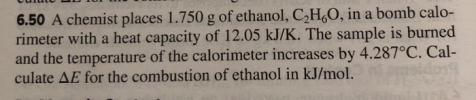 6.50 A chemist places 1.750 g of ethanol, C,H,O, in a bomb calo- rimeter with a heat capacity of 12.05 kJ/K. The sample is burned and the temperature of the calorimeter increases by 4.287°C. Cal- culate AE for the combustion of ethanol in kJ/mol. 1 of 9 > The equipment used for aviation communications emits high-frequency radiowave energy with a wavelength of 0.250 km. What is the energy of exactly one photon of this radiowave radiation? E = What is...
When a 3.80-g sample of liquid octane (C8H18) is burned in a bomb calorimeter, the temperature...
When a 3.80-g sample of liquid octane (C8H18) is burned in a bomb calorimeter, the temperature of the calorimeter rises by 26.5 ∘C. The heat capacity of the calorimeter, measured in a separate experiment, is 6.21 kJ/∘C . You may want to reference (Page 265) Section 6.5 while completing this problem. Part A Determine ΔE for octane combustion in units of kJ/mol octane. Express your answer using three significant figures.
The quantum-mechanical treatment of the H atom gives the energy, E, of the electron as a...
The quantum-mechanical treatment of the H atom gives the energy, E, of the electron as a function of n: where h is Planck's constant, me is the electron mass, and a0, called the Bohr radius, is 52.92×10⁻¹² m. Calculate the wavelength in nm of the photon emitted in the jump between n = 1 and n = 4.
26. A sodium vapor lamp has a power output of 300 W. If 390 nm is...
 26. A sodium vapor lamp has a power output of 300 W. If 390 nm is the average wavelength of the source, about how many photons are emitted per secood? (h 1 nm- 10* m) 6.63 x 10Js, c 3.00x 10* m/s, and a. 10 b, 1021 e, 10s d. 10 27. The "seeing" ability or resolution of radiation is determined by its wavelength. If the size of an atom is approximately 10* m, how fast must an electron travel...
When an electron moves from the n = 7 orbit to the n = 5 orbit...
When an electron moves from the n = 7 orbit to the n = 5 orbit of a hydrogen atom, a photon of light is emitted. What is the energy of this photon, in Joules? What is the frequency of this photon, in Hertz? What is the wavelength of this photon, in nanometers? (Eel = -2.18 x 10⁻¹⁸ J / n2. h = 6.63 x 10⁻³⁴ Joule sec. C = 3.00 x 10⁸ m / sec. 1 m = 1...
4) 74 kJ are required to heat 1 cup of water fronm room temperature to boiling....
4) 74 kJ are required to heat 1 cup of water from room temperature to boiling. The wavelength of microwave radiation in a microwave oven is 2.3 x 10⁻³ m. How many moles of photons are required? 5) Cesium requires a minimum energy of 188 kJ/mol for an electron to be ejected. What is the wavelength of light in nm that possesses the minimum amount of energy needed to cause the electron to eject? 5.4 Balmer-Rydberg 6) Use the Balmer-Rydberg equation to calculate...
16.(10) When 7.02 g of liquid benzene, C&He was burned in a bomb calorimeter the temperature of the calorimeter...
 16.(10) When 7.02 g of liquid benzene, C&He was burned in a bomb calorimeter the temperature of the calorimeter rose from 25.00 to 49.36°C. If the heat capacity of the solution and the calorimeter is 12.05 kJ/°C, what is the enthalpy change of the following reaction? DH 2 C&He() + 15 O2(g) → 12 CO2(,) + 6H2O(l); AH= ? kg/mol
 27. The "seeing" ability or resolution of radiation is determined by its wavelength. If the size of an atom is approximately 10-10 m, how fast must an electron travel to have a wavelength smaller than that of an atom? (me 9.11x10- kg and h 6.63 x 10 J-s) a. 7.3 x 10% m/s b. 3.4 x 10⁶ m/s c. 1.0 x 10⁶ m/s d. 5.4 x 10 m/s 28. The ionization energy of the hydrogen atom is 13.6 eV. What...
 6.50 A chemist places 1.750 g of ethanol, C,H,O, in a bomb calo- rimeter with a heat capacity of 12.05 kJ/K. The sample is burned and the temperature of the calorimeter increases by 4.287°C. Cal- culate AE for the combustion of ethanol in kJ/mol. 1 of 9 > The equipment used for aviation communications emits high-frequency radiowave energy with a wavelength of 0.250 km. What is the energy of exactly one photon of this radiowave radiation? E = What is...
 26. A sodium vapor lamp has a power output of 300 W. If 390 nm is the average wavelength of the source, about how many photons are emitted per secood? (h 1 nm- 10* m) 6.63 x 10Js, c 3.00x 10* m/s, and a. 10 b, 1021 e, 10s d. 10 27. The "seeing" ability or resolution of radiation is determined by its wavelength. If the size of an atom is approximately 10* m, how fast must an electron travel...
 16.(10) When 7.02 g of liquid benzene, C&He was burned in a bomb calorimeter the temperature of the calorimeter rose from 25.00 to 49.36°C. If the heat capacity of the solution and the calorimeter is 12.05 kJ/°C, what is the enthalpy change of the following reaction? DH 2 C&He() + 15 O2(g) → 12 CO2(,) + 6H2O(l); AH= ? kg/mol
Most questions answered within 3 hours.
-
Where is the error in this code sequence?
String s1 = "Hello";
String s2 = "ello";...
asked 11 months ago -
Financial data for Joel de Paris, Inc., for last year
follow:
Joel de Paris, Inc.
Balance...
asked 11 months ago -
Consider this reaction:
Al2(SO4)3 (aq)+ BaCl3
(aq) Al2Cl6 (aq)- +
3BaSO4(s) . What is the...
asked 11 months ago -
Suppose that Savneet is considering increasing her
recent random sample from 20 car rentals to 40...
asked 11 months ago -
Trucks arrive at an unloading terminal at an average rate of 120
per hour.
Trucks arrive...
asked 11 months ago -
Why are methanol and ethanol completely soluble in water while
octanol is not very little soluble....
asked 11 months ago -
A facilities manager at a university reads in a research report
that the mean amount of...
asked 11 months ago -
When the CuSO4 is rehydrated by adding water to the anhydrous
compound, is this an endothermic...
asked 11 months ago -
A ray of sunlight is passing from diamond into crown glass; the
angle of incidence is...
asked 11 months ago -
A block of mass 0.249 kg is placed on top of a light, vertical
spring of...
asked 11 months ago -
how do the kidneys compensate in the presences of acidosis
a) trigger hyperventilate
b) reserve acid...
asked 11 months ago -
Question 501 pts
The rental rate of capital to the firm increases. Which of the
following...
asked 11 months ago