Compute Theoretical Density
Homework Answers
The BCC unit cell is shown below:
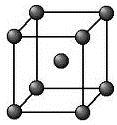
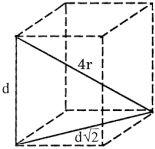
Atomic radius r = 0.137 nm = 0.137 x 10⁻⁹ m = 1.37 x 10⁻⁸ cm
Using Pythagoras theorem:
d2 + (d√2)2 = (4r)2
Unit cell edge length = d = (16r2/3)1/2
= (16 x (1.37 x 10-8)2/3)1/2
= 3.164 x 10⁻⁸ cm
Unit cell volume = volume of cube = d3
= (3.164 x 10⁻⁸)3
= 3.167 x 10⁻²³ cm3
Number of tungsten atoms in unit cell = 8 x 1/8 + 1 x 1 (8 corner + 1 center atom)
= 2
Mass of tungsten atoms = number of atoms/Avogadro's number x atomic weight
= 2/6.022 x 1023 x 183.84
= 6.106 x 10⁻²² g
Theoretical density of tungsten = mass of tungsten atoms/volume of unit cell
= 6.106 x 10⁻²²/3.167 x 10-23
= 19.3 g/cm3
1. Compute the percent ionic character of the interatomic bonds for each of the following compounds:...
 1. Compute the percent ionic character of the interatomic bonds for each of the following compounds: TiO2, ZnTe, Csci, InSb, and MgCl2. Calculate the number of vacancies per cubic meter in iron at 850°C. The energy for vacancy formation is 1.08 eV/atom. The density and atomic weight for Fe are 7.65 g/cm3 and 55.85 g/mol, respectively 3. Molybdenum forms a substitutional solid solution with tungsten. Compute the weight percent of molybdenum that must be added to tungsten to yield an...
The atomic weight and atomic radius for a hypothetical BCC metal are 43.1 g/mol and 0.122...
5 The atomic weight and atomic radius for a hypothetical BCC metal are 43.1 g/mol and 0.122 nm respectively. Determine its density. 6 Calculate the radius of a iridium atom, given that Ir has a FCC crystal structure, a density of 22.4 g/cm^3, and an atomic weight of 192.2 g/mol.
Chapter 03, Reserve Problem 09: Cubic unit cell Some metal is known to have a cubic unit cell with an edge length of 0.475 nm. In addition, it has a density of 3.82 g/cm3 and an atomic weight of 61.6...
 Chapter 03, Reserve Problem 09: Cubic unit cell Some metal is known to have a cubic unit cell with an edge length of 0.475 nm. In addition, it has a density of 3.82 g/cm3 and an atomic weight of 61.61 g/mol. Indicate the letter of the metal listed in the following table that has these characteristics. Atomic Radius (nm) 0.206 0.336 0.168 0.136 MetalCrystal Structure BCC FCC FCC HCP
Chapter 03, Reserve Problem 09: Cubic unit cell Some metal is...
Chapter 03, Reserve Problem 09: Cubic unit cell Some metal is known to have a cubic unit cell with an edge length of 0.475 nm. In addition, it has a density of 3.82 g/cm3 and an atomic weight of 61.61 g/mol. Indicate the letter of the metal listed in the following table that has these characteristics. Atomic Radius (nm) 0.206 0.336 0.168 0.136 MetalCrystal Structure BCC FCC FCC HCP
Chapter 03, Reserve Problem 09: Cubic unit cell Some metal is...
6) A hypothetical metal has the simple cubic crystal structure. If its atomic weight is 70.6...
 6) A hypothetical metal has the simple cubic crystal structure. If its atomic weight is 70.6 g/mol and the atomic radius is 0.128 nm, compute its theoretical density. (N=6.022 * 1023 atoms/mol) (Theoretical density-mass of atoms in unit cell/total volume of unit cell) 7) Write down the names of each crystal structure given below.
1) A hypothetical metal has the simple cubic crystal structure shown in Figure 3.3. If its...
1) A hypothetical metal has the simple cubic crystal structure shown in Figure 3.3. If its atomic weight is 79.4 g/mol and the atomic radius is 0.187 nm, compute its density. 2)Iron (Fe) undergoes an allotropic transformation at 912°C: upon heating from a BCC (α phase) to an FCC (γ phase). Accompanying this transformation is a change in the atomic radius of Fe—from RBCC = 0.12584 nm to RFCC = 0.12894 nm—and, in addition, a change in density (and volume)....
The density of potassium, which has the BCC structure, is 0.855 g/cm^3. The atomic weight of...
The density of potassium, which has the BCC structure, is 0.855 g/cm^3. The atomic weight of potassium is 39.09 g/mol. Calculate the lattice parameter and the atomic radius of potassium
Calculate the theoretical density of Mns, given that it has the rock salt crystal structure. You...
 Calculate the theoretical density of Mns, given that it has the rock salt crystal structure. You may want to use the table below. The atomic weights for Mn and S are 54.94 g/mol and 32.06 g/mol, respectively. Cation Fe2+ Ni2+ Mg2+ Ionic Radius (nm) Anion Ionic Radius (nm) 0.077 0.140 0.069 S2- 0.184 0.072 0.067 Mn2+ p= g/cm3 the tolerance is +/-2%
7. The atomic weight and atomic radius for a hypothetical BCC alloy are 43.1 g/mol and...
 7. The atomic weight and atomic radius for a hypothetical BCC alloy are 43.1 g/mol and 0.122 nm respectively. Determine its density.
(i) Gold has an atomic radius of 0.1444 nm and it has FCC structure. Its atomic...
(i) Gold has an atomic radius of 0.1444 nm and it has FCC structure. Its atomic weight is 196.97. What is the density of gold in g/m3? (ii) If gold had a BCC unit cell, what would be its density? (iii) If gold had simple cubic structure, what would be its density?
A hypothetical metal has the simple cubic crystal structure shown in Figure 3.3. If its atomic...
A hypothetical metal has the simple cubic crystal structure shown in Figure 3.3. If its atomic weight is 86.6 g/mol and the atomic radius is 0.169 nm, compute its density.
 1. Compute the percent ionic character of the interatomic bonds for each of the following compounds: TiO2, ZnTe, Csci, InSb, and MgCl2. Calculate the number of vacancies per cubic meter in iron at 850°C. The energy for vacancy formation is 1.08 eV/atom. The density and atomic weight for Fe are 7.65 g/cm3 and 55.85 g/mol, respectively 3. Molybdenum forms a substitutional solid solution with tungsten. Compute the weight percent of molybdenum that must be added to tungsten to yield an...
 Chapter 03, Reserve Problem 09: Cubic unit cell Some metal is known to have a cubic unit cell with an edge length of 0.475 nm. In addition, it has a density of 3.82 g/cm3 and an atomic weight of 61.61 g/mol. Indicate the letter of the metal listed in the following table that has these characteristics. Atomic Radius (nm) 0.206 0.336 0.168 0.136 MetalCrystal Structure BCC FCC FCC HCP
Chapter 03, Reserve Problem 09: Cubic unit cell Some metal is...
Chapter 03, Reserve Problem 09: Cubic unit cell Some metal is known to have a cubic unit cell with an edge length of 0.475 nm. In addition, it has a density of 3.82 g/cm3 and an atomic weight of 61.61 g/mol. Indicate the letter of the metal listed in the following table that has these characteristics. Atomic Radius (nm) 0.206 0.336 0.168 0.136 MetalCrystal Structure BCC FCC FCC HCP
Chapter 03, Reserve Problem 09: Cubic unit cell Some metal is...
 Calculate the theoretical density of Mns, given that it has the rock salt crystal structure. You may want to use the table below. The atomic weights for Mn and S are 54.94 g/mol and 32.06 g/mol, respectively. Cation Fe2+ Ni2+ Mg2+ Ionic Radius (nm) Anion Ionic Radius (nm) 0.077 0.140 0.069 S2- 0.184 0.072 0.067 Mn2+ p= g/cm3 the tolerance is +/-2%
 7. The atomic weight and atomic radius for a hypothetical BCC alloy are 43.1 g/mol and 0.122 nm respectively. Determine its density.
Most questions answered within 3 hours.
-
Where is the error in this code sequence?
String s1 = "Hello";
String s2 = "ello";...
asked 10 months ago -
Financial data for Joel de Paris, Inc., for last year
follow:
Joel de Paris, Inc.
Balance...
asked 10 months ago -
Consider this reaction:
Al2(SO4)3 (aq)+ BaCl3
(aq) Al2Cl6 (aq)- +
3BaSO4(s) . What is the...
asked 10 months ago -
Suppose that Savneet is considering increasing her
recent random sample from 20 car rentals to 40...
asked 10 months ago -
Trucks arrive at an unloading terminal at an average rate of 120
per hour.
Trucks arrive...
asked 10 months ago -
Why are methanol and ethanol completely soluble in water while
octanol is not very little soluble....
asked 10 months ago -
A facilities manager at a university reads in a research report
that the mean amount of...
asked 10 months ago -
When the CuSO4 is rehydrated by adding water to the anhydrous
compound, is this an endothermic...
asked 10 months ago -
A ray of sunlight is passing from diamond into crown glass; the
angle of incidence is...
asked 10 months ago -
A block of mass 0.249 kg is placed on top of a light, vertical
spring of...
asked 10 months ago -
how do the kidneys compensate in the presences of acidosis
a) trigger hyperventilate
b) reserve acid...
asked 10 months ago -
Question 501 pts
The rental rate of capital to the firm increases. Which of the
following...
asked 10 months ago